Showing posts with label gaffes. Show all posts

Tuesday, September 01, 2009

bollywood's chameleon car

Despite its lofty meta-cinematic ambitions, Tashan manages to bore you out of your wits while also tossing one delicious gaffe after another. The continuity department was out smoking maTakaa while reels of footage were captured, digitally created and spliced into specious brouhaha. In this post we consider one of the most visible paws of the fox starring one of the two most important vehicles in the film. It's a red beauty of ambiguous parentage and schizophrenic identity.

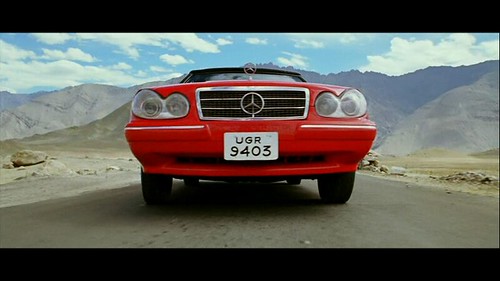
SLK 320 front

The film opens with a red mercedes SLK 320 on the wild road accompanied by a stereo switching between a little ode to 80s rock ("She's a highway to hell" courtesy Ranjit Barot) and kabhii kabhii (the plaintive voice of the late Mukesh).

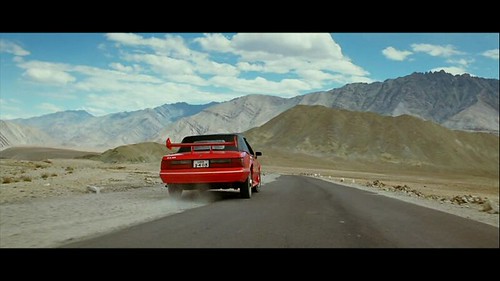
SLK 320 rear

It's a red Mercedes SLK 320 with a spoiler. UGR 9403.

And then it veers out of control and drives off the road, to the side and over the edge. The landscape looks fake, the milestone flying by is bad CG. But the worst is yet to come. A montage of obviously fake VFX shots follows to illustrate the inevitable -- the descent of the car succumbing to gravity into the water below.

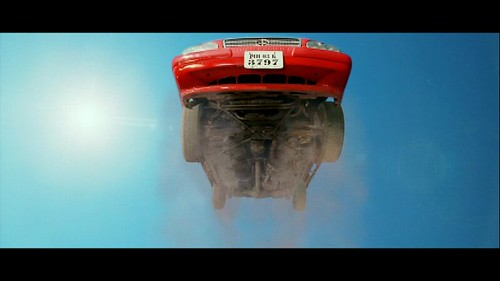
wrong plate front

It's at this point that things become confusing. The car's licence plate goes into the witness protection programme in midair relocating, in a manner of registration, to the state of Maharashtra.

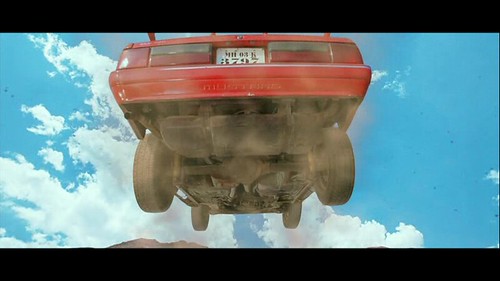
SLK 320 mustang?

A fine shot of the automobile's derriere laced with dust is marred by the word embossed on the rear bumper. I'm confused -- when did Ford team up with Mercedes?

Several minutes later, we return to the car under water.

wrong plate under water

The licence plate continues to be the same as it was before the car hit the water. It is also clear that the car is an SLK 320; I can't see lower part of the bumper, so it's hard to see if the embossed Mustang is still there (I wish I had a better angle).

SLK 320 under water

Peculiar. Very peculiar.

Since this is a film laced with references to other films (with, as a later blog post may reveal, the choice of films bears a strong bias for the Yash Raj canon) and especially recent YRF productions, it is possible to construe an explanation for this gaffe and credit it as being a little in-joke. Remember the Mustang fetish in Dhoom? Remember especially that red set of wheels bearing the likes of Esha Deol? That, kemo sabe, was a Mustang. Perhaps bhaiyaajii created his own motor mash-up (Benz+Ford = Bored?). Or perhaps we're just dealing with an overpaid sloppy crew obsessed with bringing fruition to an overbaked balloon of nothing built on an idea that deserved a creative mind.

Sunday, May 25, 2008

notes on State and Main

Everybody makes their own fun. If you don't make it yourself, it isn't fun. It's entertainment

State and Main is loaded with Mamet-speak and populated with familiars from the Mamet gang (William H. Macy, Ricky Jay, Rebecca Pidgeon). Banished from New Hampshire, a filmmaking crew ends up in Waterford, Vermont and has to come to terms with its own as well as the residents of this small town. Offering perfect irony to all this is the fact that not one bit of this film was made in Waterford, Vermont. I was reminded of Truffaut's classic exposé on and ode to filmmaking La Nuit Américaine; Truffaut's take was affectionate and enlightening, while Mamet's first comedy is laced with his smart, lethal, clipped dialogue embellished with his poetic blend of profanity (English and Yiddish). SCRPC Truffaut's film was loaded with detail on the filmmaking process; aside from the opening credits (intercut with footage from film reel transition) bounding away in tandem with Theodore Shapiro's score, Mamet's film chooses to focus on the people and what they say and do. We see the pains of the crew and hear about the mechanics of their work, but, it's only in the closing scene that we get down to the business of making the film (The Old Mill).

If we stripped the film of its set pieces and stayed just with the people, we'd end up with something like Noises Off. But then Mamet's a playright, so this isn't very surprising.

There's an occasional shard of uncanny prescience in Mamet's work: Wag The Dog, which he co-wrote, prefigured the Clinton sex scandal. In State and Main, there's an exchange between Joe White (Philip Seymour Hoffman) and Ann Black (Rebecca Pidgeon):


Joseph Turner White: You believe that?
Ann Black: I do if you do.
Joseph Turner White: But it's absurd.
Ann Black: So is our electoral process. But we still vote.

The film was released in 2000 (filming was completed in 1999), the year when the electoral college system floundered.

There's a crucial detail in the film that seems like a gaffe. Walt Price (William H. Macy) receives an invitation to a dinner at the Mayor's residence on Tuesday the 12th. He jots this down on his calendar on the whiteboard on his office using a red marker. His assistant accidentally wipes off most of the appointment and Walt asks her to restore it. She cleans out the leftover scribble and writes the appointment in the same cell using a green marker. Given the way this sequence is shot (the camera draws our attention to this appointment), we can expect that Walt will miss his appointment, because the date is wrong. Yet, so far, the date is correct. Later in the film, as the moment draws nigh, we see that the appointment in green has shifted into the cell for Wednesday the 13th and -- lo and behold! -- we find a shadow of the original appointment in the cell for Tuesday the 13th in red. It's conceivable that the assistant was prone to accidentally erase the appointment frequently and ended up eventually writing it in the wrong cell. Since the handwriting in the two cells in the final shot look alike (and neither looks like Walt's handwriting), this explanation holds water.

Saturday, November 27, 2004

Three Movies

dance with me [November 25/26, 2004]

Unfortunately, what worried me most about RGV's latest venture Naach were, paradoxically enough, the dances. Some of the slower drawn-out sequences (despite the potential for déjà vu) were engaging, but the full-fledged dances (backed by a soundtrack that has only evoked mixed reactions from me no matter how many times I listened to it) were a bit troublesome and tough to sit through. What works for the film comes from the performances of the lead pair: Abhishek Bachchan and Antara Mali (despite having nothing really appealing in her looks that would please the majority crowd). And Ritesh Deshmukh marks a step forward with a competent supporting performance as the potential third vertex in a triangle of emotions. Thematically, RGV returns to territory he last visited with Rangeela. I don't see this film matching that one's success, despite being closer to RGV's heart. Simply because the comparisons are inevitable, and because of the fickle mix of reasons that a film works. And the opening sequence is a clincher for those looking to make comparisons. Just like that film, we open with a scene in slow-motion (held for a longer while here) as Shweta Pandit's wonderful rendition of the beautifully arranged title track (love those conches!) fills our ears. The montage of dance ends with the fading rhythm track morphing into the ticking of a bedside alarm clock. The rest of the film evokes another classic about a couple torn apart by success, Abhimaan. Aside from the uncredited use of Riders on the Storm by The Doors, we have digs at film personalities like Subhash Ghai and Farah Khan. And then there's the in-joke with an unhappy director noting "ga.ndaa hai par dha.ndaa hai" about a song he has to picturise. And the short exchange during the climactic moments when the two are clear about how they feel about each other was nice:
abhinav (abhishek): ... tum bhii mujh se pyaar karatii ho?
revaa (antara): aur kyaa?

All said and done, while the overall experience is not a stupendous achievement, it's a good entry in the RGV canon.


merchants of the night [November 24-25, 2004]

Raat ke Saudagar marks a return to the world of Bs for your humble viewer. The film's narrative (for what it's worth) deals with Saudagar-esque (Ghai, not Sudhendu Roy) themes (friends who turn enemies thanks to misunderstandings blah blah), and was probably shot at night (thus giving you the title ... chuckle, chuckle). The cast boasts a roster that includes Suresh Oberoi, Mohan Joshi, Neena Gupta, Reema Lagu, Kiran Kumar, Kader Khan and Anant Mahadevan (who gets the award for best named character: shaaNyaa). On the bad song front we have Asha Bhonsle belting out "logo.n ne kahaa mujhe gu.D kii Daalii (##curfew## lag gayaa jab Thumak ke chalii)" for Dilip Sen-Sameer Sen. Bad lines like beTe, ham ne teraa naam baa.Nke is liye nahii.n rakhaa thaa ki ko_ii bhii tujhe TeDhaa\-baa.Nkaa kar ke Daal de abound. And then there's the following exchange between Kiran Kumar (KK) and Neena Gupta (NG):
KK: ham aaj raat aap ko apanaa (right hand pats his heart) mahamaan banaanaa chaahate hai.n
NG: (dons ghuu.NghaT) mahamaananawaazii kaa shukriyaa Thaakur saahab. lekin aa_ine pattharo.n ke mahamaan banakar TuuT jaayaa karate hai.n
KK: bahut khuub. bahut khuub raanii b(h)aaii. aap ke inakaar karane kii adaa hame.n pasa.nd aa_ii. magar ye mat bhuulo ki aa_iine agar pattharo.n ke mahamaan banakar TuuT jaate hai.n (deeper whisper) to pattharo.n se Takaraakar bhii TuuT jaayaa karate hai.n
NG: beshak Thaakur saahab. lekin Takaraakar TuuT jaane me.n aa_iine kaa Guruur to salaamat rah jaataa hai.

There's the usual abuse of stock music (the Betaab theme appears for one fight sequence, and the theme from Black Rain -- overused in Ghayal -- appears during another). And if you had to even dare to pick out a gaffe you could try the match-on-action issue when a corrupt politician looks to the left of the screen and calls out to Rakesh, and there's a cut to Rakesh entering from the right side of the screen.

The print I caught boasted random flashes of orange-red across portions of the film. This makes it very unlikely that a decent negative survives. So much for preservation for posterity.

to meet again... [November 22-23, 2004]

Revathy's Phir Milenge is a commendable sober entry in the small genre of films that revolve around the subject of AIDS (and the usual social stigma and ignorance associated with it). The echoes of Jonathan Demme's Philadelphia are undeniable. My problem with the film is just some of the acting and the casting. Salman Khan's image carries him through what isn't much of a performance. Shilpa Shetty narrowly escapes being a profoundly grating on-screen presence. Abhishek Bachchan continues to be sincere (and, as another plus, he even wrote his speech at the end). There's Revathy in a cameo as the doctor who makes the crucial discovery. Liked how Revathy used an edit to convey the extent of shock: when Dr. Rai Singh (Revathy) tells Tamanna (Shilpa) that she has AIDS, we cut to a snippet from the past when Tamanna was informed of the death of her parents in an accident. The association helps us understand the effect this new piece of bad news has on Tamanna. And I liked the diegetic use of khul ke muskuraa de (as a song played on the radio for a dedication). Nasser's appearance in the movie relies on his impressive on-screen presence and the dubbing talents of Ninaad Kamat (someone refresh my memory here ... why have I heard this name before?). And the film must surely merit a few points for featuring the classic tongue twister after a long long consideration we come to the conclusion that the matriculation examination is a big big botheration to the indian nation whose main occupation is cultivation. On the subtitle front, there is clearly no hope. I beseech you becomes I besiege you.

elsewhere: soundtrack notes

Wednesday, July 28, 2004

dementia 13: coppola for corman

vidcap from Mondo Digital

Before Coppola became (in)famous as the maker of such important films as the Godfather trilogy, Apocalypse Now and The Conversation, he was one of several later-to-be-famous people who worked for B-movie baadashaa Roger Corman. FFC (credited as "Francis Coppola") wrote and directed this shocker about an Irish castle, the family that inhabits it, the grief and gloom and depression that haunts them (rooted in the death of the only daughter Kathleen), and a shadowy figure wielding a mean axe. It would be clichéd to note that the film offers several portents of FFC's talent and promise. What can be said is that FFC manages to pump this great B-shocker with lots of chiaroscuro, and camera angles and twists. Add to that Ronald Stein's creepy motif-rich score.

The film opens with a high angle shot and we are introduced to John Haloran and his wife Louise. A late-night boat ride ends in tragedy as John succumbs to a weak heart. The problem is: with John dead, Louise stands to gain nothing from his inheritance. So Louise dumps John's body, and pays her sasuraal a visit, in time for an eerie memorial service for the young drowned Kathleen. The surviving members of the family include a mother (whom Louise has to win over), and two brothers (William "the squire of gothos" Campbell and Bart Patton). As Louise prepares to exploit the spiritual baggage associated with Kathleen's unfortunate death to win over the mother, she goes almost-skinny-dipping in the pond, sees a corpse, surfaces, and gets bumped off by a faceless suit swinging an axe. After this Psycho-esque twist, the film moves to more familiar ground as the axe murderer claims more victims, and the family doctor tries to get to the bottom of this gruesome affair. The other cool thing is the sense of closure: the opening credits hover over outlines of a body and other images that add to the eerieness of the moment. The final shot of the film explains the source of that opening outline. FFC has no need to hide his association with this film. Yes, it's a cheapie, but it still has class.

Gaffe alert: When Louise strips down to take a dip in the pond, she is wearing light-coloured panties, which miraculously become black as soon as she's underwater!

Mondo Digital's review of the DVD release

Wednesday, July 21, 2004

a smattering of movies

* Red Rock West: Before he made The Last Seduction (where Linda Fiorentino's good performance was denied an Oscar nomination only on the technicality that the movie opened on HBO and not in the theatre) and Rounders, John Dahl made another little best-enjoyed-on-the-small-screen nugget that mixes film noir, westerns, twisty con game films and deadpan black humour. Nicholas Cage's understated near-dead demeanour is perfect for the part he plays. The plot crunches in a lot of twists, surprises, turns and macabre humour. While frequent viewers of such lesser-known flicks will not be thrown off-guard, it still makes for decent viewing. Besides, how many Dennis Hopper flicks can you think of where he doesn't say "man" even once!

* Main Hoon Na [notes on the soundtrack]: I must be suffering from an early second childhood or something. This is the second SRK flick that I enjoyed. Farah Khan makes her directorial début with a safe homage (albeit with modern yuppie updates) to the twisty-turny entertainers of yore that mixed coincidence, high emotion, action, and song-n-dance and wrapped them up into a tidy package. SRK plays Major Ramprasad Sharma, which should have Gol Maal fans momentarily tickled. Naseeruddin Shah cameos as SRK's dad -- both are army dudes -- who is killed by Raghavan (Suniel Shetty, who proves yet again that there is no profession employing human beings that he could possibly apply for). Naseer also provides the lost-and-found angle by revealing to SRK that (a) he is the result of a brief fling that Naseer had (strong echoes of Masoom are probably intentional) (b) he has a brother (Zayed Khan, who takes to most of his role like a fish to water), the product of a legit marriage with Kiron Kher (competent, restrained and adequate). Around the same time, Kabir Bedi asks SRK to go undercover as a student (strong echoes of Back to School) to protect his daughter Sanjana (a sprightly Amrita Rao enjoying a grungy look for most of the film and switching to a cleaner makeover later on) from Raghavan. The link: SRK's brother Laxmanprasad 'Lucky' Sharma (Gol Maal déjà vu) is in the same school. That takes us to the first song (Javed Akhtar's sanan sanan for Anu Malik), which begins from a photograph (gaffe goblins will note the anachronism of the photograph) and proceeds as a single take for the most part (ruup teraa mastaanaa anyone?) , except near the point where Zayed Khan enters the scene, and then it's another single take. Interesting. What follows is a Sumeet-mixie concoction of Manmohan Desai (moments from Naseeb) and Nasir Hussain (check out the best product of the Malik/Akhtar collaboration tumase mil ke dil kaa). Sushmita Sen relishes her short part as SRK's muse, Boman Irani digs into his role as the principal who can barely remember anything, and Bindu's cameo is mercifully brief. The problems with the film lie in the technical department. The SFX are bad. And yes, that's not the focus of the film, but defying physics can be done tastefully. And the general look and feel was pedestrian. Farah Khan's brother Sajid Khan pops up hamming it to the hilt as the prom night band leader. And FK manages an interestingly warm touch for the end credits giving us a match several familiar names (Abbas Tyrewala yet again, for one). Overall, SRK didn't grate as much. And the emotional moments don't get as leaking-shower-tub mushy as Munnabhai MBBS). Unfortunately, this could start off a volley of revisionist nostalgic cinema ... I guess Bollywood will never grow up.

* Friday double bill: First up, Spider-Man 2. A good improvement on the first one. Sam Raimi packs a lot of human drama and adequate thrills into the running time. Everyone's casting makes a strange kind of sense, and Alfred Molina truly rocks as Dr Octopus. The story adheres to and deviates from the mythology of the comic books, but struck a decent balance as far as I was concerned (although it would have been nice if Gwen Stacy had figured in part I, if the Mary Jane Watson relationship had been given more time). Loved the opening credit design. Next up, Isaac Asimov's famous Laws and the series of stories based upon them takes a severe beating as Dark City director Alex Proyas takes a giant leap backwards to helm a Will Smith ego trip called I, Robot (was that meant to be a pun?). The best part of the experience is being able to listen to an extract of Stevie Wonder's Superstition (Led Zeppelin alert: John Paul Jones looped a twisted fragment of this song's riff for Trampled Underfoot) [of course, you have to deal with the inexplicably ghastly sight of Smith Saar nude in the shower!]. There's action, specious emotion, a few cool shots, a wasted cameo by James Cromwell, and a simple algorithm to prove that this film ultimately belongs with Minority Report as a visually entertaining failed adaptation of a much richer literary opus/corpus.

* Sunday double bill part I: Jim Jarmusch's Ghost Dog: The Way of the Samurai is a good cross-genre exercise featuring Forest Whitaker as a professional hit-man on contract for a dysfunctional Italian Mafia mini-mob, who tries to live by the code of the Samurai (Hagakure is the handy reference he quotes from) and uses a carrier pigeon for communication. His "best" (and perhaps only) friend is a French illegal immigrant who can't speak or understand a word of English (delightfully played by Isaach De Bankolé) [and Ghost Dog doesn't understand French]. There's a nod to Bird. There was something I noticed in the flashbacks to how Louie (John Tormey) saved Ghost Dog's life (thus putting GD in his debt): GD is being attacked by some punks in an alley, when Louie drives by. Louie stops, walks out and asks them what the problem is. The way GD remembers it, one of the punks points his gun back at GD, about to shoot, when Louie ices them. The way Louie remembers it, he fires when the punk points his gun at Louie in response to his query. I wonder if this was an intentional reference to Rashomon (the book being the obvious doff-of-the-hat).

* Sunday double bill part II: John Frankenheimer (irony: he passed away earlier this month) exercises his filmmaking toolkit admirably in making Seconds a gloriously creepy journey in "suffocating paranoia" (to borrow a phrase from the IMDB page). All the exercises in framing, wide angle lenses, sharp editing and good performances that made The Manchurian Candidate a shocker are evident. Two additions would be the score by Jerry Goldsmith (who ironically passed away recently: Jerry Goldsmith), and another classic opening credit sequence by Saul Bass (TRIVIA: Bass revisited unused portions of this sequence for Scorsese's Cape Fear). Trivia mongers and film students will have a lot to relish in Frankenheimer's commentary.

addendum: original draft post for Friday and Sunday double bill destroyed by events resulting from an ISP crash [grr!]
Monday, May 24, 2004

maqbool rocks

[previous knot in the 2004 Indian Film Festival in Atlanta thread]

[april 23, 2007]: this post makes it to the Shakespeare Blog-a-thon hosted by Peter Nelhaus, who marks his contribution with a take on Omkara


Yes, I finally get to watch Maqbool, and to top it all, on the big screen. Right from the moment you hear Sanjeev Abhyankar's voice over the pre-film credits for production and release houses till the closing credits, this is one of the most sustained pieces of filmmaking in the last couple of years in the genre that straddles the concerns, demands and merits of mainstream cinema and "parallel" cinema. Cinema as art and Cinema as entertainment come together with a bang as Vishal Bhardwaj's second film as director puts to shame all those wannabes out there, who understand nothing about filmmaking. Fundamental to every film is a screenplay -- even the absence of narrative is a controlled variable. And if you want/have to put in songs, you can do it artfully. Vishal manages all this with consummate ease.

The film opens with Inspectors Pandit (Om Puri) and Purohit (Naseeruddin Shah) (aptly named counterparts for the witches of Macbeth) indulging in a wipeout (the victim is co-screenwriter Abbas Tyrewala, a talented screenwriter who has worked as a lyricist and screenwriter with Vishal before) and a forecast -- that Maqbool (Irrfan) will rule Bombay. We are treated to a hypnotic image of Maqbool, an image that surfaces in context later on in the film. What follows is study in greed, infidelity, twisted morals, and a sense of eventual impending doom. The performances are all aces: from Pankaj Kapur's Jehangir Khan (which is sure to remind people of Brando's turn in The Godfather), Tabu's Nimmi/Lady Macbeth, Irrfan's Maqbool/Macbeth to Piyush Mishra's Kaka, Om Puri, Naseeruddin Shah. Masumi Makhija (as Sameera), who made her début in the good-hearted not-so-bad Chupke Se (where the songs, as in this case, were written by Gulzar and set to music by Vishal) and Ajay Gehi (as Guddu) appear as the young couple whose love is threatened by the confusion and misguided ambition of Maqbool. At every point in the film there are excuses to sink into a marsh of clichés and yet it is to Vishal's credit that he refuses to yield. Friends mentioned that they would have preferred a trimmed version of the film, and even referred to Ram Gopal Varma's Company. I contend that Vishal was not aiming to make another Company. In fact, anything but. The aim of this film is not to give us yet another underworld yarn. This film offers instead a fascinating character study, a rarity in mainstream Hindi cinema. The unflinching vision comes through even with the songs. I loved the soundtrack, and was apprehensive (despite assurances from JR, Gaurav and Sudarshan) about the inclusion of songs in the film. Especially so given the presence of the potentially market-friendly jhin min jhinii (which boasts rich lyrics from Gulzar and a quote from Khusrau). All fears were laid to rest. Although, having heard the soundtrack countless times, I could tell which song was coming up, right from ruu ba ruu (which boasts the essential detail of singers singing like it was a daily routine instead of pretending to be fervent as they do in the mandatory song sequences) till ruukhe nainaa (or dhiimo re which constantly appears in the background score), every song sequence is a joy to listen to, helps push the narrative forward, does wonders by letting images speak instead of words (case in point: rone do where Nimmi and Maqbool consummate a complex relationship). The narrative is peppered with great lines (aag ke liye paanii ka Dar banaa rahanaa chaahiye, aaj kal tujhe pyaas nahii.n lagatii miyaa.N), humour, and excellent mappings from the source play ("Birnam Wood comes to Dunsinane", the smell of blood, Maqbool's rise to power, the visions that haunt Maqbool's conscience). It might seem elementary that Macbeth could be adapted to describe the goings-on in the underworld, but to Vishal and Abbas's credit, they make it work! Just as in Polanski's adaptation, we see Jehangir Khan's murder (something that the original play only alludes to).

Sampling of favourite moments: Jehangir "Abbaji" Khan's introduction (while everyone else in the film is introduced sans fanfare, when we see Abbaji the first time as the cops fill in their supervisor on his profile, we see every regal quality attributed to him -- in a minimal shot setup), how we hear Tabu's voice first over the phone before actually seeing her, the "invisible" edits during the dinners, how Vishal weaves in jhin min jhini as a song in Mohini's (Shweta Menon) film (what was the title again? hamane tujh se pyaar kiyaa hai? or something to that effect) first, and then later enveloping both her yielding to Jehangir Khan's pressure and the celebration-filled engagement of Sameera and Guddu; Nimmi and Maqbool consummating their complicated relationship; Jehangir's murder; Maqbool's visions (blood on the floor, Kaka's ghost); Nimmi and Maqbool sharing the final moments of their relationship; Maqbool's death; and most of all the interpretation of "when Birnam Wood comes to Dunsinane".

On the trivia front, there were acknowledgements to Anurag Kashyap, Karan Johar(?), Mani Rathnam, Ram Gopal Varma (were the last three for the references to them in the film ?). There was also a reference to Subhash Ghai, but I don't think I saw his name in the acknowledgements. {june 15, 2004: some recent investigation based on the DVD I own indicate that Karan Johar did not figure in the list of acknowledged people ... [more]}

Definitely worth a second viewing. Here's to Vishal's next venture.

Gaffe Alert?: Y noted that Maqbool's wristwatch showed noon as he wakes up from the night of love to see Nimmi performing namaaz. Y insisted that namaaz at noon was impossible. Checked with AS and he said it was not impossible (after all you may have been unable to offer prayers at the usual time and hence decided to compensate).

Get your facts straight please alert!: The lady introducing the film stuck her foot straight into her mouth as she began explaining Vishal's background. Said she was amazed when she found out, from her research[sic] that Vishal had started off as a composer. And then came the moment when the foot rose too late. She proudly noted his versatility by announcing that he had even penned lyrics (which is accurate), and had written a song for one of the films that had played earlier in the festival. This got me interested as I began racking my brain to think of the film she was talking about. She proudly said, "Anything Can Happen" -- which was the English title for WBH2P2. Ugh! Clearly her research failed to indicate the difference between Vishal Dadhlani and Vishal Bhardwaj. Pity.

Thrill alert: The Ram/Hanuman Jehangir/Usman line (uttered by Pankaj Kapur himself, not a "flunkey" as reported by the press) is retained (Indian censors had ordered it out ... so much for progressive thinking!)

Monday, April 19, 2004

bill, once again

Not long after my first look at the second installment of QT's glorious tribute to martial arts flicks, film noir, spaghetti westerns and film lore, I was back in the hall watching the 2 hour 17 minute epic unfold again. The second look jogged my memory on stuff I had noted the first time, but never gave a second thought. And it also helped me grab some more notes

* Movie references: The poster for Mr Majestyk in Budd's trailor. The reference to the Garfield/Turner classic The Postman Always Rings Twice. Other explicit references like Shogun Assassin, Carrie (as Beatrix emerges from the grave of Paula Schultz, a reference in itself), The Golden Stallion, The Circle of Iron/The Silent Flute. References in the script AND the soundtrack to Road to Salina.

* Gordon Liu wasn't the only one to play different characters in both parts (Johnny Mo in the first, Pai Mei in the second). Michael Parks played the sherriff in the first, and Esteban Vihaio in the second.

* That book Esteban puts down ("The Carrucans of Kurrajong" by Jasmine Yuen, if I'm not mistaken) seems like an in-joke. Jasmine Yuen Carrucan (also credited as Jasmine Carrucan) was second assistant camera on the first part. Interestingly, she was associated with an aborted (although it looks like it's coming back to life ...) project familiar to triviamongers back home -- a film called Water by Deepa Mehta [more and more].

* "The Lonely Death of Paula Schultz" is the only chapter title that does not appear against a black background

* What was the bleep for during Bill's conversation with Budd when he says "afraid"?

* Once again the soundtrack CD seems to missing stuff including at least one track by Isaac Hayes, a couple of Ennio Morricone tracks, and a couple of Bacalov pieces. And even that piece of disco/sitar music as Beatrix spars with Pai Mei.

* More on the Pai Mei segment: It's amazing how much faithful detail QT adds (in subtle ways) to the segment: the lensing, the sudden camera zooms into XCUs, the background mattes, and the background music. Priceless.

* And there's a multiple-POV moment when Elle arrives at Bud's trailer in the morning: one from a regular POV, and the second time as the Bride looks down (and Isaac Hayes's Ironside begins to play).

* There are radical deviations from the script: Yuki's Revenge was excised (and replaced by a scene exploring the massacre at the chapel). Bill's description of Pai Mei's wrath happens at a fire instead of in a jeep driving to Pai Mei. And Esteban Vihaio appears to tell Beatrix about Bill's fascination for blondes instead of having Bill tell Beatrix this.

* Was Tommy Plympton (the Bride's ill-fated groom) named in reverence for George Plympton? (who was a screenwriter for The Green Hornet among other goodies)

* When Budd refers to the Bride as a cowgirl when he is talking to Elle Driver, was that a nod to the Uma Thurman starrer Even Cowgirls Get the Blues?

* And should I be thrilled that I spotted a gaffe (Bill takes SIX steps instead of FIVE before succumbing to the Five Point Palm Exploding Heart Technique) that has now made it to the IMDB page? [ADDENDUM: April 28, 2004: For some reason this has vanished from the goofs page ... and a new one about the camera being visible in Larry's glasses has appeared ...]

Saturday, March 06, 2004

the minor miracle of khakee {NOTE: scattered thoughts and spoilers}

It's amazing. Rajkumar Santoshi manages a minor miracle with Khakee. Santoshi continues to flounder in the tautness department, and it is extremely disappointing in this case, when he seems to have got the other bits right: a decent cast (barring the mercifully brief turn by Aishwarya Rai) with Akshay Kumar turning in a performance that deserves an award simply for finally managing to "act" (bravo!), Tusshar (his father co-starred with the Big B, and thus AB and Madhuri Dixit join a list for starring opposite successive generations), Atul Kulkarni, Ajay Devgan (assisted by the only decent motif in the background score, and relishing his role with devilish glee). Lara Dutta's cameo provides more evidence of how ugly and vulgar she can be on screen (which is probably all she should focus on). And then there's another star of the yesteryears, Tanuja. Santoshi makes amends for his China (Heaven's) Gate attempt at getting veterans to lead a film. And yet, we have problems. The Big B gets to mouth the tired bit addressed to Muslim terrorists in Bollywood (you know, the just because of a few like you your kaum etc etc). The film is a great watch (barring the extremely unreadable opening credits, the sick synthetic ectoplasmic sheen that plagued other films like Qayamat) until the first song. And I sat there aghast. Why does Santoshi insist on blowing up any good chance he has of making a decent movie? With all the tension building up, with a good pace, what was the frigging need to put in a song? Was this part of Ms Rai's contract? (since my "acting" role is short, I would like a few songs). And there are a couple of other predictable sick musical breaks later on. And the sequence when the cops give Ansari (Kulkarni) a decent burial cannot rise above the mediocrity of clichés. And there's bad dialogue synching at several points. The gaffe alert went off with noticeable REM when the Big B pulls back the sheet covering the face of the dead Akshay Kumar. Santoshi and co-writer Shridhar Raghavan (whose brother made his directorial début with Ek Hasina Thi) deserve credit for not shying away from breaking established clichés of life and death. And the Big B makes sure that good dialogue is delivered the right way. And also, that bad dialogue does not send you hammering your head against the wall. And pray tell me who that extra was who played SaaTam? Pathetic acting and dialogue delivery. Devgan needs another style for his cigarette smoking.

The film belongs to Amitabh Bachchan, who does a Clint Eastwood by letting the baggage of his angry young man iconography assist his playing of a believable aging cop who wants one last shot of glory. The first time we see him is when he is nodding off at a function at the training school. And later on I couldn't resist a smile when he runs out of breath and dives into his pockets for an aspirator while giving chase (I have to say, I was hoping Santoshi would put it in). Jaya Prada adds to the Big B ethos with her cameo as his wife. And pray tell me what the justification is in overdubbing haraam zaadaa (well established in Bollywood history) as haraam Kor and bhaDavaa (once again, a standard) as dalaal?? I noted a couple of references to other Big B movies, but this could be my overacting imagination. Akshay Kumar talks about the two kinds of i.nsaaf. Was that a tip to the Big B's drunken speech in Hum? Trivia note: this film was a Ramsay family production.

Santoshi seems hell-bent on doing for the Big B in his later years, what Desai, Mehra, and Salim-Javed did for him during his peak. I only hope this helps him churn out better mainstream entertainers. And I wish he would master the art of continuity and flow, which are essential when making movies like this. And yes, could we find someone who can spell resemblance correctly?

Addendum: Note from my friends: Prakash Raj, who plays ACP Naidu in the film, is a famous actor in the Telugu film industry. His face seemed generally familiar, and my guess is he has done some other Bollywood movies, but memory does not serve me well here.

Monday, February 09, 2004

ek hasina thi

another stupendous offering from RGV's Factory. The nominal implications of an assembly line are ominous. But Bollywood has filmmaking families that generate lovey-dovey mush in a similar fashion. And given that those products are decidedly inferior wallpaper packaged in exquisite wrapping paper, why should I complain about the assembly line in RGV's case when I am assured good content in addition to good packaging? The storyline is simple and straightforward. Yet it is tight. And aided agrave; la Soderbergh by technical flourishes that afford brevity, pace, and symbolic allusions:

  • The TV and radio channel surfing gives us diegetic counterpoints to the on-screen action. This is a device that has devolved to being a cliché, yet Sriram Raghavan manages to make it work, just by resisting any temptation to zoom the camera in to change a tolerable metaphor to an unbearable simile.
  • When Sarika agrees to confess, a left-to-right pan aided by the invisible cut takes us and her from the meeting room to the courtroom
  • A havaldar's side of a phone conversation tells us about Sarika's father's death, and the only thing needed to complete the moment is the expression on Sarika's face as she takes the phone. No drama. No tamaashaa.
  • Just after this, we see flames. Just before we can moan "oh no. not the funeral pyre again", the camera moves back and we are at the chuulhaa in prison. Sarika is heating roTiis. And brevity wins again. The symbolism, although blatant, makes up for valuable footage.

Pratima Kazmi (see also: Waisa Bhi Hota Hai Part II) joins a strong cast of regulars (Urmila, Saif, Aditya Shrivastav). And would someone give backgroundsman and RGV camp regular Amar Mohile more due? He's no Chowta or Salim-Suleiman, but he delivers the goods. The opening visual (what is it?? a diagrammatic mirage?) is accompanied a rare (triviamonger alert) foray by Pandit Jasraj into Hindi film singing. The other vocal track is the title song that serves as a background for a chase later on. It doesn't score high, but gets the job done. And will someone tell me why the cuss words (delivered by Aditya Shrivastav and Pratima Kazmi) were muted? With a A certificate already slapped on (although there's enough gore and bloodletting to merit that), the fickle censor board should have just things be. I wonder if the process of film certification has been automated with neural networks and decision nets.

Gaffe note: You can see the fake slap when Karan roughs Sarika up in the second half.

Inspiration note: While Double Jeopardy, Bangkok Hilton(remember Mahesh Bhatt's Gumrah?), Return To Eden (remember Rakesh Roshan's Khoon Bhari Maang?), Brokedown Palace are close echoes, a more appropriate source would be the only Sidney Sheldon book I might read again, If Tomorrow Comes. While Tracy Whitney becomes a con artist and gets back at the people who wronged her, Sarika's revenge is more domestic. There end the similarities. Thanks to Harish for the memory jog.

Wednesday, October 29, 2003

inteha: another "complete" product of the bhatt movie machine {music review}

Intihaa (yep, that would be the correct way!) means the end, the extremity, the utmost point or limit. Recall the song from Sharaabi. To wit, the film does hit the limit of your despair. In the good old days, a credit that read "written by Mahesh Bhatt" held some promise. (Of course, a credit that read "directed by Vikram Bhatt" NEVER held any promise ever!). But since Shri Bhatt resigned (caved in) to the evil tempting and compromising framework of mainstream Bollywood cinema, he began churning out scripts and films that were designed (and even executed) on the backs of toilet paper, or on brief cellphone messages (trivia note: when Bhatt appeared on Movers and Shakers, he added a gentle note of self-critical humour by pretending to be directing a movie over his cellphone -- something that people accused him of doing. Perhaps the irony that the show itself was a cheap ripoff of Jay Leno's show was something only for us to savour!). And his family doesn't seem to hold much promise either. Brother Mukesh Bhatt produces. Brother Robin Bhatt contributes scripts, screenplays and even "additional screenplays" (as seen in Zameen). And nephew Vikram Bhatt directs.

This film has Bhatt exorcising one of his pet "close to my life" themes: Saxena (first name unknown!) has lived a life of bigamy, and sired a daughter in each relationship: the elder Nandini (played AND dubbed by the good-looking Vidya Malvade) and the younger, impulsive Tina (played BUT NOT dubbed by Nauheed Cyrusi). More on Vikram Bhatt's dubbing fetish. Dying of cancer, Saxena asks Nandini to care for Tina. Nandini sacrifices her future with Rohit (Anup Soni, convincing in a brief role), but Tina is unaffected: she detests her elder step-sister and is constantly getting into trouble (TRIVIA note: the guy whose car she damages is called Mr Dhamija, probably as an in-joke reference to dialogue writer Girish Dhamija). And then a stalker comes into Tina's life. While the film has been fair so far, this ludicruous element along with a stupid incongruous song by Sinew Kneegum, sets the trail for the rest of the proceedings: a downward spiral. Ashmit Patel, brother of the vastly undertalented Amisha Patel, makes an interesting choice in his début as "the smooth operator who leaves gaping clues behind at every crime scene", a con operator who marries rich and beautiful lassies for their greens and sends them to kingdom come in car crashes (someone should have smelt a rat a long time ago!) aka the lover from hell. However, given that his looks are the pathetic dirty rugged "I'm so cool" kind, any attempts at menace are quickly superseded. And the voice I liked, turned out not to be his after all (I did smell a rat with squeaky Cyrusi -- see: Supari -- began to speak with an improved voice and diction). The songs continue to pelt us, and cause grave harm to a film that had potential. Bhatt's writing shows small firefly flashes of promises, but also exposes his complete surrender to the mindless Bollywood movie machine. The cinematography and editing are deplorable overall -- the dark scenes look really amateur, and drained of any menace). The only person who could survive this disaster is model debutante Vidya Malavde. Sigh. Disappointment reigns. They almost had it.

Gaffe alert: The investigating inspector refers to Hotel Blue Star as Hotel Blue Diamond (Puneites will enjoy this reference, others, who are either awake or catching a few winks, will probably miss it)

See also: Fear

Monday, October 27, 2003

zameen: what on earth is happening here (aka ghor unearth!)? {also: music review}

Ajay Devgan scores again, but his performance is packaged as a front-bencher pleaser more than anything else. The same with Abhishek's (although his work reaffirms my recent growing conviction that he is made for better stuff). Bipasha looks good in her air hostess uniform, but otherwise is ineffectual wallpaper. There are nice elements in the screenplay and some scenes play out well (the torture of Tambe and Sadanand, most of the exchanges between Devgan and Abhishek, the scenes at the airport featuring the pathetic politician, the intercutting between parliamentary meetings and the suffering relatives at the airport). However, just like Qayamat, this film suffers from disgustingly juvenile jingoism (the worst being Ranvir Singh Ranaavat (Devgan) beating up Baba Zahir Khan (Mukesh Tiwari, last seen in Gangaajal) while news reporters shut off their cameras and mikes). Any chance at things being a tad realistic is destroyed with the excessive slow-mo (clearly for inviting whistles from the crowds); the car chases/crashes (some done well, some too clean) and fights (such terrible editing in the climax) that defy physics, and receive the now tired-and-irritating Matrix-style treatment; and last but not the least, the unwanted song-and-dance (the opening jingostic number featuring Shaan on screen along with K K; the oddball promise of tere sa.ng ek simple sii coffee is lost on screen; and malaika arora's sister amrita arora tries in vain to please by wiggling her tush, jiggling her assets, and cavorting in semi-clad to a room full of uninterested junior artistes to dillii kii sardii, which will remain my favourite aural metaphor of the year). If only they had focused on sticking to some nice source material...

gaffes/I can't take this anymore

* During the song mere naal, Bipasha lets us know that she has really thick skin. How else can you explain her cavorting about in the snow near some hill station in a sari (sleeveless too, wasn't it?) while everyone else is hooded up?

* At a point in the second half, Ajay Devgan asks Abhishek if he is going in to save his fiancee, to which Abhishek's response mixes predictable jingoism (about maa.N, zamiin etc). The problem is: he's already married (with the song mentioned in the previous gaffe alert marking their wedding, honeymoon and awkward consummation)

open question: At one point, when the higher-ups are talking about the incident, I thought I heard Suhasini Mulay's voice and even think I saw her as an aide to a political biggie. If this is true, how thankless a role it was! If this is just hearsay (pun!), let it slip.

Here's what KK looks like, in case you were wondering:
what KK looks like

Monday, October 06, 2003

film fest

The 2003 Latin American Film Festival kicked off in Atlanta at the High Museum on Friday, October 03, 2003 with Eduardo Mignogna's directorial début La Fuga (Breakout or as the official title goes, The Escape). The film follows several inmates who escape from the National Penitentiary in Buenos Aires in 1928. Oddball, sentimental, moving and constantly engrossing, the film reminded me of the cleverness of the plot of Kukunoor's Teen Deewarein. Constant use of flashbacks (and flashbacks within flashbacks) and soaring background music (although there's a nice calm piano motif) peppers the narrative, giving it a useful dynamic.

Come saturday, and I settled down to my favourite weekend activity: watching movies. First up, Nicholas Roeg's cult 1976 film The Man Who Fell To Earth. Roeg exploits the apparent discomfort that glam rocker David Bowie might feel in making the transition from the musical arena to the silver screen. There are snatches of Holst's "The Planets" and a lot of the trademark aspects of the 70s films (and especially Roeg): high angle track-aways, a general calm and foreboding instead of the fantasy spectacle of the current century (this is not denying the occasional sci-fi moments as Bowie's alien remembers his home away from here, but even that is mixed up with visual nostalgia and cross-cutting visions). This surreal journey of exploration, success, failure, debauchery and self-pity is slow, but worth its while (the unexpected operatic sequences of gratuitous nudity could be distracting, but thankfully they contribute to sealing off any chance of the alien getting anywhere close to accomplishing his goals).

Two sessions (Saturday-night and Sunday-morning) helped me soak in the experience that was Martin Scorsese's Bringing out the Dead. This film deserved more. A great exploration of the lives of paramedics and taking place mostly after hours, the film explores the twin feelings of being god and being compassionate on the job. Everyone in the film is great, as they swing from being normal people caught in the rut of a job that challenges your sanity to going oddball and sarcastic about the business without completely going ballistic. Scorsese embellishes this hallucinatory, darkly comic and intriguing film adaptation of Joe Connelly's book with some great songs on the soundtrack (what better use could R. E. M. 's what's the frequency, kenneth have found than here?). He continues to explore themes of religion and loss, and paints another realistic portrait of the city of New York. There are some cool visual experiments too: a series of four dissolves after Mary (Arquette) sees her father in the hospital; high-angle tracking shots of the paramedic ambulance, providing a very skewed trippy view of the NYC skyline. And then there's closure: Early on in the film, Frank (Cage) tells Mary "... something good will happen and everything will just glow". The ending echoes this sentiment and the sirens, street noise and dispatcher messages cover the credits, just as they had introduced the film. [stuck between dying and dead | early draft of Schrader's screenplay]

A trip to the Indian store ensured that I had some desi flavour to my movie-watching proceedings. Preliminary scan reports follow:

Yeh Kya Ho Raha Hai? marks Hansal Mehta's third film (I loved his previous films Dil Pe Mat Le Yaar! and Chhal). This is expectedly a big studio effort and unfortunately Mehta does not work wonders this time around. Should I blame him, given that (a) this is the desi-ization of American Pie (whose braindead pandering to all things base won several fans, but gets a big egg in my book), which means minimal flexibility with script and screenplay (b) he has to deal with four morons (including a Jason Biggs lookalike) (c) lacklustre songs from Shankar-Ehsaan-Loy.

Joggers Park: Subhash Ghai should stick to funding directors and their visions instead of interfering with them. The late Anant Balani clearly had more to offer as is evident from the later portions of this film. The opening moments are irksome. The dialogue (predictably written by Ghai) reek of the immaturity and pointlessness that one would expect in the recent Dev Anand films. And the theme song sung by Usha Uthup grates. The background music borders flits between 80s pop and soft-core porn film scores. Victor Bannerjee, although a good actor, doesn't seem like one who can rise above bad material. Debutante Perizad Zorabian plays a character I would find really irritating in real life (purely based on her terrible voice -- last heard from the likes of Demi Moore and Rani Mukherjee) -- one of those "South Bombay" types. The proceedings could have benefitted from some better dialogue and flow control. The lead players do their best. What irked me once I had shifted to the next tape was that this film had a "U/A" rating, and had Perizad's character use the F-word not once but twice. Yet, the next film (see below) on my cards, despite getting an "A" rating, had bleeps. What can be worse than the F-word ??

Mumbai Matinee made my evening. Honestly. I seem to enjoy Rahul Bose's performances. He can be unrestrained and controlled, both with equal skill. Another of Anant Balani's films, this one benefits from his getting a freer reign from Pritish Nandy Communcations who also helped Jhankaar Beats). A good script, good dialogue, great background music, cool songs and a host of wonderful actors (Bose, Saurabh Shukla, Vijay Raaz, Asrani). Mention must be made of Prithvi Zutshi's cameo as a Bengali police officer, Kabir Sadanand (brother of film vamp Kunika who made a crash with Deewanapan) as Bose's colleague. And the little yoddle motif every time Monica (the cute secretary who sets everyone's heart aflutter, played by Sunila Karambelkar) crosses her legs. Although marked a débutante Anusha Dhandekar only seems to have one item song. GAFFE: In a scene where Bose pays Asrani with a credit card, Bose's character does not sign any transaction slip after Asrani swipes the card (several times!). I guess that meant he got a Rs. 5000 discount!

A little more about Anant Balani: Made three movies Gawahi (1989) with Zeenat Aman, Ashutosh Gowariker, and Shekhar Kapur; Patthar ke Phool(1991)(Salman Khan and Raveena Tandon in her debut film); Jazbaat (1995) (starring Rohit Roy and Suchitra Krishnamurthy aka Mrs Shekhar Kapur). The failure of the last film ruined him financially. He reappeared with a sudden stroke of good luck to direct 4 films: Joggers Park(Perizaad Zorabian, Victor Banerjee), Mumbai Matinee(Rahul Bose, Perizaad Zorabian), Ek Din (Rahul Bose, Nandita Das), and Chameli (Rahul Bose, Kareena Kapoor). But unfortunately he passed away before seeing the release of even one of them. He also directed TV soaps like A Mouthful Of Sky (being a failed proof-of-concept for "we are models but we can also act" with a decent title song) and Kabhi Kabhi.

Monday, September 29, 2003

movie-o-movie-o-movie

a great gala weekend of movie watching. the pleasure of the festival was augmented by some perfect weather on Sunday. but first, we step back in time, to

friday, september 26, 2003: the movie of the evening after a couple of Fawlty Towers episodes (A Touch of Class, The Builders), it was time for some Southern Gothic thrills with Bill Paxton's directorial début Frailty. Well-written, well-made and well-acted. Spooky. Special features on the DVD tell you how Bill Butler achieved the "Poor Man's Process" for the sequence in the car (reminiscent of the tricks employed for the famous cab scene in On the Waterfront) -- completely shot on a sound stage. Impressive.

saturday, september 27, 2003: first up, Better than Chocolate. canadian. lesbians. family breakups. transgender club singers. banned books. some of the jokes in this superficial comedy (The Birdcage -- haven't seen the original -- was much better). and one of the songs on the soundtrack.

To follow this up with Dum (a remake of the Tamil film Dhill, which was a remake of Kireedam. Dum has Mukesh Rishi playing a good guy, and Rishi had made a big splash as the baddie in Gardish. ) might seem ridiculous. The film is a royal pain to watch. It's staged as one of those standard 80s/90s revenge dramas with clichéd dialogue and situations. All this film can lay claim for is a set of decent videos for some decent songs on the soundtrack. Therefore, the best thing they could have done with this film would have been to package and release the videos of the soundtrack. Atul Kulkarni is menacing enough as the crooked Encounter Shankar, but what will actually go into the books of bad film cultists is the use of the word POLICE as an abbrevation to introduce his nickname: Power Order Law Income Commision Encounter Shankar. Outrageous. Vivek Oberoi and Dia Mirza are ineffectual. The physics of impact in some of the action scenes defies science. And the shining USP of the film is the front-bencher song baabuujii zaraa dhiire chalo, featuring Yana Gupta and a big fat buffalo (that HAS to be a first!). Watch out for Atul Kulkarni mouthing maadarc****. The plot device of the dalit mahaasabhaa is also a plus. The flash dissolves get painful after a while, and there are way too many closeups. The 'helmet utaaro' sequence would have worked really well had it not been paced so slow (and to top it all, there's some slow motion!). TRIVIA: the film is dedicated to Bunty Soorma (who produced Damini, Arjun, Raja Hindustani [BOO!], and Dushmani; was responsible for the filched story and passed away on March 19, 2002). And yes, there's more comedy (not all good, but at least marginally funny) from Flop Show regular Vivek Shauq. Later-to-be-famous-as-Laakhaa in Lagaan Yashpal Sharma is Babu Kasaaii. Sushant Singh gets to add as much as he can to the role of the close-friend-who-is-doomed-to-die-later-in-the-film. Nice opening too. Bad titles.

Finally, I watch Koi ... Mil Gaya: Overall, unfortunately, I must say I was disappointed. Given, the alien is cute. Given, there are some interesting moments in the songs (very very few). Actually, come to think of it, I think the only song I really cared for was idhar chalaa for (a) the sfx-enhanced choreography and (b) the brushes of electric guitar. It was also a very explicit plug for Coca Cola and Café Nescafé. But it, along with the other songs, contributed to the musical slowdown of the film. The first song in pa.nchhiyo.n ko dekhakar (on seeing these birds) features CGI birds and sky enhancements (clearly a viewer's irony). Other product plugs include Hero Honda, Sansui, Avon and more Coca Cola. Wonder if all cops in Kasauli wear blue caps. The mostly flacid background score features snatches from RR's compositions[sic] for Kaho Naa ... Pyar Hai (especially chaa.Nd aur taare), El Bimbo and pyaar maa.Ngaa hai tumhii se (which leads me to wonder if that song has a source that both Bappi Lahiri and RR are aware of...). The dialogue is truly immature. There are two dominant irritating patterns: the use of a hindi word followed by its explanation in english or the use of an english word followed by its explanation in hindi. Why? why? The religious bent to director Rakesh Roshan's Dr. Mehra's (it's great to see RR back on screen, but equally to see him die off early on in the film) message to outer space (the word Om in different frequencies) reeks to the high heavens of clichés. And his explanation of the word is cult fun: On is a Hindu religious word that has all the vibrations of the universe. Preity Zinta looks cute, but has little to do. Coming to Hrithik Roshan. Yes, he's not as bad as I had expected him to be. His gestures as a kid do hit the grate limit occasionally. But what really hinders him from delivering what could have easily been his best performance so far (except when the alien upgrades him so that his mental age and physical age are on the same page -- at which point he becomes ... Hrithik Roshan, the star) is the poor job that the screenplay and dialogue do in defining most characters (especially his) in the film. Spielberg's E. T. (to which this film owes its biggest debt) covered more ground in far less time. And what was that Govinda-esque song hailaa hailaa doing in the film?? Three cult moments: (a) when HR finishes indulging in his crowd-pleasing dancing {some funny steps there -- very Carrey-esque}, one girl comes up and says "You were fantastic. Good!" and walks away {you really need to see this to hit the floor!} (b) the upgraded HR explaining madness to PZ's folks and family friends {a tribute to Amitabh Bachchan?} (c) HR answering a difficult computer question -- reproduced here:

Q: kisii particular file ko khole bagair Window ke ek drive se duusare drive me.n copy kaise kiyaa jaataa hai?
A: sabase pahale Program me.n jaakar click kiijiye. Jab Windows Explorer khul jaaye to cursor ko us file par le jaakar right click kiijiye. Phir binaa button chho.De duusare drive me.n le jaakar button chho.D diijiye. Aapakii file copy ho jaayegii sir.
(Principal): That's absolutely right.

Would you want to learn computers from such people?

sunday, september 28, 2003: a more fruitful day, movie-wise. First up, Love Ke Liye Kuch Bhi Karega. The only reason I even gave this movie some thought was because I am admittedly a Vishal fan. And the songs on the soundtrack are pretty cool: the title song has two variants: one with soaring vocals and a rocksy riff; the other owes a lot to qawwalii. And then there's the crowd pleaser aslam bhaaii, which turned out to be no mean song to write: it's brimming with film-insider references (which are even more evident when you see the film). Johnny Lever scores by being more entertaining than irritating as Aslam Bhai. Kudos to Snehal Dhabi (famous as Chandar in Satya) for bringing down the house as the trickster/movie-producer Aaj Kapoor promising Aslam Bhai that his next film titled ham dilawaalo.n ko bahut kuchh hotaa hai sanam will be directed by Sooraj (barjatya) Aditya (Chopra) Johar (Karan) Bhansali (Sanjay Leela). And the reference to five fingers (Hrithik Roshan) makes its way into the song along with digs at Salman and Shah Rukh Khans. The songs feature Kerala (raamaa raamaa), a retro dance-up (remember the first segment of vo la.Dakii hai kahaa.N in Dil Chahta Hai?) with bright coloured sets (socho kyaa karogii) and some interesting lyrics (baa.Dal ko takiye saa gaddaa ye aasamaa.N), a third variant of the title song as a romantic duet (sunidhi chauhan soars up the frequency chart leaving udit narayan far behind on this one). And then there's Aftab's song dil meraa dil, a section of which seemed like a take on D'Angelo's infamous bare-all video. For more filmi digs check out the names that Fardeen and Aftab take up when they pose as kidnappers: Sultan Ahmed and Khalid Mohamed (good old vitriolic film journalist turned editor turned chastened filmmaker turned back to diluted vitriol?). There are funny lines in the film and the only real problem is that none of the main players can really get the rhythm right. Their inadequacies as actors are clearly evident and the only one who really surfaces above the morass is Saif Ali Khan, who seems to be getting better at his comic act. Viewers of Ruthless People and Fargo may sense some familiar elements, but there was more potential in this film. It still isn't that bad though. And it marked an E. Niwas (who also directed Dum) double bill. TRIVIA: opening voiceover by Paresh Rawal (hence the acknowledgement). This was also an RGV co-production. And the end credits roll against shooting moments and outtakes (watch carefully and you'll see Fardeen Khan give a two-handed finger salute to the camera -- another exhibit in the "sleeping censors" case). And the intermission screen is cute too: a freeze frame of Saif Ali Khan with a single word -- Relax.

Next up was Chhal, Hansal Mehta's second directorial feature, which, had I watched it when it was released (US release: DVD-only) would have been my pick of the year. There was no way in hell that any other film could have beaten this highly talented and motivated group of people before and behind the screen at making a very engrossing film, satisfying every demand you could make: narrative, performance, music (there are songs too, and work into the background, never encroaching on the proceedings). Rediff columnist Suparn Verma turned screenwriter with this great saga about an undercover cop who infilitrates the underworld and experiences a conflict of morals and values as he comes to understand that the line separating good (defined by the cops) and evil (defined by the goons) is not so fine after all. Kudos to all involved (the following is only a brief enumeration):

*Shwetah Priyam from Maya Entertainment, inc (title design)

*Ketan Rawal (production design)

*Arun Nambiar (sound)

*Ajay Verekar (art direction)

*Apurva Asrani (for returning to form in editing after Satya, and also his cameo as Kunal Sarpotdar)

*Neelaabh Kaul (cinematography)

*Viju Sha (music) and Amitabh Verma (lyrics) for music that complemented the narrative, and lyrics that gave the songs more than what such films usually get. And for giving me another song to fall in love with: chup chaap with Shaan and Sadhana Sargam sounding like their best

*producers Nitin Patil (a builder from Nashik), Uday Shah and Umesh Bagul for enabling this film to see the light of day.

*A spunky cast: Prashant Narayanan (as Girish), Naved Aslam (as Dave), Vallabh Vyas (as Shastriji), Jaya Seal (as Padmini), and the talented and underrated Kay Kay Menon (as Karan Menon/BCom)

The film is full of several great moments. It has at least two sequences where edits mix different moments and splice together a coherent exchange of dialogue (similar to the technique Soderbergh adopted with The Limey and Out of Sight). Lots of acid-washed blue drenched scenes. The film opens with an in-joke: people watching Dil Pe Mat Le Yaar! in a movie theatre (Movie Time in Malad?) [GAFFE: the sequence of scenes doesn't seem right -- just like the use of footage from Border in Satya]. Several minutes there's a shootout at a restaurant. And then a flashback. And once we get to the point we started from, there's a blur montage of the events we just saw, except, if you notice carefully, these are embellished with details that add more in the way of explanation than the usual mainstream approach of spoon-feeding. The camera perpetually holds a twisted tilted perspective (nothing is straightforward in this world) -- the nightmarish claustrophobia is well-evoked (a bit like Welles' visual adventures in The Trial). Lots of slide/dissolve (aka blur) montages (terminology is my own, formal equivalents are welcome). All in all, a wondrous moviewatching experience. All is definitely not lost. And I don't really care about complaints that we have had too many gangster/underworld movies. Haven't we had several times that number in mushy love stories? And if you want a love story, there's one here too. With its maturity and complications, instead of tree-hugging and clichéd promises. And Shyam Kaushal's action sequences can have action fans screaming John Woo, but it doesn't really matter. There's a payoff for everyone. If only people had noticed this film instead of Mujhse Dosti Karoge. See also: Donnie Brasco

A prematurely terminated transfer from DVD to VHS prevented me from soaking completely in the archetypal pathetic piece of filmmaking that Kaizad Gustad's BOOM represents. The film is an exercise in faux-Luc-Besson (ref: The Fifth Element) setpieces and flamboyance marred by terrible performances (did you really think he got all those models and lookers for their acting skills? grow up, it was the promise of an oglefest!) all around. There were some interesting bits in whatever I got to see (the diamond angle in the opening plot element kept reminding me of de Palma's Femme Fatale, but that's probably just a vibe): character names and aliases, characters providing voiceover introductions to other characters, and a great use of original old photographs of the actors when the characters they are playing are introduced. But Zeenat (thanks Sudarshan and JR for noting another descent into senility when I initially posted 'Dimple' instead of 'Zeenat') doing a post-modern kickback tabletop dance to dam maaro dam is embarassing. And the Big B seems to be in dire need of funds to have agreed to participate in this marshy venture -- his whacko character hits the embarassing button way too often. TRIVIA: when boom boom shankar (jaaved jaaferi) takes the models through a disco you can hear maar gayo re from Sandhya playing.

 
Creative Commons License
This work is licensed under a Creative Commons Attribution-NonCommercial-NoDerivs 3.0 Unported License.