- Rani Mukerji goes down Vidya Balan lane and does her own Dirty Picture (with aplomb, gumption and enthusiasm)
- the first half works really well in setting up the oddball universe
- after the interval, SSH kicks in, unfortunately
- great showcase for Pune and Punekars (Sambhaji Bridge, Subodh Bhave, Satish Alekar)
- Hats off to Amitabh Bhattacharya for the lyrics (please, just listen to them really carefully)
- nice touch having the laavaNii backing dancers in savaa Daa.clar wield digital video cameras
- Finally a film that features a poster of Chashme Baddoor (in addition to introducing fandom for Farooque Sheikh and Deepti Naval and resurrecting the name Dhurandhar)
- A Bengali star plays a Maharashtrian girl who falls for a Tamilian played by a Malayali star (you can spot the accent when he speaks his lines in the second half) and gets her cue for Dreamum Wakeupum (this film's ooh la-la) from Silk Smitha dance with Chiranjeevi in a Telugu film called Goonda (you wonder why you've heard that name before? Surely, you've seen golii maar, the rip-off of Michael Jackson's Thriller): this is seriously twisted
- What's this obsession with the statutory warning about cigarette smoking? The opening has the English and Hindi warnings presented on the screen with Rani Mukerji reading them offscreen; this shows up again after the intermission; each time we see Meenakshi's chain-smoking (literally!) Dad, the statutory warning reappears at the bottom right of the screen: This is just as bad as those tickers marketing cigarettes in those videotapes from the Gulf in the 80s and 90s. Please, Mr. Ramadoss and ilk, stop it!.
- Sachin Kundalkar does really well expanding a story from ga.ndha into an oddball romantic comedy, but just needed some tighter editing and shuffling of sequences in the second half (ijjat paapaD, allthough quirky enough, just feels like a drag in its fuller form: it might have fared better intercut with another scene, waakaDaa could well have become the song for the closing credits)
- most awesome device that later goes unused: the voice of Vividh Bharati providing introduction to and commentary about the goings-on
- You can see Kashyap's universe growing in the references: John Abraham, Dev.D
- +1 for featuring The Blaft Anthology of Tamil Pulp Fiction, Volume 2. Make that +2.
- subtitle goof: Azharbhai Chawl for Azerbaijan
- which part of Tamil Nadu was Surya's mother from? I thought I spotted some Malayalam in her Tamil
Showing posts with label anurag_kashyap. Show all posts
Showing posts with label anurag_kashyap. Show all posts
Sunday, October 14, 2012
aiyyaa: mainstream meets oddball
Thursday, October 04, 2012
why viacom?
dear mr kashyap,
Weeks have gone by since Gangs of Wasseypur never hit the marquee in the US. Weeks have gone by since "rumours" that this was part of some innovative strategy for handling releases overseas. Weeks have gone by since Gangs of Wasseypur II failed to hit the marquee in the US. The official DVD of part I is now available at Amazon.com. Theatre rips and the like have already been making the rounds at Indian stores in the US. I resisted getting one, because I really wanted to watch these films in the theatre.
I got the feeling that I'd even watch each twice. Just like Kill Bill. I watched both parts twice. In the hall. Call me nuts. And I loved the soundtracks of both. Same here. Sneha Khanwalkar helmed what I think is the best, most original soundtrack of the year. I do not anticipate anyone mustering anything remotely close to this.
But alas. When movies like Paan Singh Tomar and Shanghai and your own That Girl in Yellow Boots (but neither Gulaal nor No Smoking) made it to the marquee here with ease, what stops something so much bigger? The machinery of releasing Indian films in the US seemed to have improved over the last few years instead of making obvious overtures to profit by importing mind-numbing product starring known names and stars of various candelas? Did Viacom want to release the two parts as a single unit (like Grindhouse) and test the limits of the patience of the fidgety Indian audience and the uninterested owners of weather-beaten theatres screening Indian flicks? I have no way of knowing. How long did Viacom plan to wait before sending prints (or packets of bits) over? After the last DVD bearing an illegal rip from a theatre has been sold? After the last torrent for these rips has been left without seeds online? I have no way of knowing.
What I know is that I am extremely disappointed. A few years ago, I'd envy my friends back home each time a smaller more interesting film hit the multiplexes (the saviours for such small films). Things seemed to be improving but now with this film, I wonder if we're heading back to those days.
If this is how Viacom 18 plans to treat their projects, I hope that you and other directors whose work I find interesting will find alternatives that will allow your films to reach a wider audience and generate more revenue so that you are not treated as financial risks. Even UTV (whose DVDs are unfortunately sullied with watermarks just like the rest of them) would do.
Thank you for your kind attention.
Sunday, September 11, 2011
operation yellow boots
Anurag Kashyap does it again and this time around he's not the producer, but the director and one of the writers of the film. Having already been witness to one of the most unlikely places to hear a quote from Jim Morrison, we are not as surprised when, after she asks Chittiappa Gowda the gangster when she should come (to pay off the gangster in happy endings), the gangster, already oozing comic menace, goes if you come today, it's too early; if you come tomorrow, it's too late; you pick the time; tick tick tick tick tick tick; tick tick tick tick tick tick. This not only fits his character because he is a Kannadiga ganster, after all but ensures that those who have never been lucky to have heard (and seen) the cult favourite from Operation Diamond Racket get a chance to right the wrong. Priceless!
PS: Earlier in the scene, when we first see Chittiappa, he's watching the video of a film song (that sounded like a Kannada version of Ilayaraja's raajaa raajaathi from Agni Natchathiram) on the tube. Does anyone know which movie that was?
Sunday, May 29, 2011
hitchgopal varma?
In chapter three of his book Spellbound by Beauty, Donald Spoto writes:
Hitch could certainly take credit for his visual inventiveness, and for his brilliance in adding to a script precisely the right images, the proper tone and atmosphere. But screenwriters from [Charles] Bennett in the 1930s to Ben Hecht in the 1940s, Samuel Taylor and Ernest Lehman in the 1950s and Evan Hunter in the 1960s all quickly realised that this director's gift was not for writing dialogue but for minimising it and allowing action and reaction, gaze and glance, to tell stories. Perhaps because he wanted to write the script entirely on his own but could not, he often resented his writers, who quickly knew not to expect gratifying compliments.
As I read this passage, I found myself thinking about a similar problem with Ram Gopal Varma, whose Factory promised to offer cinephiles different stories interpreted without the trappings of mainstream convention, with interesting technique and in different creative voices. Unfortunately, if one looked at just his jaunt in Bollywood, one noticed that his writers (who even turned director under his wing) were soon fleeing the coop and trying to make hay elsewhere. The reasons may have been myriad and most of them have always acknowledged the value of their formative time with RGV. But the steady departure of competence has left RGV and his Factory hollow. Without decent writers, the quality of his recent output has been on the decline. Long gone are the likes of Saurabh Shukla, Anurag Kashyap, Sriram Raghavan, Shimit Amin, Prawaal Raman and Manish Gupta.
Spellbound by Beauty is Donald Spoto's third book on the life and work of Alfred Hitchcock. It is also likely his most controversial, because it describes the often "difficult and even painful circumstances" under which the leading ladies in his films had to work. I own a copy of (and highly recommend) The Dark Side of Genius: The Life of Alfred Hitchcock, the second book in the series.
Wednesday, December 01, 2010
converting distance
If reports are to be believed, Anurag Kashyap's Paanch is all set to hit the marquee early next year. As with the rumours surrounding Vishal Bhardwaj's forthcoming projects and casting choices, we will have to wait until the first show of the first day to be sure that the film will no longer remain the most-watched unreleased film in the history of Indian cinema (at which point, one hopes that Gulzar's Libaas steps up for the crown). The hype may well be the film's undoing, but it will still be valuable for those who have been following Mr. Kashyap's persistent progress as a unique voice in Indian cinema.
Why the title? Well, 8 (that's, roughly speaking, the number of years it will be since the release was originally planned) kilometres are roughly 5 (the film's title) miles.
Wednesday, August 18, 2010
you were only waiting for this moment to arise
[cross-posted on the Passion For Cinema blog]
I couldn't believe I was laughing to tears sitting in a cinema hall while watching a Hindi film. But there I was. My laughter went on when I realised that nobody else in the hall was laughing with me. There was Sumant Mastkar playing an old man whose last name was the same as the producer and co-screenwriter of the film, sitting in a wheelchair and offering some wisdom to the film's protagonist. But the words he spoke were written neither by Anurag Kashyap (the aforementioned producer) nor by Vikramaditya Motwane (the primary screenwriter making an outstanding directorial début), but by Jim Morrison.
But Udaan wasn't about inspired comic strokes. It wasn't a funny look at growing up. It was a well-written, well-acted, well-made story of a teenager grappling with the challenge of growing up in circumstances that were not as favourable as he would have liked them to be.
The film opens with four students in Simla sneaking out of the hostel to watch a skin flick. Cult director-producer Kanti Shah would hardly have imagined that his B-grade reeler Angoor would become as famous as it no doubt will thanks to this film. We are never introduced to our protagonist, until the moment in the principal's office the following day when the boys are expelled. We then follow Rohan Singh as he makes his way back to Jamshedpur to spend time with a tyrannical father given to bouts of violent anger and a step brother he never knew he had. Motwane takes elements ripe for high drama and lets them play out with sobriety and intelligence. Instead of making something for the stuffy art houses, he makes good use of Amit Trivedi's songs and background score (not including that wonderful cue for the first morning jog on the soundtrack CD is a criminal offence) while balancing them with sequences where silence reigns. In these sequences, Jameshedpur's industrial veneer that seemed to mirror his cold and stern father looked different and more idyllic as Rohan skipped college and penned poems and stories. I was reminded of Michelangelo Antonioni's L'Avventura, but any comparison would be unjust to either film -- Motwane is not striving for minimalist success; he's trying to tell a personal story while employing a variety of narrative devices -- if you thought he was trying to be anti-mainstream, all you have to do to crush that idea is consider the references of pop culture strewn across the film and how the lyrics of the songs that remain in the background complement the goings-on on screen.
One of the film's subtle rewards is in how it uses the city of Jamshedpur (what was the last film set in and shot in Jamshedpur?). The city is notable for its industrial heritage as well as its planning. Motwane resists the mainstream temptation of turning this film into an advertisement for tourists and instead offers an introduction to the organic elements of the city. When Rohan's father gives him a running tour, he is also introducing us to the various elements of the city. We see the city at night through Rohan's eyes. We see the factory as Rohan sees it and also, to a minor extent, as his father does. It is an admirable choice (reportedly a suggestion from Imtiaz Ali) that gives you the idea of a small town, without actually being a place too far removed from the modern world.
As if a strong turn by debutante Rajat Barmecha as Rohan Singh was not enough, we get a marvellous performance from the younger Aayan Boradia. Ram Kapoor (often sounding like Anurag Kashyap) makes a great foil for Rajat's burgeoning ambitions but it is Ronit Roy as the father who gives the film its spine. Motwane and Kashyap present him not as a dark villain, but as a complex product of the aspirations of his father, the burden of his responsibilities as the eldest son and his inability to change what he has become. He epitomises what Rohan and Arjun might become (or worse) if they continue to remain stifled by his unrelenting dictatorial care. I found myself sympathising with his plight, even though I sensed that both boys could do with some time outside his cage. Udaan is the unhurried patient exploration of their journey understanding each other and their father with a conclusion that is satisfying both in its essence and in its ode to the famous ending of Francois Truffaut's classic film that, interestingly enough, was also about a kid growing up.
Friday, July 30, 2010
kashyap and koechlin return
Despite numerous notes about Bombay Velvet and an adaptation of Doga, the newest finished film of Anurag Kashyap turns out to be The Girl in Yellow Boots announced in October last year. Thanks to a new note over at PFC, we now have a trailer for the film (warning: NSFW) from TIFF 2010 in September. It's also going to be screened at the Venice Film Festival (also in September) along with Mani Ratnam's unwitting tribute to Tropic Thunder, Raavan. Ratnam's being honoured at the festival because he is, among other things, One of the great innovators in contemporary Indian cinema, he helped introduce the auteur concept to contemporary Bollywood. Jeez. Bollywood? They got their woods mixed up again. Auteur? You have got to be kidding me. Oh! Wait! They said contemporary. Never mind.
On a more optimistic note, Dennis Hopper's The Last Movie (still unavailable on DVD) is also on the list at Venice.
Thursday, December 31, 2009
no smoking: random puffs on the soundtrack
[cross-posted on the Passion For Cinema blog]
A sign in the lobby of the marriott said: "welcome trial of K., liberty ballroom A/B", and in smaller letters underneath: "a smoke-free building"
-- K for Fake (Jonathan Lethem)
You have just traversed a hole(?) in space-time
You are no longer confined to physical objects, aspects or surfaces or contained within them
You will now experience power to identify and change the semantic sensory field that influences the final consequences of your journey
You are now at the limits of the multiverse but not beyond the space of this dream(?)
A sign in the lobby of the marriott said: "welcome trial of K., liberty ballroom A/B", and in smaller letters underneath: "a smoke-free building"
-- K for Fake (Jonathan Lethem)
A darkness prevails over the soundtrack of No Smoking. It's the hypnotic darkness of clubs and lounges drenched in shadows and light diffused through clouds of smoke. Vishal and Gulzar serve a surreal stew of potent metaphors, appropriate musical styles (the jazz club song, trance, psychedelia) in their second collaboration on a film that neither directs. This is Vishal's second soundtrack for Anurag Kashyap; the first one was for the yet-unreleased Paanch -- that soundtrack packed some of the best rock songs in Hindi films along with light pop and the plaintive fusion of अँखियाँ चिपकी जाए. It also contained the only other song that I know Deva Sengupta to have sung. He returns after तमस with Ash Tray, where Gulzar adroitly injects the English phrase into an otherwise Hindi song. There is a nice flat texture to the voice and it so appropriately sounds like the voice of a smoker. There were times I thought of Shivaji Chattopadhyay singing ये सफ़र. Vishal seals the wounds of dissonance with his trademark lingering melodic endings and strong arrangements. The arrangements reinforce the feeling that you're sharing the depressing soliloquy of a smoker -- listen to how layers of the chorus intoning धुआँ धुआँ swirl in and strongly about a crescendo conjuring images of fresh smoke blown into the air. This chorus rising from the dark recesses of the song's ambience in what is probably the most compelling metaphor for smoke ever arranged in 2007. The version on CD isn't in standard tuning: I wonder if this was done when mastering the song to preserve a certain texture in the song or if everything was moved a bit up the fretboard.
Everything dark and introspective about Ash Tray is turned inside out by the bucolic कश लगा. It's an exhortation to smoke that works like a folk ditty you'd hear as you walked along the banks of a river in the morning. Vishal joins Sukhwinder Singh and Daler Mehndi in an interesting vocal collaboration and his trademark breathing works in favour of the film's theme. Gulzar bounces from the combustible stacks of cowdung to mixed signals about the addiction (ज़िंदगी के कश लगा हसरतों की राख उड़ा) to his metaphoric pronouncements (ये जहान फानी है बुलबुला है पानी है / बुलबुलों पे रुकना क्या / पानियों पे बहता जा). The second a.ntaraa is evidence of how far Gulzar and Vishal have come since छोड़ आये हम: छोडी हुयी बस्तियां जाता हूँ बार बार घूम-घूम के / मिलते नहीं वो निशाँ छोड़े थे दहलीज़ चूम-चूम के.
The bass in Rekha's voice seems to get chopped as she belts out फूँक दे while the earthy rhythms give the song a percussive immediacy. हयात फूँक दे हवास फूँक दे / ये साँस से सिला हुआ लिबास फूँक दे seem to be the successor to न ग़िलाफ़ न लिहाफ़ ठँडी हवा भी ख़िलाफ़ (or I'm just reading too much into the song). The female voice that opens the song fades away reminding us of the breath of death, before Rekha takes over with another paean to kicking the habit (or rather "blow" it away). Sukhwinder's version hits the surreal without wasting time (पीले पीले से जंगल में बहता है धुआँ). This version is faster and more aggressive. It also boasts a female voice intoning some of the best psychobabble ever heard in an Indian film:
You have just traversed a hole(?) in space-time
You are no longer confined to physical objects, aspects or surfaces or contained within them
You will now experience power to identify and change the semantic sensory field that influences the final consequences of your journey
You are now at the limits of the multiverse but not beyond the space of this dream(?)
जब भी सिगरॅट (why ciggaret instead of cigarette in the track listing?) with its mix of jazz and lounge sets up the right milieu of a club with trails of smoke wafting about. The song unfolds like the thoughts of the compulsive smoker, whose craving has begun to itch as dusk approaches. Gulzar spins out images (शाम होने लगी है/लाल होने लगी है) and similes (उपले जैसा सुलगता हूँ) with ease and aplomb (the eyebrow hardly rises when the smoker/cigarette is compared to a smoldering cow patty). For his first collaboration with Vishal, Adnan Sami croons away in typical style. Sunidhi Chauhan's version opens with a vocal loop (statutory warning) dedicated to the deplorable disclaimer on cigarette packs (the vocal loop also closes the song). The brass riff from the Sami version becomes a wonderful guitar lick in the tradition of Badalamenti's theme for Twin Peaks, Chris Isaak's Wicked Game and Boy George's The Crying Game. Lounge and jazz are replaced by trance. Interestingly, the lyrics remain from a masculine perspective. Belting out the song with characteristic gusto, Sunidhi gets to employ the falsetto to good effect and curiously rolls the 'r' in cigarette just as Sami does.
Vishal and Gulzar manage a coup yet again as they explore the dark, hypnotic world of the smoker where shards of light are drawn through curtains of smoke. This is perhaps the closest a Hindi film soundtrack has come to working remarkably well as a concept album as well.
Saturday, February 14, 2009
is anurag kashyap on a roll?
Dev.D's out in Indian theatres and a few places in the US of A (hint: not here!). An inexplicably discombulated mind continues to prevent me from writing about the music of the film (or of any film for that matter) or about what the film (or any film) seems to promise. But his posts over at PFC, the comments he left at Baradwaj's review of the film and the recent Rediff chat session offered a few nuggets of interest in addition to a glimpse of a bushel of offerings in store. With a release scheduled for Paanch, it seems like the jinx at the box office might well be a thing of the past.
Did you know that our reviewer from hell, Taran Adarsh, is the son of B. K. Adarsh? "Who's B. K. Adarsh?" you ask, scratching your head. The man behind titles like Spy in Rome, Murder in Circus, Harishchandra Taramati, and the most famous of them, the educational film Gupt Gyan released in 1974.
Kashyap's next project is not his SFX-laden big-budget adaptation of the Raj Comics character Doga, but an interesting film called Bombay Velvet (aka mumbaii makhamal, surely) -- what a title! (a cross between Lynch and Lou Reed?) -- based on a real-life personality of the 1960s. The film finds Kashyap teaming again with John Abraham and also stars Kay Kay Menon and Naseeruddin Shah. Kashyap reportedly "roped in two writer friends of his who were the worst critics of No Smoking" These would have to be Vasan Bala and SA Thanikachalam. The writing team also includes Gyan Prakash, a profeesor of history from Princeton. I am all a-guessing about this famous personality.
There's also a reference to writing "low-budget edgy thrillers" two of which are called Happy Ending (duh!) and Chiller Home.
There's a whiff about why things went south with RGV: He cheated on me with another writer so I had to break up with him.
Despite him saying that he's done with writing, you can expect to see a writing credit for Jihaad (produced by Karan Johar; directed by Rang De Basanti co-writer Rensil D'Silva; starring Saif Ali Khan, Kareena Kapoor, Viveik Oberoi) and Shor for Rose Movies (directed by Kunal Kapoor; produced by Goldie Behl)
There's hope that Allwyn Kalicharan will be revived after Doga (A street in Paharganj that figures in Dev.D was the neon-lit foreigner-laden street based on which he had written Allwyn Kalicharan)
The man has lots of interesting rabbits in his hat. Will 2009 be the year of Anurag Kashyap? kash lagaa to that.
Meanwhile, here's the trailer of Gulaal. Warning: not safe for children's ears.
Friday, January 16, 2009
Gulaal gets a release date
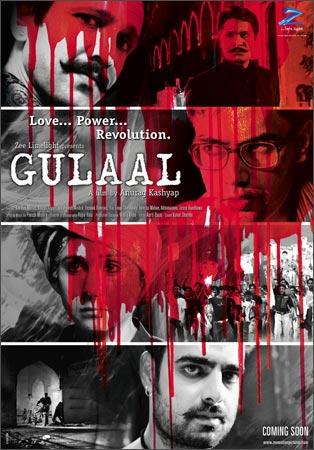 .
. and a poster.
The date, March 11, will most likely take advantage of the festival of colours, although this clearly isn't a film that will sit too comfortably with Khal-Naikaa or Silsila. Those who'd like to know more about what was meant to the smokin' Jesse Randhawa's first Hindi film need look no further than AK's posts on PFC. The immersion into the adventurous aural confections of Dev.D has just begun; one awaits the immensely talented Piyush Mishra's first offering as a music director. 2009 looks like Anurag Kashyap's year. जी जी जी जी जी.
Tuesday, December 16, 2008
trailer plug: DEV.D
This post was long overdue. For those who haven't seen it yet, may I point to the theatrical trailer of Anurag Kashyap's forthcoming film Dev.D, a contemporary take on the Sarat Chandra Chatterjee classic based on an idea by Abhay Deol. The trailer offers a quick trip (no pun intended) into a daunting, intriguing world of myriad colours and sounds (try combining a street dance party brass band and some angry rock along with a cool hook called emotional [pronounced: e-mo-san-al] atyaachaar) fuelled by addiction and the quest for love in its many twisted forms.
We have 15 songs for Dev D. All the songs will be played in the background. There are four lyricists.
[...]
It has world music, Rajashtani folk, head-banging rock, street band baaja, an Awadhi song, Punjabi song and 1980's[sic] Euro-pop song.
Elsewhere, there's a tame poster along with a more adventurous one (courtesy: PFC).
Amit Trivedi, who handled the excellent soundtrack of Aamir promises another exciting mixed bag for this film:
We have 15 songs for Dev D. All the songs will be played in the background. There are four lyricists.
[...]
It has world music, Rajashtani folk, head-banging rock, street band baaja, an Awadhi song, Punjabi song and 1980's[sic] Euro-pop song.
As that wasn't enough, try appearances by the dance trio The Twilight Players in the film.
update: [december 18, 2008]: The official website boasts more of the variegated palette along with NSFW elements (you thought they were joking about "Lustline," didn't you?). The Tamil dirty talk is especially recommended for chortles. It's bandwidth hungry though and takes its time to load, so make sure you have a tank of patience before you click through the phantasmagoria.
Thursday, December 13, 2007
more SATYA trivia
While opening his PFC post pitching for Sudhir Mishra's Khoya Khoya Chand, Anurag Kashyap drops a nugget of trivia about Satya:
Satya, the much celebrated cult classic of this country was conceived after Ramu saw Iss raat.. infact[sic] Sudhir was asked to work on it in the beginning before getting the famous Ramu Indifference treatment..
Satya, the much celebrated cult classic of this country was conceived after Ramu saw Iss raat.. infact[sic] Sudhir was asked to work on it in the beginning before getting the famous Ramu Indifference treatment..
In a wonderful world, this would've been enough incentive to have a DVD of Is Raat Ki Subah Nahin on the stalls. But this would fall right next to the other scenario from the wonderful world: in anticipation of Khoya Khoya Chand's release, stores have DVDs of previous Sudhir Mishra ventures on display. Alas, this is far from a wonderful world despite what Satchmo had to say.
Tuesday, September 04, 2007
smoking!
The trailer for Anurag Kashyap's surreal No Smoking is up over at PFC. Travis Bickle, Mark Renton, Bob Fosse, Richard Morrison, Josef K and more. Eagerly awaited. It's also my first peek into the lyrical web that Gulzar's woven for the film thanks to jab bhii cigarette jalatii hai, which has Adnan Sami doing the honours as club crooner -- wouldn't this mark the first collaboration between Sami and Vishal? A Vishal interview elsewhere indicates that there are five songs on the soundtrack including a Bipasha Basu item number. An old post hereabouts has more on the other songs.
elsewhere on PFC: The No Smoking Diary
elsewhere on PFC: The No Smoking Diary
Thursday, July 12, 2007
black friday, devdas, onir and a palanquin for a bad song
last post in this thread
There's an interesting thread over at the PFC portal with second thoughts about Black Friday. Now that the film has finally made it to the marquee (sans requisite fanfare, one might add) and even to DVD (as quietly as could be), the hype's had time to die.
Mr. Kashyap, meanwhile, is all set to take Abhay Deol's idea of a contemporary version of Sarat Chandra Chatterjee's Devdas with Dev.D. His post on PFC offers a sample of the usual interesting unease he was greeted with as he bounced the idea off various people in the industry. Some more information about the film may be found here and here.
Onir (My Brother Nikhil, Bas Ek Pal) inaugurates his space on PFC.
And finally, in order to prevent this post from being a PFC springboard, let me direct your attention to a fine discovery of a bellyache-inducing compositional flourish called when hiir sat in the Dolii. It's from a 1993 film called Raunaq (has anyone seen a DVD anywhere?). It's a familiar Punjabi ditty on a surreal linguistic romp. [link courtesy: TDQ]
[july 13, 2007]: Holy Double Feature! Santosh Sivan opens his space on PFC with an extended introductory flashback.
Saturday, February 03, 2007
memories from the making of Black Friday
As the real black friday draws close and Anurag Kashyap is all set to make his marquee, posts have begun on PFC dedicated to the making of the film. The latest edition offers a wealth of sound clips comprising an interview with Anurag Kashyap about the film and its various aspects. Hear all about the long Dostoevskyian baadashaah khaan sequence and the importance of the music, the points of view chosen and abandoned, the chase sequence that links this film to the never-begun Allwyn Kalicharan (and connections to Takeshi Kitano and Andrei Tarkovsky), the importance of the choice of language, the impact of economics (probably the most expensive non-star-cast film made in India) and a tad more detail on why Naseeruddin Shah and Ir(r)fan Khan backing out. There's also a very interesting bit from the trial: after the film was actually screened at the hearing, the accused party wanted to change their stance!
is baar censors ne kuchh nahii.n kaaTaa ... chaar gaaliyaa.N kaaTii.n; do m**darch*d kaaTe ek b*hench*d kaaTaa; ek aur gaalii kaaTii; aur jab usake liye hamane argument kiyaa ki sir ye aap kyo.n kaaT rahe ho Black Friday me.n se ... aise hii ye log baat karate the ... wo actually jab Tiger Memom kaa ghar jalataa hai puuraa maahiim jalaa duu.Ngaa m**darch*d kar ke ... wahaa.N beep aataa hai ... to chaar jagah beep aataa hai ... wo chaar gaaliyaa.N kaaTii hai.n ... aur jab hamane unako puuchhaa ki aapane ye kyo.n kaaTaa ... censor-waalo.n ne ... unakaa argument ye thaa ... counter-argument ... ki aap ko aThaarah ch**tye diye the na is baar?
A lot of what unfolds in the interview might make more sense for those lucky enough to have caught a bootleg or a film festival screening, but the interview with its very engrossing questions and answers is highly recommended. The PFC post also has links to the other items in the Black Friday series.
Come February 09, 2007, you can watch the film and then judge the film. YT sincerely hopes that you rule in AK's favour.
Some interesting asides: Super 35 (which is the choice for AK's No Smoking) was not available in this country until Sarkar; the first film on Panavision is being shot by N Chandra (the film's called Breaking News).
It would be amiss of me not to mention that the interview also touches on some interesting aspects of the still-unfinished Gulaal.
There's also a very important thought that AK labels as his "theory of relativity of cinema" -- he uses my favourite example (Citizen Kane) when he notes "the importance of [the film] ... why it is the greatest film can be best defined by people who saw it in '46/'50 [1941]"; it also anticipates the reaction of people to Paanch (when it's eventually released, grossly out of sequence in his ouevre).
The bellyaching moment arrives in the form of an answer to the question about problems with the censors this time around. It echoes some of the charming reasons dished out by the censors for banning Paanch):
is baar censors ne kuchh nahii.n kaaTaa ... chaar gaaliyaa.N kaaTii.n; do m**darch*d kaaTe ek b*hench*d kaaTaa; ek aur gaalii kaaTii; aur jab usake liye hamane argument kiyaa ki sir ye aap kyo.n kaaT rahe ho Black Friday me.n se ... aise hii ye log baat karate the ... wo actually jab Tiger Memom kaa ghar jalataa hai puuraa maahiim jalaa duu.Ngaa m**darch*d kar ke ... wahaa.N beep aataa hai ... to chaar jagah beep aataa hai ... wo chaar gaaliyaa.N kaaTii hai.n ... aur jab hamane unako puuchhaa ki aapane ye kyo.n kaaTaa ... censor-waalo.n ne ... unakaa argument ye thaa ... counter-argument ... ki aap ko aThaarah ch**tye diye the na is baar?
And some peeks into Vishal Bhardwaj's soundtrack of No Smoking: two qawwaaliis, one by Daler Mehndi and Sukhwinder; a Sufi song by Kailash Kher and Swanand Kirkire.
And there's an appreciation of Mani Ratnam, and especially RGV (only an outsider can make Satya), who manage to objectively deal with their own work.
And now, thanks to Anurag Kashyap, I have something interesting to feast my ears on -- the Brooks Qawwali Party.
Thursday, January 11, 2007
coming soon: black friday
This has definitely got to be a first. Imagine saying this for an Anurag Kashyap film. It's about time, I say. February 09, 2007's the day. Those who've seen the bootleg can take heart that a longer cut's on the way. Prayers rise and fingers cross. Meanwhile, here's a PFC post featuring a video of AK unveiling the film's poster and a wonderful shot of the poster itself.
previous item in thread: Anurag Kashyap begins blogging on PFC.
update:[jan 12, 2007]: Adlabs has acquired the worldwide distribution rights for the film. One prays that they don't sully the print with their watermark -- it destroyed Mixed Doubles for me.
previous item in thread: Anurag Kashyap begins blogging on PFC.
update:[jan 12, 2007]: Adlabs has acquired the worldwide distribution rights for the film. One prays that they don't sully the print with their watermark -- it destroyed Mixed Doubles for me.
Friday, January 05, 2007
whither chhatrii
It's cloudy outside and there have been short spells of rain, but, as JR woefully tells me, there's no sign of The Blue Umbrella (contrary to expectations). However, there's a two-part interview with Pankaj Kapur over at Rediff [Part I, Part II ]. My favourite nugget:
You do commercial cinema very rarely. But then after a film like Maqbool you go ahead and do a Dus. Now how does a role like that compare to your repertoire? Or do you merely look at is as a fun assignment?
As far as Dus is concerned, I think it was a fairly etched character. Excepting the end development of the character, about which I had a series of discussions with the director [Anubhav Sinha] about where he is taking the character eventually. At the end of the day, it's the director's call. As an actor I can only suggest, discuss and leave it to him.
To me, whether I am playing a part in commercial cinema or, if you'd like to call it, middle-stream cinema, my attempt is the same. It depends on how the circumstances of the director permit him to understand what one is pointing out to him and incorporate the same into the script or not.
And sometimes even the best efforts of the director and actor may not sketch out the way you would imagine them to be for various constraints, but then you have to live with the kind of world you are in. And you tell yourself, 'Okay, there would be a Maqbool, a Blue Umbrella, but there would be a couple of commercial films as well.' And the idea of doing those films is to reach a certain audience that maybe does not, in the immediacy of time, watch a Blue Umbrella. For them, it is to make them aware that I exist in that cinema as well, so that maybe at some point in life they sit up and say 'oh, the same actor is there in this film, lets go and have a look at it.' So it is to maybe, partially increase the number of people who watch your work in the other kind of cinema.
You do commercial cinema very rarely. But then after a film like Maqbool you go ahead and do a Dus. Now how does a role like that compare to your repertoire? Or do you merely look at is as a fun assignment?
As far as Dus is concerned, I think it was a fairly etched character. Excepting the end development of the character, about which I had a series of discussions with the director [Anubhav Sinha] about where he is taking the character eventually. At the end of the day, it's the director's call. As an actor I can only suggest, discuss and leave it to him.
To me, whether I am playing a part in commercial cinema or, if you'd like to call it, middle-stream cinema, my attempt is the same. It depends on how the circumstances of the director permit him to understand what one is pointing out to him and incorporate the same into the script or not.
And sometimes even the best efforts of the director and actor may not sketch out the way you would imagine them to be for various constraints, but then you have to live with the kind of world you are in. And you tell yourself, 'Okay, there would be a Maqbool, a Blue Umbrella, but there would be a couple of commercial films as well.' And the idea of doing those films is to reach a certain audience that maybe does not, in the immediacy of time, watch a Blue Umbrella. For them, it is to make them aware that I exist in that cinema as well, so that maybe at some point in life they sit up and say 'oh, the same actor is there in this film, lets go and have a look at it.' So it is to maybe, partially increase the number of people who watch your work in the other kind of cinema.
In rather unrelated news, Sakshi Juneja unveils the first part of a 5-month old interview with Anurag Kashyap, just about a year after a nice interview with Kay Kay Menon. Aside from some more insight into the genesis of Paanch, the chief trivia tidbit would be "I left Mission Kashmir half way because I was not happy with the way things were shaping up..."
addendum: JR's gentle nudge (a comment on Sakshi's page) and an old blog post that leads from Socha Na Tha to Star Bestsellers offer more information about the short film that Kashyap did with Kay Kay. Now if only I can get my hands on the series ...
And here's a much-delayed pointer to a clip from "Four Step Plan," Chaitanya Tamhane's documentary critiquing the plagiarism in Bollywood.
Wednesday, December 20, 2006
mr kashyap pops up in the most interesting places
Baradwaj Rangan's interview with Gautham Menon (Kaakka Kaakka, Vettaiyaadu Vilaiyaadu) sports an interesting detail about Menon's next film Pachaikili Muthucharam:
...Gautham is now busy with the release work for Pachaikili Muthucharam, which is expected around Christmas. He calls this an adaptation of "Derailed – the book, not the film. I've totally worked from the book and I've given it a very Tamil, very Indian feel." We got around to talking about this because he mentioned that he was reading a lot of books of late, wanting to adapt them, trying to pick up rights, "which is how it works in Hollywood." It was Anurag Kashyap who gave the book to Gautham, suggesting a possible film version, "and I said let's buy the rights. We contacted the publishers, but they said Hollywood has already picked up the rights. I still thought I could make this with Kamal sir and release it before Derailed gets released. I'd give credit to the writer." But, of course, Kamal sir said no. And meanwhile Derailed, the film, came out. "I sent my assistants to watch it, and they said it was quite different." Gautham makes a point of this because "I have a problem if people say I took off from the movie. I generally don't do that at all. [..]"
...Gautham is now busy with the release work for Pachaikili Muthucharam, which is expected around Christmas. He calls this an adaptation of "Derailed – the book, not the film. I've totally worked from the book and I've given it a very Tamil, very Indian feel." We got around to talking about this because he mentioned that he was reading a lot of books of late, wanting to adapt them, trying to pick up rights, "which is how it works in Hollywood." It was Anurag Kashyap who gave the book to Gautham, suggesting a possible film version, "and I said let's buy the rights. We contacted the publishers, but they said Hollywood has already picked up the rights. I still thought I could make this with Kamal sir and release it before Derailed gets released. I'd give credit to the writer." But, of course, Kamal sir said no. And meanwhile Derailed, the film, came out. "I sent my assistants to watch it, and they said it was quite different." Gautham makes a point of this because "I have a problem if people say I took off from the movie. I generally don't do that at all. [..]"
Sunday, November 26, 2006
the making of SATYA
Kindly head over to the PassionForCinema blog where Anurag Kashyap has just begun to describe the experience of making Satya, one of the best and definitive Indian films ever. It's just the first part, so if you can't stand the suspense, stay away till the last post is in. Hopefully, we also get more on the creative enigma that is RGV.
addendum: Part II is up.
addendum: Part II is up.
Monday, October 16, 2006
anurag kashyap's diary goes online

Oz's baby Passion for Cinema serves as the host for Kashyap's diary accompanying the making of his next film No Smoking with John Abraham (produced by Vishal Bhardwaj and Kumar Mangat). His first PFC post may be found here. Here's to more interesting reading from the man who seems to "walk cinema, talk cinema." And needless to say, one hopes that his trilogy of unseens (Paanch, Black Friday and that love story set in a dystopian future called Gulaal. And what of Allwyn Kalicharan? Here's hoping there are no more additions to this list -- even Orson Welles had a few (and so few they were) completed films under his belt.
elsewhere: pointers to and notes from oz's Kashyap interview | a pointer to an intimate look into the turbulent life of Mr Kashyap
update: [october 18, 2006] And this merits an article in the Mid-Day. Wow! [link courtesy: oz]
Subscribe to:
Posts (Atom)