Showing posts with label public_library. Show all posts

Sunday, December 28, 2008

extracts from the reading list

I have to toss a sop to coincidence when the phrase tout court shows up in two books that I picked up at the public library on Christmas Eve. I'm sure the phrase is not uncommon, but I have to confess that I haven't seen (or noticed) it before. As a tribute to the coincidence, here are some extracts from each book.

The first is the third book in Donald Spoto's series on Alfred Hitchcock. Spoto's name and work is known to any serious Hitchcock fan; A well-turned copy of The Dark Side of Genius: The Life of Alfred Hitchcock, the second volume in the series, lies in my bookshelf (gathering some dust, I must regretfully add). Employing a pun, Spoto calls the new book Spellbound by Beauty and it covers, as is evident from the title, the Master's obsession with his leading ladies (and especially blondes). Spoto has been accused of starting to paint a rather uncomplimentary picture of Hitchcock as a person, starting with his second book. This third book, as the preface indicates, seems to promise more material that is bound to offend those that hold Hitchcock in high regard, as a creative genius without blemish. But, as Spoto also points out, genius has never been free of a life peppered with hurdles, sorrow, hardship and personality flaws:


Writing or speaking anything other than the highest praise or failing to promote the most affectionate encomia for so august an icon as Alfred Hitchcock has become, in the eyes of many, equivalent to cultural sacrilege. But the craft of biography requires that the shadow side of subjects be set forth and comprehended - otherwise, their humanity is diminished, their pain minimised, and those they hurt are ignored. Any appreciation of Hitchcock's art and life must take into account the enormity of his psychological, physical and social suffering, as well as that which he (perhaps unintentionally) caused others. From his suffering came the obsessively recurring themes and the constant sense of dread with which he continues to astonish, entertain and enlighten.

The other bit comes from the wonderful introduction by Anthony Burgess to the compilation The Best Short Stories of J. G. Ballard:


Ballard considers that the kind of limitation that most contemporary fiction accepts is immoral, a shameful consequence of the rise of the bourgeois novel. Language exists less to record the actual than to liberate the imagination. To go forward, as Ballard does, is also to go back -- scientific apocalypse and pre-scientific myth meet in the same creative region, where the great bourgeois novelists of tradition would not feel at home.

The complete text of the introduction is available in the Google Books preview of the book.

The final extract (did I say two? I lied) comes from Emmanuel Carrère's book I Am Alive and You Are Dead: A Journey in the Mind of Philip K. Dick. It's a succinct description of what happens when a cult figure acquires mainstream acceptance and recognition:


Given the uniform Vintage editions of his complete works and the many articles about Dick that have appeared in both academic and popular journals, his fans must feel a little like the early Christians did when their faith was officially adopted by the Roman Empire: triumphant, of course, but also slightly nostalgic for the days when they lived in the catacombs. The Happy Few cease to be happy when they are no longer few. Dick has become part of the mainstream.
Wednesday, April 02, 2008

the daunting stack

Almost a year ago, I waxed in glum disarray about needing to rekindle the reading habit. The library hauls have resumed over the last several months as has the effort to actually read some of those books I snagged in book sales. Although those pesky addictive DVDs still show up in the lists, I've been able to sample a few interesting books, been unable to get through a few before they were due back on the shelves and been able to slap the back cover shut in triumph on a few. The mixed bag has featured clusters by writers who have been favourites:

* Neil Gaiman: Fragile Things: Short Stories and Wonders, Smoke and Mirrors

* Jonathan Lethem: You Don't Love Me Yet [in a strange coincidence, the stash bearing this book also featured the Criterion release of the Preston Sturges gem Unfaithfully Yours containing an essay by Jonathan Lethem

* Shashi Tharoor: Bookless in Baghdad, The Elephant, The Tiger And The Cell Phone -- both unfinished for want of time

* Kurt Vonnegut: Breakfast Of Champions, Cat's Cradle

There were books that had languished long on the "Must read this some day" list:
* Love And Longing In Bombay by Vikram Chandra (please pray for me as I embark upon the mission of trying to get through Sacred Games, the large tome dedicated to Sartaj Singh.

* Hard-Boiled by Frank Miller and Geoff Darrow with its excrutiatingly detailed art and its seductively horrifying exploration of a world ridden with vice

* Kafka Americana where Jonathan Lethem (yes, him again) and Carter Scholz collaborated in solo and duet with a post-post-modern, reflexive set of tales laced with pop culture that presented Kafka as (among other things) the creator of Batman and as a Hollywood screenwriter. This is so much more fun that it sounds like. Then we had the Dennis Hopper biography, the engrossing Bernard Herrmann biography A Heart At Fire's Centre and Sprawl City: Race, politics, and planning in Atlanta by Robert Bullard.

The ones that never got done included

* An Infinite Summer by Christopher Priest: I only managed to read one of the tales, Whores, which offered a delirious experience in synaesthesia (as the train clattered through the devastated towns and countryside, I seemed to taste the music of pain, feel the gay dancing colours of sound)

* Dreaming In Code by Scott Rosenberg

* Samuel Fuller's delightful memoir A Third Face.

Time to get back to Reading Comics and Wampeters, Foma and Granfalloons.

Saturday, January 14, 2006

yeah, that's right [last post in thread]

Friday the 13th. 'Twas brillig (well, technically about two hours after that) and YT walked out from the library with X-Men: Phoenix Rising (a compilation of the Jean Grey/Phoenix arc from Avengers #263, Fantastic Four #286 and X-Factor #1). But what YT really thought was rocking was the diverse set of DVDs (a larger number courtesy a friend's generosity and library card) in the bag: a contemporary comic book adaptation (Constantine), a cult horror classic (The Evil Dead), a later minor nugget from Sam Raimi the man responsible for the last film (A Simple Plan), a blaxploitation classic (Super Fly), an Oscar-winning documentary about Munich 1972 (One Day in September), the Criterion release of a minor noir nugget (Night and the City), the Criterion release of the Robert Bresson film whose final image echoes in Schrader's American Gigolo (Pickpocket), the delicious 2-DVD Criterion special release of a classic remade into Friedkin's rather hard to find Sorceror (The Wages of Fear), a restored Orson Welles nugget (Othello).

As if this was not enough to stretch the time/space continuum, YT snagged three books for a total of $1 in a wonderful book sale at the library: David Mamet's American Buffalo, Edward Albee's Who's Afraid of Virginia Woolf? and Ray Bradbury's Zen and the Art of Writing.

As always the problem lies in actually watching all this stuff.

Tuesday, September 13, 2005

oops! I did it again[September 10, 2005] {the thread thus far}

So I just made yet another (déjà vu; yawn; all that) haul at the library. Small sources of random joy.

* Thanks to sufficient mention on Mount Helicon, I now have the task of reading Mark Haddon's The Curious Incident of the Dog in the Night-Time (and I thought it had something to do with Sherlock Holmes in a post-modern way)

* You Can Do the Math ("overcome your math phobia and make better financial decisions") seemed interesting enough as a pick off the shelf (and there's hopefully more trivia about the multitude of named capitalist demons haunting us in the US of A)

* The Wisdom of Crowds by James Surowiecki has been on the list for a while, and it helped to have it sitting on the shelf (waiting for me)

* Ariel Dorfman's Death and the Maiden moved up the list in order to furnish preparations for Dansh (looking forward to Kay Kay Menon) and Siskiyaan (after installing the see-through impact-proof wall before the TV screen to facilitate a release of anger and frustration while still keeping the TV alive for future viewings) [more on why]

* And finally on the language front we have The Unfolding of Language by Guy Deutscher (a casual flipping of pages seems to make me wish I dropped acid), The Big Book of Beastly Mispronunciations ("the complete opinionated guide for the careful speaker") by Charles Harrington Elster (which boasts a note of praise from William Safire: ek-STROR-di-ner-ee), and The New Well-Tempered Sentence ("a punctuation handbook for the innocent, the eager, and the doomed") by Karen Elizabeth Gordon (a book that mixes wordy poetic discussions on matters of usage as far as the suite of punctuation is concerned along with panels detailing the adventures of the cover girl Loona, a duke and duchess, and two people called Rosie and Nimrod).

Tuesday, August 23, 2005

preoccupied with superheroes ... again

But first, a smaller entry in the chain of library haul reports: Fodder for linguistic glee with Kate Burridge's Blooming English (whaddya know? Yesterday was National Punctuation Day in the USA). Two chips off the old Bloch with Last Rites, Volume III in the trilogy called The Selected Stories of Robert Bloch (the publishers Underwood-Miller were also responsible for the 5-pack The Collected Stories of Philip K. Dick) and Midnight Pleasures.

And now, dear reader, we come to Jonathan Lethem's new collection of stories Men and Cartoons [more elsewhere here-wise]. The book features some of the motifs I've seen in Lethem's other books (some directly as a reader, some vicariously while browsing articles and reviews). Super Goat Man makes no bones about Lethem's taste for comic books and comic book lore. It's an interesting bent to have for story-telling, and I hope to see more examples of such influenced work (perhaps less overt the next time?). The collection opens with a Carver/Hempel-esque (there might be more direct influences, but these notes are based on what I've read) story called The Vision. The story exploits both a mundane setting and the adoration of comic books in a better way than the more overt Super Goat Man. Access Fantasy mixes social satire (complete with a dystopian view of the future) and an amateur detective to good measure. What stayed with me were the parameters that defined the society: a combination of trailer parks, barriers, and in-your-face advertising with a vengeance. Then there's the O Henry-esque-but-not-quite domestic tale called The Spray, which mixes another element of fantasy into a slice-of-life tale of love and past infidelities. Vivian Relf is a story with an interesting premise: a man meets a woman at a party and both of them are sure that they have met before. Yet they haven't. Repeated encounters only serve to punctuate the man's life. Planet Big Zero tells the tale of two childhood friends who seem to have drifted apart as time went by: one of them is now a writer of a comic strip and the other doesn't seem to have done much with his life. It marks an ebb in the collection, but The Glasses (which begins with the delicious Rows of frames sat on glass shelves, clear lenses reflecting gray light from the Brooklyn avenue. Outside, rain fell. At the door a cardboard box waited for umbrellas.), a delightfully strange tale of a black customer who complains about smudges on his glasses to two duelling arguing opticians. The last story The National Anthem didn't do much for me. A disappointing coda to an otherwise interesting collection.

But wait, the most rewarding story is this oddball nugget called The Dystopianist, Thinking of his Rival, is Interrupted by a Knock on the Door. A very Borges-ian opening The Dystopianist destroyed the world again that morning, before making any phone calls or checking his mail, before even breakfast. He destroyed it by cabbages introduces us to the tale of the Dystopianist, who, in true comic book fashion, finds a rival in a childhood acquaintance, who is now the Dire Utopianist, who has rendered him and his work ineffectual; and then his visions begin to come true. It's a delight that should have closed the book; or perhaps move closer to the end. Such quibbles aside, this is another display of an intriguing imagination fuelled by science fiction, fantasy, and comics.

Thursday, August 11, 2005

the bibliophile's bash III

[and then there was II and then there was I]

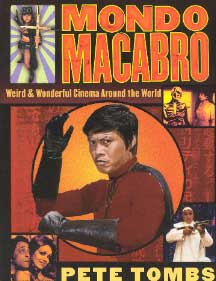
mondo macabro Yours Truly was back at the library. Having deposited a few returns, YT proceeded to the shelves browsing. YT knew there were holds. But this was the second part of the visit: Impulse shopping, without the purchase. YT spots Joe Queenan's The Unkindest Cut, wherein he chronicles his attempts to write and make a movie (12 Steps To Death) for less than $7000. Since YT has enjoyed reading other Queenan works. The cynical take on populist mush and pandering tripe has been a comfort on many an occasion.
YT then spots the golden pick of the evening. Innocently sitting on the shelf above is Mondo Macabro: Weird and Wonderful Cinema Around The World by Peter Tombs. YT knows that Peter Tombs is also behind the site of the same name. What makes this wonderfully delightfully catalogue of bizarre movies is the set of two chapters dedicated to Bollywood (with a special emphasis on the Ramsay/Bhakri horrors that YT has always relished).
dariya dil LP cover

This book also features the Dariya Dil LP cover (take a look to your right) from Niall Richardson's LP cover collection (the actual page for the record is here) that made it to a BoingBoing post as well. Needless to say, YT is interested in the soundtrack.

YT now performs some complicated mental computations involving addition and subtraction and estimates that YT will not tip the scales on the maximum number of items one may have issued out from the library. YT proceeds to the checkout counter. The weary lady smiles knowingly (unless YT is imagining it). She has trucked stuff off the holds for YT; it's unlikely that someone would forget that.

After scanning the card, she informs YT that there are 8 holds waiting. YT has to perform some quick calculations, but shock at the upward blip in the number between the last time YT checked the list online and now results in a clerical error. YT is prepared to sacrifice a book.

YT's eyes now follow the lady to the holds shelf. YT realizes how eerie it is to see your name staring back at you. Several times. Hand-written. Man! That book is huge. Turns out to be one of several Harlan Ellison books that have arrived. It's called Medea: Ellison's world (probably owes its name to Medea), a document of the process of creation of Sci-Fi: from world to character-driven tales. Should prove interesting. Next up is a collection titled Alone Against Tomorrow: Stories of Alienation in Science Fiction. Nice cover. Then there's Edgeworks I. Although the reports on content have been slightly negative, there's another entertaining bogus author bio, and it's the packaging that makes having a good old printed book worth it.
mefisto in onyx cover by frank millerThe same applies to Slippage. Aside from a lot of typographical excursions (placement of phrases and words in keeping with the title), there's also the mass-market appearance of the long short story (yeah you read that right) Mefisto in Onyx, which YT just finished and liked for the theme, and the language, as well as the cover art and introduction by Frank Miller (words and phrases to remember: "jaunting into someone's landscape" and "shrike").

With enough Ellison to drool over for the next few weeks, YT now moves to the next few items. There's Nabokov's postmodern undersung Pale Fire, which ends up on the list thanks to a vigorous month-long recommendation from Sudarshan, who also posted a review on Mount Helicon.

And finally, since YT is a film buff, there's Sam Peckinpah's West : new perspectives.

A splendid time is guaranteed for YT.

Monday, July 25, 2005

a massive haul of material worthy of a month off (being a visit to the public library)

Nothing unusual. Just the weekly visit. Favoured branches have changed based on commute times and destinations. But what hasn't changed is the potential that one day (like today), I'd look like I was walking out of a grocery store of books and movies. Here's what I have now: on the movies front, we have Bowfinger (some preliminary thoughts noted elsewhere) and a David Mamet nugget called Spartan. As for the books, we have for ourselves what you would refer to as an overdose:

* Being a Chuck Palahniuk fan, I've begun to trace his influences. A key influence has been another minimalist writer Tom Spanbauer. So I've already begun his début novel Faraway Places and now I also have his most famous work The Man who fell in love with the Moon.

* Another influence that Palahniuk cites a lot (an influence that was also a prominent feature in Spanbauer's writing workshop that Palahniuk attended) is Amy Hempel. The directly referenced story The Harvest is available online, but also part of At the gates of the animal kingdom, which I snagged today. I also picked up Reasons to Live.

* I picked up Salman Rushdie's Fury on a whim. It was either this or the fatter The Ground beneath her Feet. Besides this one seemed like an angrier book ;)

* Make-believe town: essays and remembrances marks another edition in my David Mamet reading

* And then there's Neil Gaiman's American gods : a novel (after a wonderful introduction to Sandman from Sudarshan, I couldn't resist gobbling this up)

* And from a trivia-mongering perspective, there's Fountain Society, the only novel (AFAIR) that horror-meister Wes Craven ever wrote ...

* Continuing my Harlan Ellison trip, I picked up Deathbird stories

* And for no particular reason (perhaps to read "Repent, Harlequin!" Said the Ticktockman again?) I picked up Masterpieces: the best science fiction of the century edited by Orson Scott card.

Friday, October 29, 2004

reading, reading, reading

A recent decent haul from the public library seems to have made me Eco-unfriendly [explanation]. But I must acknowledge that before I left off on The Name of the Rose I was pleased by the rich writing (which makes it a good translation from the original Italian -- how faithful it is to the original language remains to be seen, but it works well in English, which is what really matters).

There's The director's event; interviews with five American film-makers: Budd Boetticher, Peter Bogdanovich, Samuel Fuller, Arthur Penn, Abraham Polonsky by Eric Sherman and Martin Rubin. This is followed by Steven Soderbergh : interviews edited by Anthony Kaufman. Ben Sidran's Ben Sidran : a life in the music falls in the category of "I was browsing around and picked this off the shelf", and looks like it is destined to return to the shelves sooner than expected. I'm almost through The Ig Nobel prizes : the annals of improbable research. But the leader of the pack is a book that brings up stuff very close to my heart, and is an extremely delightful and insightful read: Lynne Truss's Eats, shoots & leaves : the zero tolerance approach to punctuation.

Wednesday, April 07, 2004

AFPL gets a new look and a new system

My favourite haunt, the Atlanta Fulton Public Library, has just unveiled their new electronic system. It's called iBistro. The L&F is elegant, and I hope this means goodbye to the old purple/green/blue scheme. Oh yeah, it's running Linux:)

Wednesday, March 10, 2004

a man can either be a cauliflower or he can attempt great things. There is nothing in between

I picked up Sanjay Nigam's The Snake Charmer on a whim. It stared out at me from a bookshelf close to the elevator in the public library. Grabbing a book like this is usually fun. You know nothing about the writer. So there's the element of discovery. And, hopefully, reading the book is aided by this element. In the case of Nigam's tale of a luckless middle-aged snake charmer, who becomes an unlikely Ulysses after being responsible for the shocking death of his snake. The book is lucid and lyrical, full of lines pithy and truistic. A very fast entertaining read. Benzene, chile peppers, and priceless lines ("tomatoes only work for the anaemia of loneliness"). And being an afficionado of scatalogical humour I must quote Nigam's description of Sonalal's first encounter with the Western-style toilet: The bathroom proved especially vexing. He hadn't sat on a Western-style toilet before, though it was one of those things he'd always been curious about. When he finally did sit on it, the experience was anticlimactic. Though he'd never been constipated in his life, his bowels didn't budge for two days. But at last his sphincter became accustomed to the new sight, and the world grew subtle again.

Tuesday, August 12, 2003

bookshelf snapshot

Looking up at the bookshelf I see that I have my new additions from the library to deal with: A Sanskrit Grammar for Students by Arthur MacDonell (which I must return, for I don't think I can muster the patience to match my initial enthusiasm), Analog Days (a book about the history and importance of the Moog synthesizer), and William Safire's Let a Simile be your Umbrella, another collection of this language maven's excursions into the fine and very-very-fine matters of the English language.

Addendum from the future: Later in the evening, I added a few more volumes to the sagging shelf: Harmony (a very readable text by Walter Piston, released in a fifth edition with edits from Mark Devoto), Knowing the Score (a set of interviews conducted by David Morgan with different contemporary film composers about their work) [review], Ultra Lounge: The Lexicon of Easy Listening by Dylan Jones (being an interesting look at the genre of easy listening music).

Wednesday, July 23, 2003

more library hauls

This is the "I will never learn" moment. Got two books on JavaBeans from the public library. For my non-technical relaxing moments I also got the original Shaft on DVD and an interesting book by Thomas Hine called I Want That! How We All Became Shoppers, a book about the American the buyosphere (interesting term there) {not-so-promising review}.

Wednesday, July 16, 2003

library book fest

For reading, we now have Michael Crichton's Prey (mainstream sci-fi pulp adventure with a premise of nanotechnology), Who the Devil Made it (a collection of interviews conducted by Peter Bogdanovich {rant elsewhere} with famous Hollywood film directors), Stiff : the curious lives of human cadavers, Don't make me think! (a book on web usability by Steve Krug). For our viewing pleasure we have Ghosts of Mars, the last film John Carpenter made (to date, that is).

Wednesday, July 09, 2003

cool (literally) tool and some more library hauls

Found a useful tool I've been seeking for quite a long time: a compressed air spray to clean your keyboard. All you do is affix a capillary to the nozzle, point it at the crevices in your keyboard, and hit the trigger. With some light spray, what you can expect to see is all the dust and the other crap that ends up nesting in those little dark areas in and around the keys. This product was Falcon's Dust-Off. The downside, according to the last link, is the presence of HCFCs in the spray. Wonder if that's still the case though -- the literature scattered on the can's surface has nothing to offer about the constituents. Man! That can was cold!

And it was another trip to the library followed by me trudging home with a loaded bag (the library bum, that's me!): a couple of Inspector Ghote mysteries (Inspector ghote caught in meshes, Inspector ghote plays a joker) and Randall Kennedy's controversial Nigger : the strange career of a troublesome word (something on my to-read list) comprised the dead-tree section. The movies included John Huston's Moby Dick on DVD (acquired solely to watch Orson Welles in his brief role as Father Mapple, Compulsion (being another filmic interpretation of the Leopold-Loeb case, the more famous version being Hitchcock's first colour film and experiment in long takes, Rope), Murder!, an early relatively unsung Hitchcock talkie, Belle Epoque (a tale of a Paradise of love and passion; winner of 9 Goyas (the Spanish Oscars) and the Foreign Film Oscar-- come to think of it, a lot of the "famous" foreign films I've seen seem to deal with eroticism in various forms). And rounding off the list is a 4-cassette audio version of This is Orson Welles, a compilation by Peter Bogdanovich (once again, a man good in print and bad on celluloid) of conversations with Orson Welles.

Wednesday, July 02, 2003

library hauls

The sole bright spot in the otherwise bleak wet yesterday was another trip to the library -- I was clearly not satisfied with picking up a book on UML-based project management (Does the heavy dependence on Microsoft software mean that Project Managers are sold on bad bloated software?). Grabbed two DVDs: Traffik volume II (the TV mini-series that seeded Soderbergh's movie) and Fawlty Towers volume III and Six and Violence (being volume VI of the compilations of Monty Python skits). Then there's Jazz Noir by David Butler (more about that in a moment). And Song Review, a 2-CD compilation of Stevie Wonder hits. And finally, a very very interesting CD (Pro Arte CDD-120. Made in Japan!) featuring recordings of the Cantilena Chamber Players. The track of interest is Round a common centre, a tonal commision piece by Lukas Foss, featuring Yehudi Menuhin on violin, Elaine Bonazzi (mezzo soprano), and Orson Welles (reading "The Runner", a little-known poem by W H Auden). This track premiered at the 1980 Winter Olympics. Historical importance aside, it's great to hear the familiar voice. Another item in the ongoing obsession with all Welles-media.

Jazz Noir by David Butler, is an extended version of his PhD thesis. The book explores the reasons for the incorrect widespread belief that jazz and film noir were entwined during the 1940s and 1950s, that the shadows cast by one were inescapably echoed in the sounds of the other. Butler also examines the racial myths and ideologies that drove the use of jazz in American film. So far, it has been a very lucid (that's saying a lot for academic literature!) read and has a splendid collection of references. It's a welcome addition to a list of interesting books on this fascinating genre of film.

Wednesday, June 25, 2003

yet another jaunt to the library

After having enjoyed Mr Arkadin recently, I walked over to the Ws in the fiction section and was overjoyed to find a copy of the source novel. Add to that two more Sherlock Holmes homages from Nicholas Meyer, The West End Horror and The Canary Trainer. Hope they're as entertaining as his first effort The Seven Per-Cent Solution, which I bought last year. There's also a tribute to Duke Ellington featuring Wynton Marsalis.

Thursday, June 19, 2003

ek aur haul

Library time again. What with the droves of rain... Picked up videotapes of The Oblong Box and Mr Arkadin. The latter is an unsung Orson Welles gem, which suffered like most of his films, from the multiple version issue. I bookended the tapes (notice the wonderful pun ... ) with three books on poetry: How to read and interpret poetry, being a basic introductory guide, Sound and form in modern poetry; a study of prosody being a nightmarishly technical work, and Frances Mayes' wonderful The discovery of poetry : a field guide to reading and writing poems. Watch this space for some verse soon ...

Tuesday, May 06, 2003

reading platter refill

Despite the thunderstorms and pouring rain, I made my way to the public library (conveniently located outside the train station) to renew a book on SQL variants employed on different database management systems along with Nobody's Perfect, Charlotte Chandler's affectionate biographical look at the wonderfully talented and diverse Billy Wilder.

Friday, May 02, 2003

universal evening

New Library Reads: Patrick McGrath (Spider, which I didn't do justice to the last time, and Asylum); Go West, Inspector Ghote (a great topic of specialization for Mastermind); Home from Nowhere, Kunstler's sequel to The Geography of Nowhere.

A slight spell of dark clouds and rain spray did little to dampen the spirits as we dined out at Universal Restaurant, formerly New Heera of India (the old management sold it to the people running Universal Groceries Ltd next door). Papads (some well done; some a tad soft) as appetizers. A main course of regular rice (which accompanied all orders) with chicken biryani (including an architecturally ambitious stellar-structured badi elaichi), paalak paneer and mixed vegetable curry. Paalak paneer when done right comprises a green palak soup where the paneers act as bread crumbs. Sadly, such was not the case here. It's probably the first time I noticed it, but the paalak (spinach) remained in the dish in the original filiform, serving more like gratuitous seasoning than a core component. The mixed vegetable curry chose different vegetables than I was used to (green peas, carrots, potatoes). Good food overall; could have been better. The most agonizing aspect of the evening were Rahman's compositions for Legend of Bhagat Singh. While Rahman's dedication to sounding north-entic must be applauded (but he's got enough plaudits already for similar efforts -- Taal), the music was tinny and repetitive and the lyrics really grew on you (i mean, really, like a fungus). Too late, as we were walking to the counter, did they switch to the much better Lagaan) (And as I thought of how Ghanan ghanan was picturised, I looked outside, and noticed the traces of the brief spell of rain we had. Poignant?)

A visit to the rewarding Universal Groceries Ltd. next door was very rewarding (yes, he has very few words to describe himself!). Grabbed the rather rare RD Burman 3-combo Balika Badhu/Daulat ke Dushman/Doosri Sita and two Yesudas compilations (with *no* songs in common: a feat rather difficult to achieve with HMV's fetish for heavily overlapping compilations!).

Step aside and ponder: Each of us has something we can do or something that can happen, which will leave us smiling or happy no matter what (or in my case, no matter how trivial or simplistic). For me it seems to be finding a rare R D Burman compilation or release, lying on the shelves, with few to no takers. I know I had an unbridled smile the moment I saw a blown-up photograph of his countenance smiling back at me, presenting me with three of his soundtracks, long forgotten (by most) and ill-marketed.

Sunday, April 20, 2003

easter weekend

It's Easter Sunday. The weather sucks though: cloudy, bleak and clammy. It's been this way since Good Friday. The irony has overstayed its welcome, though (need I add at this point, that I was reading Son of Rosemary on the train today?). Thankfully, I chose to attend mass, which has given me positive boost. I've been a faithful couch potato for the last couple of days now. I picked up two Ira Levin books at the public library on my way home on Friday: Son of Rosemary and Deathtrap (a two act murder mystery set, as was A Kiss Before Dying, in Connecticut). I finished the play on the train home. The play was extremely successful on Broadway (it set a record as the longest running mystery/thriller on Broadway) and also became a film starring Michael Caine and Christopher Reeve. I loved the play -- it reminded me a lot of Sleuth (whose movie adaptation also featured Michael Caine). The first act reminded me of a Marathi play I had seen on Doordarshan a long time ago called Sadist. That said, the rest of Friday was devoted to Star Trek: TNG, now showcased as "TNG Uncut" on TNN (which means they take out the little bar at the bottom and give you the episode full-screen).

Saturday was movie splurge day. I started off with Michael Caine (yes, yes, I caine-t get enough) doing in his early days as the smart scientist who saves the day in The Swarm. A tad overlong, the film is also interesting for the cast roster that's an exercise in name dropping: Katherine Ross (remember her in The Graduate?), Richard Widmark, Olivia de Havilland, Slim Pickens, Fred MacMurray, Henry Fonda ... time to go gulp! Then after a break for the daily duties, I settled back into the warm cavity I had created for myself in the couch for Mimic, a movie I've been meaning to see for a long time, ever since I caught del Toro's Cronos. The plot is a classic B-horror tale: a mutant strain of roaches threatens New York City. Del Toro's harrowing vision of the underbelly of the NY subway system (a favourite of horror writers. Ref: The Midnight Meat Train, from Clive Barker's Books of Blood, a collection I highly recommend) gets fantastic support from the SFX crew (Rob Bottin pops up yet again). The twist (and hence the title) is that this strain of giant roaches has evolved to mimic its predator, man. Corny as it may sound, the twist is understated, and the film worked for me for its textures, colours, and moments. There are lapses in logic, but I would forgive all that in exchange for a hour and more of solid scares. I took an extended break (well, to be honest, the tube betrayed me with low-quality programming) and returned after dinner to catch good old Clint Eastwood in High Plains Drifter. This was Eastwood's first western as a director, and there's a little tribute to Sergio Leone and Don Siegel, if you look carefully. The elements are all familiar: a small frontier town, a mysterious stranger, a conflict of morals, the inevitable showdown and the subdued tension. If you've seen the movie and still didn't get it, Clint makes it easier for you (check out the audio clip).

 
Creative Commons License
This work is licensed under a Creative Commons Attribution-NonCommercial-NoDerivs 3.0 Unported License.