Wednesday, October 26, 2011
eternal riders of pune
After a fresh experience of the roads in Pune lasting several days, I am ready to conclude that the average Puneite on the road (on foot, gripping the handle of a motorised two-wheeler or a bicycle, helming an autorickshaw, car, van, bus or truck) has three significant qualities: he or she is discourteous, he or she is selfish and he or she is suicidal. Despite this lethal combination of qualities, he or she seems eternal. untouchable by death. amar. imagine that. The font of eternal life must exist in the murky miasma of the traffic jams in Pune: how else does one explain the lack of significant fatalities on the roads when everyone (regardless of their size or the size of their mode of conveyance) is trying to squeeze into every available space of every size at any imaginable speed? That woman sliding between a bus and a jeep passed through without a scratch; that scooterist swung cleanly a breath away from the noggin of a large van; those two cars crissed and crossed by a motorcyclist without affecting his path or angle at all. Unbelievable.
Friday, October 21, 2011
you pay for the space: the annoying things are free
Cellphone screens in the dark. Think of fireflies with Asha Parekh-ian (or Nanda-esque) derrieres. They are annoying. Distracting. Especially when you are trying to watch the movie.
Cellphone ringtones. They are annoying. Distracting. Especially when you are trying to listen to the dialogue uttered by the characters in the movie that you have been trying to watch.
Inconsiderate. The people who paid for the seats they are sitting in and insist on continuing to use their cellphones to send text messages, receive and check text messages, make calls and receive calls without being courteous enough to switch their phones to silent mode. The cinema hall is just another place to hang out and presumably what transpires on the screen is akin to the unfortunate band that plays music while you dine in some faux star restaurant.
Except that the film and the band are not the same thing.
Could you please take your call outside?, I lean over and say to the girl sitting next to us, who, after a conversation louder than the booming sound of the film playing in the hall, has decided to talk on the phone,
It's an important call, she replies, failing to see why I should have a problem with this. I continue to be polite and inform her that the volume of her conversation is louder than the volume of the film (which is why I have a problem -- because I paid to listen to the film and not to her). Her reply is priceless: You could have said it in a more polite way (or words to that effect).
Is it time to take a leaf from Falling Down and go watch movies with a baseball bat in tow? Is that the only way to get such inconsiderate, discourteous (and seemingly clueless) people to behave? Why doesn't the management of the theatre/multiplex request people to be courteous? Why aren't there any ads like the Don't spoil the movie by adding your own soundtrack ad that plays at the AMC theatres? Why doesn't someone take a hint from the Alamo Drafthouse? (the uncensored PSA is here)
Monday, October 17, 2011
entomical cojones
Look carefully at the glass wall for the customs office (or some office dedicated to a similar function) at the airport in Pune as you walk from the check-in counters to the place where the security check is conducted and you will be informed (among other things) not to take khus khus and (I kid you not) beetle nuts into Dubai (or the Gulf, unless I am mistaken). Surely they meant betel, unless those parts of the world regard the family jewels of the members of the Coleopteran order as either a culinary delicacy or something as precious as a rhino's horn.
Thursday, October 06, 2011
jobs all over
Last night, when I read that Steve Jobs had passed away, I switched to the Hacker News tab and refreshed it to read what the world had to say. I saw something I had never seen before: every single one of the 30 items on the first page was about Steve Jobs. It was worth a "screencap":
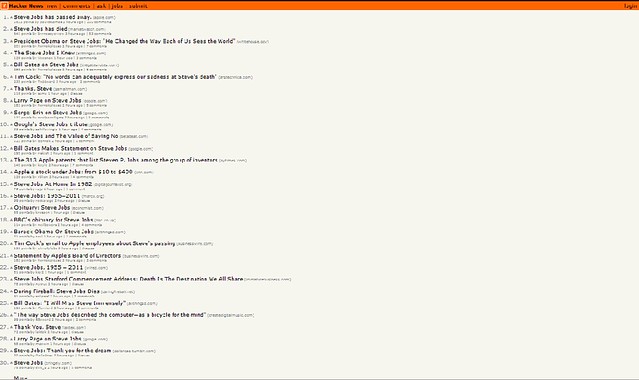
My favourite tribute so far (aside from the austere bold link on google's main page) was the image here.
Tuesday, October 04, 2011
super seven: the fox is on fire
All hail Nicholas Nethercote!
When Mozilla launched Memshrink to finally do something about all the memory that Firefox never seemed to let go until it had to shrug, I discovered Nicholas Nethercote's blog. Since then I have been reading every new post on his blog, enjoying his writing style and also learning a lot about performance tuning and about the innards of Firefox (I didn't know just how much sqlite was used in all those add-ons). I also waited eagerly for Firefox 7 so that I could see the results of all these fixes and last week I didn't hesitate a moment when I saw the pop-up in the system tray telling me that Firefox 7 was available. Mercifully, the only hacks I needed to get two add-ons working were familiar ones that I had effected when Firefox 5.0 was rolled out.
A few minutes later, after Firefox was back up and running, I could see the difference. I spent some time playing with about:memory?verbose, because the output now contained information about the various compartments that were using memory. Firefox was not lurching to chomp away memory. Instead, it seemed more well-behaved and offered strong testimony to everybody who had worked hard to plug all those leaks and free all that heap.
The only cloud in this silver sky was a news article screaming that Chrome was poised to take over from Firefox as the second most popular browser. Perhaps all these fixes have come too late. Perhaps the article didn't analyse the data correctly and fairly. I don't care much right now as long as Firefox 8 promises to shed even more lard.
Saturday, September 24, 2011
non-vegetarian vegetable
The local Indian store has a modest section offering vegetables each labelled in English with often liberal spelling. Redish was just something to warm you up and prepare you for Bison Bites aka Snack Gaur. Rest assured, O shocked vegetarians. This was not the bison served up to complement a sip of cold carbonated cola; this was just a typo too much for trichosanthes cucumerina, also known as your friendly neighbourhood snake gourd. You may now breathe again.
Sunday, September 11, 2011
old-time poetry
I found some amateur verse from the old electronic archives today. I seem to have written it in October 2002, when I used MARTA more often than I do now; here goes nothing:
walking steadily to keep time
with a bus approaching
it's a race to survive
the fumes and fury
of rush hour
why do they desert me
when I'm in a hurry
i see too many of them
when I'm not
with a bus approaching
it's a race to survive
the fumes and fury
of rush hour
why do they desert me
when I'm in a hurry
i see too many of them
when I'm not
PS:: The title is a play on the name of a rather interesting store that I discovered some months ago (the only branch in Georgia, as it turns out)
operation yellow boots
Anurag Kashyap does it again and this time around he's not the producer, but the director and one of the writers of the film. Having already been witness to one of the most unlikely places to hear a quote from Jim Morrison, we are not as surprised when, after she asks Chittiappa Gowda the gangster when she should come (to pay off the gangster in happy endings), the gangster, already oozing comic menace, goes if you come today, it's too early; if you come tomorrow, it's too late; you pick the time; tick tick tick tick tick tick; tick tick tick tick tick tick. This not only fits his character because he is a Kannadiga ganster, after all but ensures that those who have never been lucky to have heard (and seen) the cult favourite from Operation Diamond Racket get a chance to right the wrong. Priceless!
PS: Earlier in the scene, when we first see Chittiappa, he's watching the video of a film song (that sounded like a Kannada version of Ilayaraja's raajaa raajaathi from Agni Natchathiram) on the tube. Does anyone know which movie that was?
Thursday, September 01, 2011
deeply ambiguous
The poster for Deep Blue Sea features two living creatures -- a shark and a lady in distress. Does the tagline "Bigger. Smarter. Faster. Meaner" refer to the shark, the shark's gaping maw or the threatened rack?
Friday, August 26, 2011
bearable exposition
I get the feeling that all writers churning out candidates for the mainstream bestseller lists have to deal with exposition a lot more often than writers of works that are less mainstream. Some of these writers turn this devil around and decide to take the opportunity to show off all the research they have done (Crichton did this well; Dan Brown does not).
Intermission: Can you imagine Anthony Burgess writing A Clockwork Orange in the style of Dan Brown? The book would have been thicker and loaded with interleaved explanations of nadsat and descriptions of the prison, its architecture, its history and who knows what else. A title like Fruits and Mechanics would have topped this cake of futility.
I'm on a Michael Connelly buffet right now and the 8 books I have read have introduced me to exposition of various flavours and of varying levels of subtlety (or the complete lack of it, in some cases), but his exposition never strays beyond the realm of the police procedural and the court room. This, I think, is a good thing. It would have been unbearable to wade through a mini-treatise on the architecture of the courthouse just as we were about to begin an interesting trail.
Some of the books are written in the first person. This allows the writer to be more liberal in the exposition, because, after all, this is supposed to be a man or woman telling you a story. The more details you get, the better. A lot of exposition that might otherwise stick out like a sore elephant in a regular third-person narrative goes down easier when Jack McAvoy or Mickey Haller is writing to you, dear reader.
I tend to prefer little to no exposition (which is why I admire the bold stroke of the glossary in Vikram Chandra's Sacred Games: you read the tale with its natural rhythms and later use the glossary to understand the vernacular), but I can understand the need for it in mainstream fiction. Besides, fitting it into the narrative without losing the reader is not trivial. Given this, I liked the few examples from the 8 books I had read so far, where the exposition was adroitly placed just like a shot/reverse shot scene where the cutting didn't bother you. Here's an example from The Brass Verdict (I have taken the liberty of marking the relevant sections):
"Two arrests. ADW in 'ninety-seven and conspiracy to commit fraud in 'ninety-nine. No convictions but that is all I know for right now. When the court opens I can get more if you want."
I wanted to know more, especially about how arrests for fraud and assault with a deadly weapon could result in no convictions, but if Cisco pulled records on the case, then he'd have to show ID and that would leave a trail.
I wanted to know more, especially about how arrests for fraud and assault with a deadly weapon could result in no convictions, but if Cisco pulled records on the case, then he'd have to show ID and that would leave a trail.
Tuesday, August 23, 2011
may which force be with you?
Both Rediff and Hindustan Times have something to say about Force, the remake of Kaakha Kaakha. Unfortunately, both disagree on what seems to make this production special enough to merit a news item.
Rediff says: What will make this film stand apart from his other films is that Amin claims he has not used cables in Force at all, a vital element in action sequences.
HT says: Film's action director Allan Amin told the tabloid: "John is a physical guy so the action was all high octane. We did use cables for certain sequences[...]
It gets even better when both disagree on the weight of this motorcycle that John Abraham chose to lift himself without wires instead of eliciting the services of a stunt double. Rediff insists that the weight of the bike was 200 kilograms, while HT is confident that it was only 150 kilograms (it's still heavy enough to merit a "wow," but "really heavy bike" does not sound attractive enough in a news article). Perhaps a special feature on the DVD of the film will include a section dedicated to trivia to console us all.
Spoonerism alert: The Rediff article begins with a reference to a film called Rang De Sabanti (you know they are actually talking about this).
Saturday, August 20, 2011
did NDTV use a machine to transcribe an interview?
A couple of months ago, NDTV published an exclusive (they said it) interview with A. R. Rahman conducted by Prannoy Roy. The interview is mostly a piece of fluff with each subsequent question often having nothing to do with the previous one. There are a couple of nuggets of trivia, but they hardly make this piece worthwhile. The most irksome thing, however, is evidence that the transcriber was clueless, the editor was asleep or that the transcriber was a machine and that there was no editor. How else does one explain Y R Muttu instead of Vairamuthu and Jammu Sukand instead of Jhamu Sughand? Who can tell? Who knows? Who cares?
Monday, August 15, 2011
send the BSIFA back in time
Although Edward X Delaney was perhaps his most famous creation, Lawrence Sanders also created another interesting detective called Timothy Cone, an ex-Marine working as an investigator for Haldering and Company, a Wall Street firm specialising in corporate intelligence (in plain English: he investigates deals and mergers that reek of foul play). He is, needless to say, brilliant; he is also rather eccentric (otherwise he probably wouldn't be an interesting character). The tales of Cone are short, all written in the simple present tense (for creative reasons unknown) and collected in two volumes, The Timothy Files and Timothy's Game. Their lasting value, however, lies not in the plots and the twists (a lot of which are just surprises -- only Cone really can really put the pieces together), but in the scenes of intimacy between him and his boss Samantha Whatley (yes, they are having an affair unbeknownst -- they hope -- to the other people in the office). I was not surprised that Sanders valued such scenes, since he had devoted entire novels to desire, lust and coupling (you can't go wrong with titles like The Seduction of Peter S and The Passion of Molly T). What I was not prepared for was that his descriptions of the moments between Cone and Whatley seem to almost parody themselves with poetic flourishes, pithy phrases and often laughably inane choices of words. Allow me to present a sample from the works collected in The Timothy Files:
but they cannot deny their bodies' appetites, and when their hormones take over, they go berserk.
they're two stick figures, all bony knobs and hard muscle. their mating is a furious battle, not against each other so much as the emptiness and lunacy of their lives. when they strain, it is not to punish but to break out into another world. oh, look at the meadows and the daffodils! the lawn they seek is bliss.
it's such a sweaty wrestle, not quite hysterical but frantic enough. and
when they're done, staring at each other with dulled eyes, reality comes
seeping back, the real world takes over again. but something remains ...
they're like two rough hawsers, braided, rasping against each other and welcoming the scratch. in no way are they gentle or tender, because they are both hard, hurt people, wanting to get out. and this is the only way they know.
so there are no proclamations of love or undying passion. instead there is is a gritty intenseness, both of them serious and hoping. their coupling is a partnership of two bankrupts, as if all their liabilities combined might show up in black ink and make them wealthy.
so there are no proclamations of love or undying passion. instead there is is a gritty intenseness, both of them serious and hoping. their coupling is a partnership of two bankrupts, as if all their liabilities combined might show up in black ink and make them wealthy.
they really do get out with each other, as attuned as a duo of violinists, howing and scraping in unison and losing themselves in mutual harmonies. carried away and lost with closed eyes and seraphic smiles, loving life and its surprises.
finally, ignited again, they come together in a different mood: all murmurings and soft twistings. they couple in a drugged tempo, slow and lazy, as if this night might last forever.
later, drowsy and satiated, they lie entwined, peering at each other with dazed eyes. they say nothing of what has happened, not wanting the moment to slip away -- as it inevitably does.
later, drowsy and satiated, they lie entwined, peering at each other with dazed eyes. they say nothing of what has happened, not wanting the moment to slip away -- as it inevitably does.
BSIFA was a reference to this
Friday, August 05, 2011
a reference in time
I often start reading books by authors after watching films based on them. Sometimes it takes just one film. This was the case with Tell No One that got me started on Harlan Coben or the case with The First Deadly Sin, which sent me off on a Lawrence Sanders trip.
With Michael Connelly it took two films years apart. I caught Blood Work, simply because it was a Clint Eastwood film. Years later (a few weeks ago, to be precise), The Lincoln Lawyer provided an example of competent handling of familiar tropes (see also: Vacancy). A visit to the library yielded my first Michael Connelly book, Angels Flight. The absence of an almost certain apostrophe in the title may be a coincidental nod to a similar flourish in Finnegans Wake. Although this was part of a series of books featuring Hieronymus "Harry" Bosch (no relation to but named for the Dutch painter with the same name), it worked well as a work in itself. The end of page 76 of the hardbound edition yielded an interesting surprise:
Next to the stairs a lighted bus stop had been cut into the steep hill. There was a fibreglass sunshade over a double-length bench. The side partitions were used to advertise films. On the one Bosch could see there was an ad for an Eastwood picture called Blood Work. The movie was based on a true story about a former FBI agent Bosch was acquainted with.
Things get clearer on page 78:
The bus stop hadn't been used. Rider came up next to him and followed his gaze.
"Hey, did you know Terry McCaleb over at the bureau?" she asked.
"Yeah, we worked a case once. Why, you know him?"
"Not really. But I've seen him on TV. He doesn't look like Clint Eastwood, if you ask me."
"Yeah, not really."
"Hey, did you know Terry McCaleb over at the bureau?" she asked.
"Yeah, we worked a case once. Why, you know him?"
"Not really. But I've seen him on TV. He doesn't look like Clint Eastwood, if you ask me."
"Yeah, not really."
This was a reference that proved very interesting, not just because it linked my first Connelly book to the first film that I had seen based on his work, but also because the reference seems to break the rules of time: Angels Flight was published in 1999 and Blood Work was released in 2002 (the book was published in 1998). I know what you're thinking -- did Connelly do to this book what George Lucas did to the Star Wars trilogy years later? He probably did not.
A more reasonable explanation would be that Eastwood had optioned the book, but that the actual filming started late and consequently the film hit the marquee in 2002. An interview hosted at the Barnes and Noble page for the book suggests that this is indeed what had transpired:
Jim Charter from Ames, IA: Hi, Michael. I just finished ANGELS FLIGHT and loved it, of course. I have to know, though, if you were just playing with us, or is Clint Eastwood really going to make BLOOD WORK?
Michael Connelly: Your guess is as good as mine. Eastwood optioned the story last year and hired an Academy Award-winning screenwriter to adapt it. That is where it stands right now. In that respect the mention in ANGELS FLIGHT is fantasy
Michael Connelly: Your guess is as good as mine. Eastwood optioned the story last year and hired an Academy Award-winning screenwriter to adapt it. That is where it stands right now. In that respect the mention in ANGELS FLIGHT is fantasy
There you go.
Saturday, July 23, 2011
the guacamole of his own deception
Imagine, if you will, Jack Nicholson stepping out of Chinatown and Johnny Depp walking off the set of Fear and Loathing in Las Vegas and both of them getting into Seth Brundle's telepod. Rango seems quite like the result of the teleportation. I am thinking more of the chameleon and the poster, but the film owes a huge debt to Chinatown, among other films, and Nicholson was in it. The film also has a Hunter S. Thompson "cameo" and that's what Depp's film was all about. Even the poster seems to ring a trippy bell.
The film runs high with numerous riffs on and references to films like Star Wars canon, Sergio Leone's westerns and Apocalypse Now and these references zip past your eyes and ears at a pace that respects your attention. The more you know about the movies it quotes from, the more you are likely to enjoy it, but even if you just walked in hoping to be entertained, you are not going to be disappointed.
Johnny Depp turns in a splendid performance behind the microphone and finds able support in the rest of the crew (which includes Alfred Molina, Bill Nighy, Ned Beatty, Isla Fisher, Harry Dean Stanton, Abigail Breslin and Ray Winstone). If you love Westerns, and especially the ones that Sergio Leone directed, you will find a lot to enjoy here. The narrative sticks to the familiar tale of a hero's journey (see also: A Bug's Life, Kung-fu Panda) mixed with the familiar trappings of a Western. The colours are bright and glorious, the animation detailed and the film itself is a marvel. Where else does one find Mariachi owls, Wagner on banjos, a bank that stores water and a rattlesnake with a gattling gun for a rattle? Gore Verbinski and ILM have made a fine film that really and truly holds its own in a genre that has been dominated by Pixar.
Wednesday, July 13, 2011
listen and pronounce
Dear Indian IT professional[sic],
I regret to inform you that the word iteration is not pronounced as eye-te-ray-shun. The correct pronunciation is it-a-ray-shun (I could use the International Phonetic Alphabet here, but I fear that it would only confuse you). I understand that English is a very strange language: the idea is pronounced eye-di/dee-ya(a), but the word instead is pronounced ins-ted. When one wants to understand how to pronounce a given word, one could, I believe rely on a dictionary or thesaurus or just listen to other people (who, hopefully, are not stricken by this affliction as you are) talk. Saying I Traitor (see how it spells!) when you mean Iterator can only offer your listeners some reason to chuckle (or perhaps they have already been driven to apathy after hearing the likes of you talking on and on as if you had some misplaced sense of self). Until dictionaries that are regarded as standard references defer to the multitude of your ilk and accept eye-te-ray-shun as an alternative form of pronouncing iteration, please consider being gentle on the ears of your listeners while also making you a better speaker.
I regret to inform you that the word iteration is not pronounced as eye-te-ray-shun. The correct pronunciation is it-a-ray-shun (I could use the International Phonetic Alphabet here, but I fear that it would only confuse you). I understand that English is a very strange language: the idea is pronounced eye-di/dee-ya(a), but the word instead is pronounced ins-ted. When one wants to understand how to pronounce a given word, one could, I believe rely on a dictionary or thesaurus or just listen to other people (who, hopefully, are not stricken by this affliction as you are) talk. Saying I Traitor (see how it spells!) when you mean Iterator can only offer your listeners some reason to chuckle (or perhaps they have already been driven to apathy after hearing the likes of you talking on and on as if you had some misplaced sense of self). Until dictionaries that are regarded as standard references defer to the multitude of your ilk and accept eye-te-ray-shun as an alternative form of pronouncing iteration, please consider being gentle on the ears of your listeners while also making you a better speaker.
Thank you for your patience and time.
belly buddoor
While watching the extremely liberated and entertaining Delhi Belly a mild sense of déjà vu hit me.
- Three friends/roommates in Delhi
- a scooter that goes kaput at inopportune moments
- spoofs of pop culture
- getting accidentally involved in criminal goings-on
The answer: Chashm-e-Buddoor, Sai Paranjape's cult classic comedy from 1981.
I do not mean to suggest that the Abhinay Deo-helmed film is a rip-off or that Akshat Verma was taking a hint from Sanjay Gupta and running a DVD of Chashm-e-Buddoor endlessly while doodling out ideas for his script. I just found it interesting that two films I enjoyed had such common elements.
Saturday, July 09, 2011
the roaring jeepbuster
Coming soon to theatres is Singham, the Bolly-remake of the Tamil blockbuster with Ajay Devgn (is this what they call dropped-A tuning?) stepping in for Suriya/Surya. The trailer featuring the title song has everything any lover of the opulent waste, the audacious stunts and fuming masculine grimaces of constipation that had been hallmarks of South Indian pulp cinema, usurped by Bollywood in a rage of remakes in the 80s and 90s and then left to thrive in the home base. taathaiyaa over to arrays of Dhols, colour-coordinated vigorous dancers, synchronised steps, a well-fed virile moustache (coconut oil, makkhan and lots of spirit gum). Watch kicked goons trip the loop fantastic as they defy the ordinary laws of Physics that work well in the IIT JEE, but not in the world of commercial cinema. Take a break to watch our hero fire a single shot at a jeep to send it flying (I kid you not!). The poster itself is quite cool, but I really like the teaser poster that was released some weeks before. That one just features a lion (Singham, duh!) with the letters of the title drawn out like a trim for its mane. The accompanying trailer offers more aerobics than the one with the title song. One only hopes that the obligatory romantic interludes are kept to a minimum, so that the lion's share of the film is devoted to conflict, confrontation and cracking jaws. It has just one curious oddity: it ends with the camera running in at a low angle to Devgn's face as he spits out his wheezy weak punchline: jis me.n hai dam to fakt baajiraao si.ngham. You see there's just a wee problem in how he pronounces fakt. फ़क्त is not how a Maharashtrian would pronounce it. There's no nuqtaa, which means it should be pha (try saying pa and ha at the same time and you'll get the idea) and not fa; and despite being written as फक्त, it's pronounced फक्तं (that's phakta for you). I wonder now if this was a weak attempt to toss a faux cuss word into the laps of the censor and then smile in all innocence.
By the way, does anyone know more about the name Shikre? I'm familiar with Shirke, but I don't think I've seen the name that Prakash Raj's character sports in the film. His name in the Tamil original referred to Murugan's vehicle of choice (the connection between that and a lion is left as an exercise to the reader).
zingers
If Google had been called Thirty instead of Google, their recent foray into social networking could have given Jeetendra his most profitable endorsement contract.
Does I am Bombay to know qualify as an Indian entry in the tome of rhyming slang? ("dying" replaced by "Bombay" (Bombay Dyeing))
I would like to trademark the term Pan Parag (पान पराग) Developer to refer to developers who always seem to think "One class is not enough; I must write several classes to do something simple" (of course you remember the ad featuring Jalal Agha!)
How's this for the opening line of a story or book?: a granola bar fell out of the box and to its death
I'd like Prem Chopra to make a comeback as a sleazy Bollywood villain with the line My name is Madan; show me your badan (बदन)
Watching bad Telugu movies is a gulTi (गुल्टी) pleasure
Q: What did God say to Jesus on Good Friday?
A: Hang in there
Flamingo of the Fundament would be a great English title for the 1961 film Aas ka Panchhi (आस का पंछी)
Software builds are like hearts; they are bound to be broken
RIP rasika
Rasika Joshi passed away on Thursday, July 07, 2011 after a long battle against cancer, robbing us of a great actress. She was 39. I was unfortunate never to have caught any of her work on the stage and only had her stellar turns in the films that got made when RGV's Factory was at its most fecund: the daring role of the prison bully in Ek Hasina Thi, Vishnu Prasad's annoying mother in Gayab!. The maid in Vaastu Shastra seemed like a weak echo of characters she had already played, but, if the film was an indication, the Factory had begun to sport some warts. By the time she showed up as Mrs. Dave in Go, the Factory was sputtering and when she appeared as Shiva's mother in Johnny Gaddaar, Sriram Raghavan had moved out of the Factory. As she seemed to become a frequent fixture in Priyadarshan's films, RGV continued to try and get her, even if it was a blink-and-you-might-miss-her role, for his films (Darling, Ram Gopal Varma ki Aag) and even for his forthcoming Not a Love Story. From an acquaintance and a fan, Rasika, you will be missed.
Subscribe to:
Posts (Atom)