Monday, September 01, 2008

DVD synopses

While casually eploring the catalogue at the public library, I hit the page for a DVD of Pratiggya, a 1975 Dharmendra starrer: Here's the synopsis from the listing: Dharmendra secretly goes under cover and gets revenge on the person that took his childhood and family away from him. "Secretly goes under cover"? As opposed to "loudly"? Makes sense if you consider movies like Haveli, in which Marc Zuber spent his time telling everyone he met that he was an undercover cop and that they shouldn't tell anyone.

Bollywood DVDs have long boasted some of the most entertaining synopses. A trip to the local Indian grocery store can prove rewarding as you scan the paragraphs on the backs of the numerous covers on the shelves. Laced with sentences that betray an uncomfortably weak grasp of English grammar, idioms and vocabulary, the synopses often end by posing a set of questions to the reader -- these aren't questions of the kind that plague the existence of a PhD student but questions that are more on the lines of teraa naam kyaa hai basa.ntii?.

A few samples exist in the archives of this basket of bile: Aag Se Khelenge, Trimurti). There is, however, always more grass in the field where that cow came from. Consider the synopsis of Baaghi, which includes the nugget: [...] Sajan along with his friends rescues his love from the brothel and feels happy about it (also note have Kajal becomes Kajol by the time the synopsis is done).

We end with the synopsis of Naaraaz, which revels in the strict cliché stereotyping, high concept character development and the catastrophically convoluted tapestry of coincidence that passes off for plot in Bollywood.


NARAAZ is a strange love story of two friends who are from opposite backgrounds.

We are thus introduced to the concepts of foreground and anti-foreground; since these never attain the appropriate quantum states in Bollylore, such buddies rarely destroy each other, despite the presence of a temporary mandatory conflict.


DEVA (Mithun Chakraborty) is from a low caste poor family and due to this kind of background, he is an angry person.

There's a sample of the abuse of the material conditional; low caste implies kashT and someone who's very very frust. gariibii implies gussaa. It must also be noted that well-off low caste people don't make very good subjects in Bollysagas.


There is a dramatic confrontation between the two loving friends who are both angry with the society following opposite paths.

That bit hints on the Dilemma of Societal Divergence, a theme common in numerous reeling excursions served up by the Bollyfilm fraternity (sorority too, whatever).

There's more where all this came from. But the archaeology of the asinine must wait for another day. In the meantime, the plots of Bollyspiced dishes, often complex enough to discombobulate the best experts in correlation and chaos, deserve their space. But that too must come in good time. Bhuvan Panda said it right: bhuukh ke binaa bhog swaadishT nahii.n lagataa. It's time to bring on the hunger first before the meal is served.

more power to few

Amogh points me to a article about supermarket juggernaut Tesco replacing its signs to say "up to 10 items" instead of the grossly incorrect (and yet colloquially acceptable) "10 items or less." The article also includes helpful notes on the difference between less and few for those interested.

In closing, may I serve up a tidbit from an old issue of the World Wide Words newsletter: A mother in Stockport got Marks and Spencer to correct a grammatical error (an incongruous apostrophe) in text on a pyjama top. In the newsletter, Michael Quinion notes perhaps it could amend the "Five items or less" notice that I spotted on Friday in the Bristol branch. The Tesco change might offer a glimmer of hope. I don't think we'll see a change as far as the TV show and the film are concerned.

Sunday, August 31, 2008

don't they call it steadicam for a reason?

Aesthetic choices in recent action thrillers seem sharply at odds with what I can stomach when I watch them. Two recent movies, the Will Smith blockbuster Hancock and the Don Cheadle vehicle Traitor, found their merits overshadowed (nay squelched) by creative choices in the departments of cinematography, editing and colour grading.

In addition to its other problems (a promising germ of an idea sacrificed at the altar of Akiva Goldsman and eclipsed by the star power of Will Smith) Hancock boasted footage guaranteed to induce motion sickness, headaches and general annoyance. All the stunts and special effects, all the simple dialogue sequences, all the simpler establishing shots were charged with the anxiety of an incontinent person desperately trying to find a ceramic seat of solace. While bobbing in ecstasy, the shots also swing in and out of focus (mostly out) making one wonder if these represented experiments in combining the techniques of action thrillers and those of cinéma-vérité. When this stylistic approach is extended to the action sequence, one laments the lack of dollars to fund a simpler, more coherent and more effective approach.

Traitor takes a great premise, interesting ideas and a serious earnest performance by Don Cheadle and sets them up against a battery of technical clichés that mount an assault on the senses that is comparable to the terrorism in the film. Clearly in the running for the award for low average shot length, the film employs desaturation and oversaturation of colour randomly (I'm sorry I didn't get the "different look for a different locale" device), enthusiastic energetic cuts even in the calmest of moments (the familiar flash-cut technique from Japanese horror films also makes an appearance) and, of course, the faux cinéma-vérité. The material is more engaging than in the Will Smith vehicle and manages to soothe the senses. There are sequences that are familiar to viewers of thrillers; and yet, what little remnant suspense they may hold is eroded by editorial decisions that seem to come from a different school of thought. Had it switched to a simpler mode of cinema, this film, despite its rather cursory handling of interesting characters and ideas, would have, thanks to Cheadle's performance as Samir Horn, been a lot more watchable. It was a surprise to see Aly Khan -- I remember him from Banegi Apni Baat, Private Detective and S4H3.

If you want to see how to shoot an action sequence more effectively, look no further than The Dark Knight). If you want to learn how simpler effective cinematography can contribute to your narrative (especially when you seem to have technically competent creatively challenged people on board), go watch the films of Sidney Lumet. And please add a note on your film poster about how shaky things can get. If I wanted to throw up (especially after a buffet at one of the many local Indian restaurants), I'll know which hall to walk in.

Wednesday, August 27, 2008

white comanche: when the B stings

A very very good reason to watch White Comanche is that it features William Shatner in a double role. It gets even better when you find out that the man who made the howl "Khan!" a classic plays twins born of a white father and an Indian (read: the American kind) mother; hence, the title, O gentle reader. Thanks to the uneven distribution of genetic contributions from each parent, one's more American/White and the other's more Indian/Comanche. After exercising his chops playing evil alter egos of James Tiberius Kirk, Shatner found the perfect project to unleash one of his finest slices of smoked ham. Since it's Shatner playing both parts, the differences between them are subtle: the American twin is named Johnny Moon and spends most of his time in the film fully-clothed, while the Comanche twin is named Notah (which means "Snake") and rides about topless with a foul mood and a mean streak. The acting, led by His Highness Ham Kirk himself, is lamentable and the dialogue is loaded with strings of surreal non sequiturs and flights of facetious fancy (eat the peyote, drug of the devil – dream your dreams of hate!). Joseph Cotten had notched up a formidable list of credits on B-schlock and foreign productions (Syndicate Sadists showed up in the following decade) and shows up here as the Sheriff, spitting his lines with professional distance. A special note must be made of the background score that mixes Morricone and echoes of cues from Star Trek: The Original Series along with a strange blend of skiffle and brass.

Such names as Cotten and Shatner most likely seemed spectacular struts for the producers of this enterprise, but they bargained not for the power of the one playing two. Should you not be able to summon the courage to endure this enterprise (no pun intended), you may wish to skip ahead to the climactic duel between the two brothers. It starts off with an exchange of lines whose order may have relied on pure combinatorics and momentous metaphors:


Notah: Johnny Moon!
Johnny: Up here.

Johnny: You're as the wild duck that sits on the pond.
Notah: I have promised my people you will burn in the fire.
Johnny: I'm coming down.

SYN/SYN-ACK/ACK was so much easier. The quid pro quo builds up to a final duel -- both men, bare to the waist race their horses towards each other as they try to get a good shot for a kill; Notah's war cries punctuate the beginning and end of each run. It's worth the price of admission.

Monday, August 25, 2008

tapestry

(in which he shares some pointers to online treats)

The Parallel Universe Film Guide combines the detail of Wikipedia and the unlimited expanse of a creative mind on the loose and serves up a buffet of reelfests that exist only in the ether of its pages. A few samples include I Know What You Ate For Breakfast, its sequel I Know What You Did That Day Last Week You Took Off For So-Called Religious Reasons and The Erotic Neurotic. There isn't a Scott Of the Antarctic, but there's enough for a chuckle or two.

If you've had enough grief dealing with all the cruft scattered about your hard disk like confetti by various applications in the MSFT Windows universe, try CCleaner. It's small, fast, free and extremely effective (it took less than 45 seconds to determine that more than 1 GB of assorted scattered bits of binary poop would not be missed and cleaned it out all out in less than 35 seconds).

Ever noticed the product placement for Cadbury's chocolate in Andha Kanoon ? there is no such thing as free lunch[sic] said Akshay Kumar in Aitraaz, a film that also had Annu Kapoor going Karbuuzaa Kud chaakuu ko majabuur kar rahaa thaa ki aa kaaT; ##come and slice me##.

I leave you with a pearl of wisdom buried deep in a line of dialogue from Tauba Tauba, one of the few films in Payal Rohatgi's skin-flick kitty: When everything is nothing, then i'll show you something. As Bappi Lahiri sang (with Kishore Kumar and Mohd. Rafi, no less), nothing is impossible.

Sunday, August 24, 2008

stuck in the groove

terii aa.Nkhe.n bhuul bhulaiyaa (hare raam hare raam) from Bhool Bhulaiya was admittedly catchy and well-mixed. But it's also one of those sticky lingering artifacts of a music director's work that refuse to fade away as he/she moves to the next project. I can't shake off that feeling of hare vu as I listen to tuu hai merii soNiye from Kismat Konnection and bas ek ki.ng from Singh is Kinng -- that Neeraj Shridhar, who belted out the original song of devotion and skimpy damsels, shows up again on both tracks doesn't help matters.

It happened when Vishal-Shekhar moved on from Cash -- the rhythm track in Tashan's chhaliyaa owed something to naa puuchh. And when Raja Hasan's voice broke out on maarii tiitarii in De Taali, it was as if he had begun to sing taalii bajaawe (Tashan me.n) from Tashan.

If memory serves me right, A R Rahman's Taal leaked into one of Padayappa or Sangamam (all I remember is my reaction; alas, I wish I could be confident about the Tamil film).

This isn't meant to stray into territory covered by long discussions on the "signatures" of music directors or on how they reuse their tunes in part (an interlude in one song becomes the mukha.Daa of another; a motif on the background score evolves into a song for playing hide-and-tree) or whole (Hridaynath churned out a robust melody for Lata to sing both Ghalib's rone se aur and Lekin's suniyo jii). This is thus not the place to mention that kisakaa hai ye tumako i.ntezaar mai.n huu.N naa (Main Hoon Na) was born as dha.Dakataa hai dil in Baazi; this is not the time to note a little interlude on the flute in Abhay's koyal-sii milii tumako prefigures the title song of Kal Ho Naa Ho.

Rajesh Roshan found inspiration in When Johnny Comes Marching Home when he delivered na bole tum na mai.nne kuchh kahaa in Baaton Baaton Mein (Had you already watched Stalag 17 or Dr. Strangelove or: How I Learned to Stop Worrying and Love the Bomb, you'd have been wise on the lift; or perhaps it took the third edition in the Die Hard saga to jog your memory). Have you ever noticed how that tune shares a lot with the title whistle in A Fistful Of Dollars?

We end with offering a musical reason to remember and talk about skin flicks. Wild Orchid, one of the more famous works in the canon of Zalman King, boasts an interesting soundtrack, a song from which, Bird Boy features prominently in a scene as the camera follows Mickey O'Rourke and Carré Otis walking -- that melody showed up later to contribute to Nadeem Shravan's success with koii na koii chaahiye in Deewana; years later, Anand Raj Anand made jaane kyaa hogaa raamaa hay in Kaante). And if you want to hear that loop from maa.Ngataa hai kyaa from Rangeela, go watch Emmanuelle in Space.

ooh la la la ... raindrops keep falling on my head

Wednesday, August 20, 2008

one man, one take, one stunt

Titus Tinnitus is back. As the Melodious Monty all set to melt the earwax and the Rhinal Romantic all set to breathe new life into allergic clichés, the Nasal Nawab impresses his fans with another stellar achievement: a stupendous display of jumps, kicks and yells (a tribute to the late Bruce Lee, no doubt) for an action sequence -- and in a single take at that.

An audio feed of the event would no doubt have sounded like this: and ... Action!! ... Tish. Tish. Tishuu.N. aa-Tishuu.N. Tishuu.N. ... uu.N uu.N. Tishuu.N. ... and Cut!!.

The bearer of Bollywood Bonanza Blower revealed the secret of his ability to deliver such an efficient single take:


I am a huge movie buff and have grown up watching only movies. I have watched each superstar carefully and every good performer is like a guru to me. They are inspiration to me. So acting comes as naturally to me as music. That is the reason I was comfortable doing those scenes.

And I thought I was comfortable doing those scenes was usually something people tossed out when talking about sequences of on-screen intimacy. I like the implication that an inspiration is enough to fuel excellence. uu.N shaa.nti uu.N.

Tuesday, August 19, 2008

holy linguish!

Please tell me someone didn't get paid to write inarticulate (no pun intended) drivel like this (unless they were talking about Shahid Kapur's passion for photography).

The exploration of painful Inglish (that's Indian English for you puTTan) continues with a look at the shadow of a doubt. That's doubt used as a verb in a sense as to mean exactly the opposite of convention. Consider the statement I doubt that this is what is causing the problem. This does not mean, dear hapless reader, that the speaker does not believe that this is the cause of the problem. Au contraire da befuddlement. The speaker, should he/she own up to having an Indian passport, means to say that he/she suspects that this indeed is the cause of the problem. One pities the ears and eyes that are at the receiving end of such oppositely coded pronouncements. Should you choose to subject your brain to some more topsy loops, try the entry for doubt in Eric Partridge's Usage and Abusage.

Before the closing rites, let us pray for the soul of the dative case in German that seems to have inspired (without official credit, of course) concoctions like "I replied him yesterday itself" and "Can you explain me this?" Note that both examples sorely lack an appropriately placed "to." Note also the appearance of the familiar "itself" topping off the first example -- this word along with "only" serves to emphasise, assert and underscore what has transpired before it. Mind it itself. We are like this only.

In closing, allow me to recommend George Orwell's excellent article Politics And The English Language. One hopes that this encourages those that fight against the abuse of the apostrophe, against the singular decline of the plural, against the ubiquity of specious verbosity and crap-speak and noisome neologisms. You ain't never alone.

Wednesday, August 13, 2008

in which RGV writes and talks to enthrall

It's always fun to listen to RGV talk even though the films he's produced and directed of late have comprised some choice zingers and stinkers -- veritable challenges to the faith of his fans and those who still believe in him as a director. PFC snags a slice of the maverick filmmaker's time and gets him to go voluble on reel matters and familiar subjects. The fragments are a delight and one wishes they'd uploaded more material. One of the things that comes up a couple of times is the tussle between craft and content. The Breathing Method contained what has now become a classic Stephen King line (he even uses it to open Different Seasons, the collection containing the story): It's the tale not he who tells it. Arguably, the teller is inextricable from the tale (consider Satya directed by Karan Johar as an example -- It's all about loving your shooting). RGV brings it up too, noting that if people noticed the craft in his movies, he probably wasn't working with subject matter that was strong enough to hold the attention of the audience. The craft exists to bolster the content. That along with why he thought Om Shanti Om was the most honest film he had seen.

Meanwhile, back at his blog, a new post talks about the genesis of Rangeela and offers some fine words about Aamir Khan; it also casts an arc light on the cause of the famous tiff between the two while dropping an all-too-familiar name in the process. It takes a great deal of courage to write some of the things he's written there and the closing block says it all:


And before some minds out there jump to this conclusion that this is an effort on my part to patch up with him in order to do a film with him I want to categorically state here that I will never ever do a film with him and the reasons for that are:
(a). I am not as sincere or as committed as him.
(b). I don't have his patience.
(c). Above all I truly think he is a far better filmmaker than me.

One could be forgiven for mistaking all that he has said and written as some sort of sop to all his critics (although there's enough evidence that he doesn't care much either for sycophantic bearers of praise or of sprinklers of caustic bile), but there really can't be any denying his ability to entertain as an interview subject. Few Bollywood filmmakers can manage that.

[august 16, 2008]: Elsewhere, Baradwaj snags an interview with the man and watches how RGV turns the tables and takes control. It's also interesting to see (as BR has noted as well) how some of the things RGV echo his statements in the PFC interview (not to mention stuff on his blog).

Sunday, August 10, 2008

capitalist JDBC and more lingua frantica

[with acknowledgements to JR for the samples we exchanged while discussing this many months ago]

Is it money, phone plans or calling cards? What affects the mind so much that you describe prepared statements as prepaid statements?

Homophones are a great cause of mirth and misery. Like the times people write "in sink" instead of "in synch" -- or were they offering subtle commentary on Timberlake's band of yore?

Then there's the apparently Indian (aka desii) fondness for the past tense of will in statements. Would, when used correctly, conveys a sense of the past or of the remote conditional (e.g. I would have said that if I could, If I had wings, I would fly) or even the touch of the formal (e.g. I would like a glass of water without ice please). But the desii take is a unique improvisation. Reading lines like I would be doing this tomorrow or I would be coming in late [did he/she mean I would be coming in late if I could? -- a case of elision feeding ambiguity that's highly unlikely] makes me cringe. Here's an article online (chosen purely at random, mind you) that opens with a salvo of teaky torture. I really wish they wouldn't do that.

Tuesday, August 05, 2008

casablanca without heroes

I've never read a John Le Carré novel. Ever. Not even that precious weathered copy of The Spy Who Came In From The Cold (retrofitted with a photograph of Richard Burton from the film adaptation) acquired in one of the numerous raddii shop runs years ago. But I've been aware of the adventures of George Smiley and of the film adaptations including The Russia House starring Sean Connery.

pinter, tailor, spy
pinter (centre), tailor (left), spy (right)


The first film adaptation of a Le Carré work I ever saw was The Constant Gardener. That solemn brooding piece of work could hardly have prepared me for The Tailor Of Panama, adapted for the screen by the writer himself (the only one so far) and directed by John Boorman. John Boorman creates a version of Le Carré's book that gets a life of its own on the screen. This is a film that works more as an acting piece than a thriller laced with spectacle and the players don't disappoint. Pierce Brosnan ends up being the second Bond actor to figure in a Le Carré adaptation and makes the most of his chance to play the "antithesis of Bond". His Andrew Osnard is an MI-6 agent, whose cover has been blown after an affair with an ambassador's mistress; Osnard's boss manages to get him a final chance -- he sends him off to Panama to try and uncover something; Osnard knows how to play people and especially women (a Bond-ian trait taken past the PG-gilded curtains of the franchise). Brosnan riffs on his image as Bond, as he imbues Osnard with a familiar charm and yet also spikes him with a dose of nastiness. Geoffrey Rush plays the titular character, Harry Pendel. Harry is a tailor, but the trouble with Harry (aah the pun!) is that he spins tales. Pendel is a nice timid and tragic figure; The shifting evolving relationship between the two men occupies the bulk of the film.

There are a few flourishes that I liked: The film opens with an interesting use of descriptive text over the film that describes the Panama canal and finally marks a segue to the main title. It's an interesting alternative to the voiceover; call it a "text-over" if you like. The other is a scene in a brothel where Harry tells Andy about the President's plans to sell off the canal as they sit on a vibrating bed while a porn film featuring Asian girls runs on the television set in the room. It's set up without fanfare and manages its effect thanks to the actors and a camera setup that eschews any attempt to draw your attention to the elements of the production design. Then there's now-Nobel Laureate Harold Pinter showing up as Uncle Benny, Harry's dead uncle and conscience. And there are references to Casablanca, but you'll be hard-pressed to find a Richard Blaine here. It's not that kind of movie.

Triviamongers will also spot Daniel Radcliffe making his film début, playing Harry's son; years later, Radcliffe has made the journey from Pendel to Potter to become famous for playing a Harry of his own.

retorts to billshot

JR's put up a splendid compilation of "malapropriate" crapspeak. Anyone who's been in corporate meetings or presentations will no doubt recognise these verbosely vapid samples of aeriform excess born from the unholy union of elision, obfuscation and political correctness. He's promised another post dedicated to retorts to stupefy the purveyors of spissitudinal codswallop; I cannot resist contributing a teaser for that: He brought a great deal to the table -- A great waiter, was he?.

Sunday, August 03, 2008

all about ash

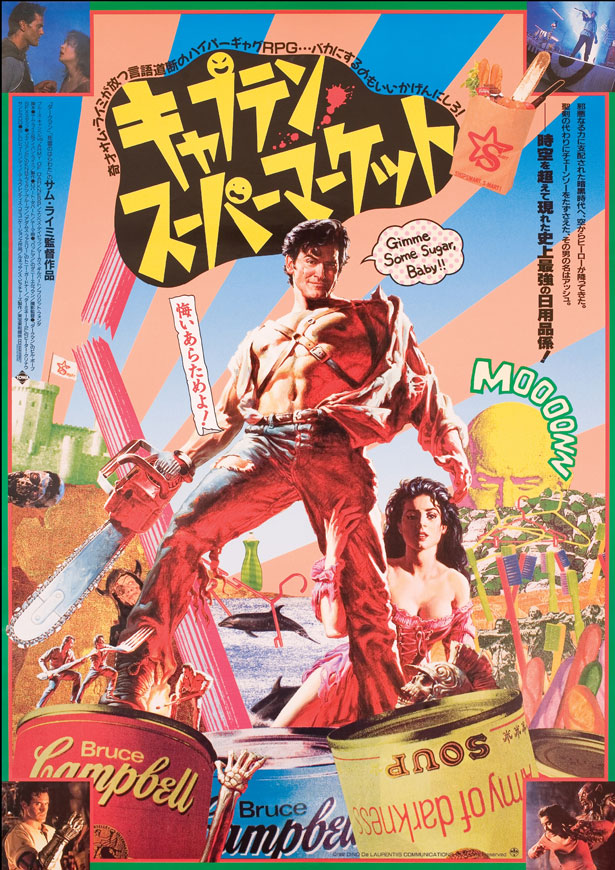
image courtesy: the boston phoenix
The Evil Dead is perhaps the scariest of the trilogy that made Sam Raimi famous, even though it is not without touches of humour and moments where you wonder if you're supposed to laugh or scream (or, perhaps, both). The presence of footage from the film in Donnie Darko (which I caught again recently) might well count as a repeat viewing.

The Evil Dead II was a little more overt about its debt to The Three Stooges while still heaping up gore and comic horror. Issues with rights prevented this sequel from using footage from the original and it consequently ended up starting off as what looked like a re-interpretation of the events in the first film. The first time I saw it, the scene that lingered was the light bulb filling up with blood before inevitably exploding and splattering the basement. The second time I saw it, the wonderfully ingenious twist in the sequence when the force chases Ash into the house won. That scene merited an instant rewind.

Surprisingly, I ended up watching Army Of Darkness rather late (last year, to be precise). The verbal essence of this film and the two films that preceded it was already familiar thanks to heavy use of lines in Duke Nukem 3D, an old favourite on the PC. The film continues to riff on The Three Stooges, but its props betray a debt to Jason And The Argonauts and The Seventh Voyage Of Sinbad, both featuring the classic stop-motion animation of Ray Harryhausen. Besides boasting the hilarious appearance of Evil Ash, the film itself proved to continue to showcase ingenious approaches to low-budget filmmaking: my favourite would have to be that they used women (dancers, especially) for the skeletons, because they had a more amenable body frame. Consider that a skewed example of forced perspective if you like. One must not forget Sam Raimi's multiple cameos.

But all this is really an excuse to show off the cool poster, which is one of several showcased in a book called Translating Hollywood: The World of Movie Posters that contains several samples of international posters for Hollywood movies. The use of Campbell soup cans is priceless.

Friday, August 01, 2008

balaji's angel

Celina Jaitley, who will always be known for the remarkable method acting employed in faking it at playing a violin in a bikini, has finally answered her true calling by appearing in her first item number. Who better to showcase her talents that the grocer of serial saponification, Ekta Kapoor. The film, which, as mandated by the Kapoor Klan Kasting Klause stars little brother Tus[s]har K, is called C Kkompany (why not just K Kkompany? creativity, perhaps) and revolves around three best friends and a harmless prank, which turns their lives topsy turvy. Sounds like Khel Khel Mein. While Ms. Jaitley attempts to meet or surpass the expectations set by RGV's uninhibited screen kitten Nisha Kothari, we can rest assured that the film's going to be a piece of Krap.

past popcorn-free experiences: breach, exotica

At the end of Breach, I saw it as The Ipcress File stripped of its humour and genre-spoofing, but with an extra helping of the mundaneness of espionage that went by on display in first half. It's a sweeping generalisation, of course. Yet, the calm patient narrative in Billy Ray's film manages to deliver a sense of tension while remaining primarily a drama whose outcome we are aware of simply because the film is based on true events: the arrest of Robert Hanssen, an FBI agent who was a spy for the Soviet Union. Without doubt, the film belongs to Chris Cooper's performance as Robert Hanssen, although our protagonist is Eric O'Neill, an FBI operative working undercover to snag evidence to bring Hanssen in, played by Ryan Philippe, who, despite turning in a competent performance, doesn't quite offer a convincing nemesis for Cooper's Hanssen. Hanssen was an interesting character (a devoted religious family man with a penchant for making amateur porn films and selling his nation's secrets to the enemy) and Cooper's performance draws you in. It, however, isn't enough for a film that is perhaps a tad too restrained, a mite too under-stated and rather "under-exciting." Cooper's performance offers a compelling reason to watch the film but also sets it a really tall order to live up to.

Atom Egoyan's Exotica uses a nightclub as a focal point in a film about characters very different and uniquely strange and yet very believable. Aided by strong performances and a wonderful sense of design, Egoyan uses a non-linear odyssey into a world of intimacy, aloofness, desire (or the lack thereof) and cold business. Mychael Danna's tapestry of Middle Eastern and Asian influences lends the film an appropriate aural texture as do the songs (listen carefully and you'll hear tumhe.n yaad karate karate). Lives and hearts seek ways to communicate in a claustrophobic world that encompasses the restricted carnal pleasures in the densely atmospheric strip club that gives the film its name and the cramped bustle of the exotic pet shop whose owner smuggles rare bird eggs into the country. There's no way I can forget Leonard Cohen's voice singing Everybody Knows after this.

Sunday, July 27, 2008

vacancy

When their car breaks down on a lonely road, a couple on the verge of a divorce finds a room in a motel from hell. That brief does gross injustice to Nimród Antal's Hollywood début Vacancy. The wonderful opening and closing credits echo the work of the legendary Saul Bass, whose credits include the titles for Hitchcock's Pyscho, the film that established the evil motel as a classic trope.

Despite being faced with making a genre piece that treads familiar ground, Antal chooses to tackle the material with intelligence, patience and respect. Frames are imbued with a sense of dread, no thanks in part to Andrzej Sekula's cinematography and Paul Haslinger's score. The aspect of selling terror and fear exists not only in the film's genre but also in its disturbing sub-plot involving a snuff film ring. Antal stays away from stuffing the film with standard elements of shocking gore and flash-cut torture porn; he instead allows our minds to make the scary moments even more frightening. The characters that pepper the film, including our leads, exist instead of merely showing up as familiar props. The film's end offers another surprise for those used to having their terror flicks topped with a twist ending, a sequel-friendly switcheroo or a segue into expository calm. It only comes as fine dessert for a fine main course. This is a film that respects its genre and its audience and that's saying a lot in the present climate of Saw and Hostel wannabes.
PS: In its infinite wisdom, Hollywood has found a way to feed a franchise. A sequel, written by Mark L. Smith, the writer of this film, is in the works. It's direct-to-DVD, though.

Sunday, July 20, 2008

short notes for reelers from the past

Ahista Ahista: Shivam Nair's directorial début boasts Imtiaz Ali's second writing credit and a return of Abhay Deol to play a character penned by Ali. Shivam Nair unfortunately can't do what Ali did with Socha Na Tha. Deol's character, Ankush, is a witness-for-hire outside marriage bureaus (which reminds me of Shashi Kapoor and Amitabh Bachchan playing courtroom witnesses-for-hire in Immaan Dharam). The premise is sound and promising, but the film sports the song-and-dance breaks that destroy any hope for a sober narrative. Soha Ali Khan doesn't quite master her interpretation of Megha Joshi, something that can't escape your attention given that the film sports sequences where the camera lingers on her. The background score is obtrusive and bland, laced with irritating persistent motifs. The pace (no pun intended) is another problem. The problems of speed are nowhere evident than when the end credits begin to roll. We hit the FF button on the remote to speed things up only to find that this only made the film play in normal speed! So much for a title being such a big hint about what was in store.

Sleepaway Camp: [warning: spoilers] This cult classic from the 80s rode on the wave of the success of slasher flicks at the time, in particular the Friday the 13th canon. Director Robert Hiltzik adopts the summer camp device made famous in Sean S. Cunningham's film; he also proves deliciously creative with the deaths (the chef at the camp is viciously scalded by the contents of an overturned cooking vat, a kidtaking a dump dies after the mystery figure tosses a bee hive into the cubicle, a face of a victim is smothered by a pillow while the body is squeezed between the bed and the wall) along with a shower killing that by existence alone is a nod to Psycho. Hiltzik's face is loaded with clichés (kids mouthing obscenities; bullies getting their comeuppance) and bad acting, but has a strong pumping campy heart. The film's claim to fame, however, lies in its "gender-bending" twisted twist (you heard that right) that also takes care of another not uncommon device in films about serial killers -- gender confusion as a motivation for the killings.

Saturday, July 19, 2008

fracture: homicidal modern


Lt. Robert Nunally: Your wife? Is she OK?
Ted Crawford: I don't think she is. I shot her.

Although packaged as a mystery thriller with twists awaiting the viewer in the final feet, Fracture is clearly a chamber piece for two set against a larger cinematic canvas. Anthony Hopkins plays Ted Crawford, a wealthy structural engineer who kills his adulterous wife and then gets himself exonerated by employing a convoluted scheme. His adversary is Willy Beachum, played by Ryan Gosling fresh from the praise for his performance in Half Nelson. Crawford's profession provides the source for the film's title and dominant idea (everything and everyone has a weak spot). Working like the Rube Goldberg machine seen in the opening credits, Crawford's scheme exploits Willy's over-confident disregard for the case. Hopkins has the charisma to steal the show in scenes set up for the actors to bandy chops; despite this, Gosling holds his own rather well by delivering an unforced interpretation of the ambitious Willy Beachum, who tries to come to terms with being taken for a ride. There is a lot of welcome detail in the film's texture that often assists exposition (the sign in the meeting room noting that there's no time limit for attorney meetings, the various artifacts in the courtroom). The background score by Mychael and Jeff Danna is dramatic and brooding; despite the synthesised elements, it echoes the tropes of film noir (there's even a rather Herrmann-esque motif at an early moment in the film), offering a complement of tension to the on-screen proceedings. The narrative and the performances make for a reasonably engaging viewing experience, although things might seem a bit too relaxed (or boring, as the case may be) for people who're used to their thrillers served up with more action and edited by Edward Scissorhands. And yes, everyone in this universe seems to use a Mac.

Friday, July 18, 2008

things we said today

A post on Salman Khan's blog about marriage contains a nugget that writers of Bollywood comedies[sic] might like to use:


... the oldest popular statement is that 'Shaadi ka ladoo jo khaye who bhi pachtaye aur joh na khaye who bhi pachtaye'. I don't like sweets so it doesn't concern me.

Amogh points me to the second nugget, a reminder of the tragicomic state of Indian politics:


Earlier in the day, BJP leader Venkaiah Naidu presented to the media independent MP from Amroha in Uttar Pradesh Harish Nagpal, who has decided to oppose the government and vote against it. Mr. Nagpal said: "I have not read the documents related to the nuclear deal and I do not understand the issues. But I am against the deal."

And here's where the title of this post came from.

Sunday, July 13, 2008

misspelled assault at the marquee

While one flick with an overzealous moniker is set to hit the stands, the whatabouts of He Who Recently Decided To Chuck His Cap promise more mayhem at the marquee and in primary schools where spelling is taught with great difficulty. First up is A Love Iiiisshtory, a pronunciation guide for which will (no doubt) be handed out to every patron during the premiere. The spelling differs from the last time this flick was mentioned hereabouts. The correct number of Is (2, 3, 4, more?) will also be revealed. It would be quite tragic if the ordinal magic was not configured correctly. The Supposed Singer Of Sufi ("I have realised that comedy is my forte") marks another first in this film by doing stunts (not to be confused with the frenetic facial jerks in his videos).

Cooking elsewhere is another flick directed by Satish Kaushik. A creative partnership seems to be burgeoning between the director of such tongue-twisters as Hum Aapke Dil Mein Rehte Hain (translated: I dwell in your heart) and Hamara Dil Aapke Paas Hai (translated: my heart is with you ya) and the hirsute nasalite who popularised snot-free sa.ngiit. The film's called Hhey Gujju! (a tribute to the typographical horrors of Sajid Khan's Heyy Babby) and features The Walking Sneeze in a double role. Two for the price of one. Very very saaruu. One of the nostrils is a Gujarati bhaaii from Rajkot named Karsanlal Trikamlal Gandhi, who lives in Chandni Chowk, New Delhi; the other nostril is a non-resident Indian casanova (clearly) named Akash Patel. Ardent listeners of Tishoo Tunes can expect a lot of Gujarati folk fusion music. Quentin Tarantino was criticised for the racial epithets (especially the N-word) that he peppered his films with, while it was fine for African-American filmmakers to bandy the word around. He Who Is From Gujarat should thus have no problems with the title of the film. Yet, one never knows. Singh Is Kinng (ugh, SI[C]K!) had to negotiate some tricky Sikh waters. Satish Kaushik's reelfest might not have it all fine and Daa.nDiyaa.

The fresh lassie roped in is Lakshmi Rai (chosen because of her Punjabi looks), who's already made a name for herself in South Indian cinema. As a parting note, here's the song Can You Feel My Love featuring the said lassie in a flick called Kanchanamala Cable TV.

Saturday, July 12, 2008

one N to ruin them all

one N to find them, one N to bring them all and in the darkness blind them (John Ronald Reuel Tolkien about the inane misspelled title of the newest offering from Akshay Kumar and Vipul Amritlal Shah ... wishful thinking)

Akshay Kumar is slated to be the next Tom Cruise. Even in the garb of a Sikh, complete with the Bollywoodian flourish of a fluorescent lime turban he remains Akshay Kumar in every epileptic gesticulation, in each frenzied flail, in all conversations in abandoned forms of sign language that pass off as dance. One contends that even when he plays a priest wearing a Surf-white cassock, a purple epitrachelion and a flaming red belt in a movie purportedly titled "John Is Donne." He will remain eluctably Akshay Kumar. One M only. The extra N is, as you may have guessed O victims of word abuse, a numerological safeguard. VAS puts it thus: As a Producer I have my film's interest to caretake. We need success at any cost. My view has always been that whatever can be done to better the vibes of the film or add to the 'luck' factor should be done. So simply, the extra N is only to bring it numerologically to an auspicious number. What that auspicious number is, we'll never know. It probably becomes inauspicious, if revealed. Count your blessings. This film will probably add Sikhs to the list of objects that can be mocked.

ranbir steiger?

After having scored big at the box office by milking the economic potential of nostalgia in Veer-Zaara , the purveyor of DVD detritus, Yash Raj Films, is back with another pair of hands eager to squeeze the udders of the cow of fond filmy memories with Bachna Ae Haseeno, starring Ranbir Kapoor, the owner of the famous fundament in Saawariya as the only male corner in a square along with Deepika not the TV Shanti Padukone, Bipasha Dhoom 2 Doppelgänger Basu and Minissha "Hipster" Lamba. Teen Deviyan it ain't. The title doesn't merely hark back to the Pancham classic. You are also reminded that the film starred the Daddy-O of young Marcello. That track gets dressed up with Sumit Kumar in a duet with his late father's voice and Vishal Dadlani rapping effortlessly to boot. Unforgettable.

Although the plot of such an enterprise is purely a matter of procedure and decorum , one wonders if, by some eerie surreal quirk of creative fate, this film could have been based on a 1968 Rod Steiger starrer No Way To Treat A Lady. That flick was a dark comic thriller and filching it would surely mark a little leap for Bollywood. Alas, one predicts numerous shots designed to make the guys drool and the girls sigh, more examples of bullet vision abuse and cutting that would make you wonder if the editor was fighting a losing battle against incontinence. The film's title lends itself to an initialism that summarises this wistful whine of a post. Humbug.

Tuesday, July 08, 2008

the tashan of the Christ

image courtesy: Entertainment.OneIndia
Rajnikanth, Kamal to attempt a Ben Hur! screams the hyperbolic headline of a blurb at Rediff.com. What follows is a note that the recently ravan-ous Kamal Haasan and the raato.n kaa raajaa (not to be confused with that Dheeraj Kumar "classic") aka the CAD (Computer-Assisted Do-gooder) are all set to appear together in a film based on the life of St Thomas, the apostle of Jesus Christ. The report notes that the film's going to derive its approach from films like The Ten Commandments and Ben-Hur (hence, dear reader, the big leap of faith to the headline).

Kamal Haasan's barbigerous claim to playing the Saviour is backed by the possibility that Rajnikanth can play the doubting disciple and say tum ##Jesus## nahii.n ho sakate!. To which Kamal saar could respond with his patent-pending grimace (the resigned acceptance of yet another familiar calamitous happening -- one could imagine Atlas when presented with another world to shoulder right after having famously shrugged).

Then again, perhaps it is best for the superstar to sport the stigmata, don the flowing robes, grow a silvery beard, convert familiar Tamil-Fu moves into divine gestures (minus the juggling acts with the cigarette -- no smoking please, we're saints). He's already played the title role in Bhagwan Dada. He could also offer an interesting interpretation of the infamous Einstein/Bohr exchange (Einstein: God does not play dice; Bohr: Don't tell God what to do!). Besides, if Rajnikanth, who can?

Sunday, July 06, 2008

tragicriticatastrophe

The Village Voice is carrying a review of the latest collection of reels to bear the name of Kunal Kohli as director, Thoda Pyaar Thoda Magic. This in itself isn't shocking/alarming/heartening (depends on how you want to look at it); journalists and film writers in various rags have been carrying capsules dedicated to the big Bollywood releases in major cities in the USA (The New York Times is an example of one such bearer of said reviews). Unfortunately, these journos (barring people like Anupama Chopra) don't strike me as the kind of people who've had enough exposure to Bollywood. As a passing curio, Bollywood flicks work fine: the surreal mix of non sequitur song and dance sequences, high melodrama (nothing mellow about it mate), tacky costumes, misplaced technique and the world's most convenient coincidences would have made Buñuel proud had it been an created with the intent of being surreal). And if you're a PIO living in the USA, chances are that the flicks you'll catch, if at all, are the big banner releases with big names, the flicks that seem to promise some profits to the local distributors.

So unless you're really following Bollywood films in totality and finding ways to fill the gaps for the smaller films (or, for that matter, for the other big flicks that didn't make the cut abroad), you're likely to really off down the wrong road as far as reading the Bollywood flicks you watch, especially when you attempt to evaluate them in the context of Bollywood (I really have no problems with you going Lacan on the films or comparing them to oeuvres you're more familiar with). The aforementioned review seems guilty enough, given fragments like the following:


Yes, the film is glossy and colorful, and yes it features a dancing velociraptor, but Kohli’s film stands out from the glittering Bollywood oeuvre for its refusal to capitalize on America’s caste-fascination and its conspicuous paucity of glitzy song-and-dance numbers.

Promos for Bollywood flicks continue to focus only on the songs. Be it a murder mystery, a romantic comedy, an intense drama about communal tensions or an action spectacular, you're going to get the same bland overexposed dissolve-montage of frames featuring people in costumes and poses. The promos for Kohli's flick (some of which feature that velociraptor -- a poorly animated creature too) are enough evidence that there's no paucity.


Instead, the bulk of the movie consists of inscrutable character psychology in (dis)service of a messy plot, all layered with a less-than-subtle comic critique of American cultural dominance.
[...]
Kohli is clearly jostling for a slot as a serious filmmaker—eschewing airier Bollywood themes for (often implausible) knotty emotional entanglements[...]

Sigh. Are we talking about the same movie here? Is this the movie featuring that shot of Rani Mukherjee riding a bicycle looking like Medusa after an appointment at the beauty clinic or are we talking about a special version released only for journalists? Serious filmmaker my fundament! airier Bollywood themes? Is that a euphemism for hot air and ballast? I wouldn't know. I'm not on the same wavelength here. Very very tragic.

PS: That title's not exactly Supercalifragilisticexpialidocious, but you get the idea.

Saturday, July 05, 2008

ek ajnabee: a boring stranger on fire

[thoughts on Tony Scott's Man On Fire and Apoorva Lakhia's uncredited reworking of the film, Ek Ajnabee (rants dedicated to that may be found here and here and there's something dedicated to Taran Adarsh's egregious reviewing habits as well)]

Reportedly, when Brian Helgeland was in a video store, Quentin Tarantino, who was working there, recommended the 1987 adaptation of Quinnell's novel Man On Fire. Seventeen years later, Helgeland's adaptation made it to theatres as a Tony Scott vehicle. One almost wonders if Apoorva Lakhia went through a Helgeland-like experience himself before he decided to execute a false shuffle with the elements of the film and script his "original" follow-up to the uncertified cure for insomnia named Mumbai Se Aaya Mera Dost.

Tony Scott’s version, despite being a serviceable action thriller, also finds the director out of control with his technique. The dynamic camera, kinetic style and greedy editing cartwheel into overdrive in an explosion of jump cuts, pan, sweeps and jitters soaked in a diseased veneer that augments the feeling of a bad trip. The script and the performances bolster the latent themes of retribution and redemption (which, with the American Joe sweeping in the aid of the Mexicans, fuel a right-winger’s wet dream), but Scott’s style constantly draws attention to itself and nearly destroys the experience. “Do not be overcome by evil but overcome evil with good” (Romans 12:21) is a quote that comes up in a conversation between John Creasy and Sister Anna; Scott seems to have appropriated it and presented his version (“Do not be overcome by the screenplay but overcome the screenplay with technique”). This is the altar where Sanjay Gupta attends mass.

With the bids rather low on Scott’s original, Lakhia, it would seem, had an easier task before him. All he really had to do was translate things to a suitable milieu, make things believable in the desii universe and, with a few competent performances, he’d have a reasonable copy that bore only a whiff of kerosene. Alas, Mr. Lakhia had bigger fish to fry in castor oil.

He cooks up a script with dialogues laced with cuss words destined to be bleeped in all releases. These include the F-word, anatomical slang and an offensive term owing its origins to the female of the canine species. Since the Big B has been game for all sorts of new age on-screen excursions, he gets to drink Starbucks coffee, mouth some of these in addition to the familiar set of pronouncements that kept dialogue writers busy and paid in Bollywood for decades (बुरे वालों को सज़ा देना ऊपरवाले का काम है और ऊपरवाले तक पहुंचाना मेरा काम है). Perizaad Zorabian stands in for Radha Mitchell, Arjun Rampal for Christopher Walken and Rucha Vaidya, who was last seen standing in for Dakota Fanning in the I Am Sam ripoff Main Aisa Hi Hoon (translated: I Am Like This Only), stands in for her again.

A character that seems to have received a lot more attention in the writing and the making is that of Wong played by Raj Zutshi. He has a ball with the makeup and some choice lines. In 1972, Anand Babu (Rajesh Khanna) repeatedly voiced his hatred for tears in Amar Prem; here Wong expresses his hatred for crowds. He also gets a mouthful of non sequiturs to spit out: a coward born is a coward dead; कमजोर लोग मुझे बचपन से ही पसंद नहीं ; life's a b*tch. It's a pity the film's about someone else.

The songs and background score from Amar Mohile along with the title track from Vishal-Shekhar emerge as the only interesting fruit in this catastrophic cultivation. In addition to Lara Dutta's cameo at the end, we also get yet another one from Abhishek Bachchan. Another bit of tradition gets its due when Sanjay Dutt shows up in a music video during the end credits. All this doesn't do much to hide Lakhia's conceit best evidenced by the cap that the Big B is wearing in the scene where the family is headed for London. The cap bears the name of Lakhia's last film and serves as a reminder of the kind of misguided self-congratulatory entity we are dealing with.

Friday, July 04, 2008

aggar: a triumph of disaster

The extra 'G' is but one of the things in Aggar, yet another addition in Anant Mahadevan's exploration of the thriller form as a dentist's appointment. Mithoon Sharma's songs offer some relief best sought in aural form, separated from the trite tapestry of images and moments spun to their cadences. The Nose was the original choice for music director and one wishes that he had stayed on to offer more nostrills. The premise seems oddly familiar to things in Asylum, a novel by Patrick McGrath that was adapted to film in 2005; but enough has happened to it to save it from indictment.

What we have is the unholy triangle of a shrink, his wife and his patient played respectively by the talented Shreyas Talpade, the perennially irritated Udita Goswami and the chaetophorous tragic Tusshar Kapoor (two S, two O, where will my career go?). The casting choices alone offer enough hints should you wish to try and crack the narrative twists and save yourself time.

The destruction of promise starts off early. The opening credits are revealed against a background of smoke through blinds-like black bars running outward left to right and right to left. These are intercut with fast-cut shots of the characters. The surprise at seeing something reasonably competent is short-lived as soon as the the main title pops up in a tacky not-quite-haematic red font. We are then treated to a host of tropes that are permanent fixtures in the quivers of incompetent filmmaking in Bollywood: a languid pace, misconceptions about the purpose of editing and, the most common one of them all, earnest hamming.

This is a world where everyone has a Nokia cellphone, uses only Lenovos and drives white Toyotas. If you look at the call history in Udita Goswami's cellphone, you'll know that this movie is set in December 2006. If you look carefully at the cellphone numbers that figure in the movie, you can also nail the twist before it nails you.

This brings us to what each performer got out of this film. Tusshar gets to dance to a Mithoon ditty with a George Michael poster in the background; he riffs with Shreyas Talpade about windows (the opening/shutting kind not the perpetually crashing kind); he gets to compete with Celina Jaitley's bikini/violin shtick by hamming it on the flute. He even gets to pay tribute to Daler Mehndi by showing up in triple form in ki bin tere. He gets a combination of IPC 305 and 306 (aiding a suicide -- go figure!) tossed at him. Meanwhile, Udita Goswami pronounces vinyls as wii-naails. The two are also the participants in the obligatory fully-clothed sniff-a-thon that passes off as the family-friendly desii steamy sequence. The film also attempts a new record in information hiding by delaying the occasion when we actually find what the name of Udita Goswami's character is. She also ends up notching another record for the film when she spits the F-word, in uncensored fashion, at Tusshar Kapoor (the line, dear reader, is I f*cking hate you!): more proof that the censor board had nodded off in boredom. What of Shreyas Talpade? He gets to mouth bits of deep zen like अब अगर दुनिया को पीठ दिखाओगे, आर्यन, तो दुनिया भी तुम्हें पीठ दिखायेगी (translation: if you turn your back to the world, the world will turn its back to you; alternative translation: if you back the world, the world will back you; how's that for back-to-back alternatives?) and ख़ुदा नहीं बस थोड़ा ख़ुदगर्ज़ हूँ (translation: I ain't God, I'm just a bit selfish; selfish? Fish. Ichthyus. Jesus. But ... that means he's the Son Of God and hence, by definition of the Trinity, God. O Theology!).

Special mention must be made of the annoying character serving up the obligatory comic interludes that should have died several years ago. This character is responsible for groan-inducing utterances like इस route की सभी लाइनें मस्त हैं and जिसे मैं अपना cyrus समझता था वो बाजूवाले का virus निकला.

And what of the subtitles? Rest assured, dear reader. The gems continue to inundate the ticker; whether they are products of a cogent mind playing a joke in glee or outpourings of incompetent putzes on the payroll. Consider as a sample the subtitle "for those who don't believe in court?" which accompanies the line "for those who don't believe in God?" This is either a hint at a subtext about a legal system with its roots in a code of morality motivated by religious beliefs or the result of bad hearing.

It's all about a 200 crore company and a 50 crore insurance policy, but one doubts that anyone really cares. After all, when the end credits roll, the cast is seen dancing in a video for the title song. So much for believable characters.

Monday, June 30, 2008

bollywood title for the moment: Deewana Must Die

I kid you not. That's the name of Guddu Dhanoa's next film. It's got Adhyayan Suman (who recently bounced off the marquee with Haal-e-Dil, the haal of which has most probably speared the dil of all those who had invested in it). Although the smart and studious one has been quoted as saying that he's starring in a sequel to Deewana (which gave Bollywood a star in Smirkinder Stammernath), Dhanoa denies this. He even denies that the film has anything to do with the high school comedy John Tucker Must Die, since his film (a) has a different story and (b) features one leading heroine (only one, saar, no more). Given that one of the most famous nuts in love was a scion of the Montague clan, perhaps this is Dhanoa's attempt at Bollywoodising Romeo Must Die. Time must die until we find out more.

bollywoody

A gentleman going by the name of Anil "Senior" Sharma (such an unfortunate abbreviation) is about to make his directorial d´but with a film called Dil Kabaddi. This ain't the Anil Sharma responsible for Hukumat, Elaan-E-Jung, Farishtey, Tehelka, Gadar or The Hero (Love Story Of A Spy). Now this film about the games of the heart was originally titled Bubblegum. Wookie sense didn't prevail and we got a title that just barely qualifies as a less ambiguous name. Snagging bits from here, there and everywhere


Konkona Sen Sharma and Rahul Bose (who plays a professor) are a couple. Irrfan Khan plays an executive married to Soha Ali Khan; he ain't getting enough and she thinks he ain't romantic enough. Payal Rohatgi plays an aerobics instructor. The film reportedly deals with friends and complexity of marriage while living in a big city.

Now, I smell Husbands and Wives, which might mark a first for Bollywood: I don't think anyone's had the temerity to try and toy with this director's ouevre before. If this observation's not unfounded, we can only rue the waste of acting talent in the flick. Yes, I'm being presumptuous about the quality of the final product, because it'll take Bollywood a long time to get to making the kind of films Mr. Allen makes.

Sunday, June 29, 2008

a few reelers

the ship of evil
30 Days Of Night works as a sombre effective modern-day vampire piece. It's ironic that the comic book miniseries it's based on had started life as a failed pitch for a film. Director David Slade guides the cast through a gory, atmospheric wonderfully lensed narrative that, despite sporting all the familiar elements of the genre, tosses in its share of embellishments. In sharp contrast to Count Dracula and his sirens, the vampires don't have much for looks and speak an argot of their own. This means that there isn't much scope for conversation between the blood-thirsty hordes and the humans fighting for survival. This also means that the vampires are focused cold-blooded killers without table manners; you won't find any tortured soul wearing anguish behind the veneer of the toothed snarl. There's also none of that pop culture awareness and self-referential subtext that breathed life into the Scream series. In fact, the film plays out more as a calm action thriller with the tropes of horror. The opening and closing credits have a life of their own, especially the end credits, which, accompanied by an ominous cue from Brian Reitzell, play out against an epilogue to death comprised of photographs of townspeople viewed through a cascade of shadows and cracked ice.

Owning Mahowny (there's a nice rhythm to that title, especially given the way his name is spelled) is the tale of Dan Mahowny, a boring bank manager who has a gambling addiction (or as he chooses to describe it "a financial problem; a shortfall") and lands up managing a multi-million dollar account. Addiction breeds temptation and soon the bank's money makes it to the casino floor. Based on a true story, the film derives its strength from characters instead of from gambling and the slick glitz associated with it. Philip Seymour Hoffman nails the part yet again, making Mahowny a tragic wretched figure we find ourselves liking, hating and pitying. John Hurt chews with relish on his part as Victor Foss, an Atlantic City casino manager, who recognises Mahowny as a high-roller and also has an appreciation of the inevitable fate of the compulsive gambler: he isn't playing to win; he's playing as long as he can ride from one loss to another, weathering the thrill of a winning streak along the way. We know Mahowny's going to get caught and we share his inability to do anything to prevent it.

The previous cinematic adaptations of Charles Belden's short story The Wax Works have been minor milestones in themselves. The first adaptation directed by Michael Curtiz was the final Warner Bros. film in Technicolor. Its famous 1953 remake starring Vincent Price was the first 3D film from Warner Bros.; the film made it to the Guinness Book of World Records as the first 3D film to be released with a stereophonic soundtrack. The 2005 adaptation sports only the least interesting aspect in the adaptations. Curtiz's film worked as a mystery film while the remake with Vincent Price moved down the horror road. The latest offering from Jaume Collet-Serra takes the easy way out -- it transplants the story into the overpopulated dumb trope that is the slasher flick. It takes the plot element of wax from the original narrative and appropriates elements from The Texas Chain Saw Massacre. Having Paris Hilton on the roster is another hint about the direction this film has decided to take. If you get a bunch of people you don't really care about, a bunch of people who are quite annoying, would you really care if they were dismembered in the most grisly fashion? The use of the Robert Aldrich classic What Ever Happened To Baby Jane? is perhaps the most interesting bit in this mindless by-the-numbers affair; and perhaps reading up about a Bowie knife, after it showed up in the film (with its share of exposition). "On May 6th, watch Paris die" screamed the promotional T-shirt that Paris Hilton wore, with the studio's permission, to promote the film. That summed up the essence of the film (for another example of cinematic notoriety, try Hounddog and the little scream queen Dakota Fanning). On an unrelated note, Elisha Cuthbert looked like a better version of Kirsten Dunst. A little reading-up told me that she had auditioned for the part of Mary Jane Watson in Spider-Man, a part that eventually went to Dunst. It would have been nice to have Dunst show up here instead. That could've given us an artsy title like Waxing Dunst: We'll Always Have Paris. I should stop now, before I explore the jokes about building material.

Friday, June 27, 2008

summer of quintus

While Bill Gates chalks off his last day at work at MSFT today, we mark another year without the baadashaah of the breathtakingly non sequitur musical interludes, the late great Rahul Dev Burman. Ironically, two recent Bollywood movie soundtracks sport a Panchamesque sprinkling or two.

De Taali marks another Vishal-Shekhar excursion into fun and aural adventure what with two versions of the title track (one dance floor-friendly and the other a sprightly crisp version meandering around the edge of an acoustic guitar riff), a blend of club and Rajasthani folk, a curiously arranged equation of self to a drop of rain and a gentle whimsy ballad of love that deliciously tosses in an English phrase as a punch. What stands out in the context of this post is the Anushka Manchanda/Shekhar Ravjiani duet hone lagii. It's playful like the mischievous Asha Bhosle songs the 70s and the rhythm pattern on the acoustic guitar says it all. This isn't an overt tribute like Jhankaar Beats, but it represents Vishal-Shekhar presenting a tribute to the late Pancham that retains a lot of their creative identity.

After the lushly energetic arrangements and strong melodies of Hum Dil De Chuke Sanam, Ismail Darbar has evolved to becoming more famous now for his tiffs, temper and arrogant veneer. This might explain why the mention of Rasiya Sajan might draw a blank stare from a lot of people. One wonders if a similar fate is in store for his soundtrack for a film starring Ajay Devgan, Sanjay Dutt and Manisha Koirala (will this be the (Yeh) Majdhaar of the 21st century?). In a tragic case of irony, this clearly-germinating-in-the-cans celluloid sin shares its name with a standard Bollywood paean to reincarnation in 1976 that sported one of RDB's most famous songs and one of the best songs in Hindi film music based on raag shivara.njinii. One also fears that the songs will be reduced to smithereens once some hideous visuals are cut together to their melodic shifts and percussive cues. This would, ironically, be in keeping with tradition as far as some of RDB's finest compositions is concerned.

Reportedly, Darbar was channelling Laxmikant-Pyarelal in the soundtrack. The mixed bag includes dilarubaa, which stands out as a fine addition to the long list of songs peppering B-grade flicks like Shiva Ka Insaaf or Raat ke Saudagar as it runs Laxmikant-Pyarelal through a Nadeem-Shravan filter (although the end tosses a brass/drums cue that portends Rafi's voice opening o hasiinaa zulfo.nwaalii). kuchh kar lo boasts characteristic traces of Darbar in the refrains while Kwaabo.n kii raanii joins Anu Malik and Bappi Lahiri in stomping on Beethoven's grave as it recycles Für Elise before sending out musical quotes from Jatin-Lalit.

The most obvious blatant traces in the other songs, however, seem to suggest that the inspiration came from the talented Pancham. You can't miss the a-haa quote from chunarii sambhaal gorii in baabuujii. tuu merii mahabuubaa starts off threatening to sound like Ilayaraaja (or perhaps as Anand-Milind recycling the master), but as soon as the rhythm sets in, you know you're in Pancham land with a Jatin-Lalit wisp. That's ab ke saawan (Jaise ko Taisa) or, rather appropriately, a subset of the composite rhythm of mahabuubaa (Sholay). This brings us to achchhaa to mai.n chalataa huu.N, which is rich with slices from the master. Who would have known that it would take one flick destined to be DOA to revive a song from a flick long forgotten from years ago featuring the one and only Mithun Chakraborty in a double role? The similarity to merii aawaaz ke dosto.n from Aamne Samne is unmissable, although the rest of the mukha.Daa devolves into what sounds like the heavy punchy beat-backed bulk of The Nose's ouevre. It's a song that would fit well in a B-flick although the brass and the heavy vocal sighs bring back memories of Monica and her unnamed man cavorting to piyaa tuu ab to aajaa from Caravan.

Sunday, June 22, 2008

nishabd: loud nothingness

As he works with a script that exposes a premise of promise, but fails to deliver much of interest, RGV also seems to have failed to make up his mind on how he wanted to shoot the film. Nishabd finds the maverick director in conflict, a conflict deeper and more perplexing than the one his protagonist is confronted with. The sound mix of RGV's recent films has been troubling: the background score often drowns out the dialogue in the scene (at times, the laser subtitles from adlabs were the only hint that you've missed something). Amar Mohile's background score employs an unsubtle catchy thundering motif and adds to the ills of the film (had the mix been right, it might have been less inadequate). This means that you note riffs that sound like Khaled's "Didi" or ishq hotaa nahii.n (from Jogger's Park, a film, ironically, about a man in a similar predicament).

Jiah Khan makes a confident bold début and the Big B, Revathy and Nasser throw in sincere performances that save the film from being a complete disaster. RGV has been a man more of the visual than of the spoken word, which means that ineffectual dialogue stands out even more annoyingly in his ouevre. The film works well in the quiet calm retrospective sequences where the Big B's character (named "Vijay" as a strange tip of the hat to the angry young man, who would hardly ended up as this Vijay) reminisces. The other bits that might have offered more promise are the sequences where no one says anything and everything is done with framing and expressions with the director making the audience a voyeur as guilty as (and perhaps even more than) Vijay. But that would have been a different film more faithful to the title and, one wagers, a more interesting film for RGV to have delivered.

But it's the camera that does the most damage. The tilted angles, the frenetic short-lived shots, the swooping descents and ascents make the beautiful Munnar often seem like a Lynchian suburb hiding a dark secret and also makes you wonder if this film was set up as a gangster film or a more intimate exercise in human emotion and social norm.

It's also a pity that Vishal Bharadwaj's rozaanaa is nowhere to be found in the flick (not even in the end credits). With a blend of U2 and Dire Straits, Vishal had exploited the most famous baritone in Bollywood to trace an ambitious melody of highs and lows along with the dangling whispery strands of dissonance that are on their way to becoming a trademark of this talented composer; Munna Dhiman's lyrics managed to make the most of simplicity while exploring the feelings of the old Vijay in a manner that eluded the film the song was made for.

Saturday, June 21, 2008

saridon

A recent viewing of Billa starring Ajith -- a viewing that was as punctuated with fits and jerks as the film's style -- prompted another pause to ponder the legacy of Chandra Barot's film as well as the remakes in Ajith's filmography.

When I heard about the remake starring Ajith, I first wondered if Ajith was setting up a stack of remakes in a manner similar to Anil Kapoor in the 80s and 90s. Ajith had figured in Kireedam, a remake of the Sibi Malayil film that had already spawn its share of remakes. Billa was slated to be a remake of the Rajnikant hit, itself a remake of Chandra Barot's Bollywood classic from 1978.

Ajith's Billa was slated to be a stylistic cousin of Farhan Akhtar's 2006 remake of Barot's film, Don: The Chase Begins Again while still paying its respects to the R. Krishnamurthy adaptation that boasted its own hit title song My Name is Billa (set up as a cousin to मैं हूँ डोंन with Rajnikanth on a dolly approaching the camera with the main line).

Farhan Akhtar's remake had a technical competence and consistency that other big-budget Bollywood actioners and entertainers in their imitative exploration of every technique seen in Hollywood blockbusters had never attained. Since Tamil cinema has often boasted examples peppered with technical excellence, I had wondered if the 2007 edition of Billa would offer something better. Unfortunately, despite being marred by Shah Rukh Khan's inability to imbue the part with more menace, Farhan Akhtar's won by light years. The Ajith film, despite boasting a punchy dance floor-friendly reworking of the title song, resembled an average entertainer laced with technique employed with the same clueless abandon as in Bollytrash. Ajith's Don spent most of the film doing one of three things: walking, talking and killing. With all the walking he did, the filmmakers might have done well to add the texture of public transit and given us a Don who enjoyed his relative anonymity (something you find hard to digest given the overblown unsubtle execution of each thrill) by mingling with the crowd. But that might have been a lot less exciting than featuring Malaysia (yet again), a plump starlet offering daylight Ramsay Brothers delights with her beach dance, blood-letting with a katana and crushed soda cans starring in experiments in movie physics. The language divide notwithstanding, the Tamil remake only tossed more points over to Farhan Akhtar's side of the net.

Friday, June 13, 2008

effect without cause

We were watching Donnie Darko the other night. It was the second time for me, but this time around Seth Rogen was a more well-known face. When the movie was done, a conversation ensued about Maggie Gyllenhaal and what other films she had been in (especially films we had seen). A short movie sequence flashed through my mind: Maggie Gyllenhaal wearing an apron baking cakes. My friend, mysteriously enough, had the same flash. We then started piecing bits of memory together until we saw (in our mind's eyes) the protagonist of the film ... Will Ferrell. The film was Stranger Than Fiction, a film we'd seen over a year ago.

I had also forgotten about the wonderful soundtrack accompanying the film: the Mad World cover has since acquired even more fame thanks to having featured in the commercial for Gears of War; and the other song that was going to stay in my head for a while was The Killing Moon by Echo and the Bunnymen.

A day later, I turned to page 79 in Vikram Chandra's Red Earth and Pouring Rain and the page began with


beers and talked about Lawrence. The one in the movie, I mean, not the real one. The music suddenly got louder, and it was Echo and the Bunnymen doing "The Cutter"

Spooky. But they have a word for it: synchronicity. I can live with that. The chapter was titled "A Thin Kind of Happiness"; perhaps noticing something like this offers a stab at that.

update: That was Saturday, June 07, 2008. A week later, I'm in the library dropping off some DVDs and picking up a couple on hold for me. I scan the shelves dedicated to new books. I spot a familiar name: Richard Matheson. It's a collection called Button, Button. The little bit "a new introduction by Matheson himself" on the back cover and the simple page inside listing the old copyrights for the individual stories along with information about their renewal are the only indicators of this being a recycled collection. The reason is clear for all to see on the front cover: "features Button, Button, soon to be a major motion picture The Box starring Cameron Diaz"; it's also part of the block on the back cover, just in case you missed it. A few minutes later, I'm sitting in Caribou Coffee sipping on a caramel cooler and exercising their free WiFi to find out more about The Box. The film's wikipedia page tells me that it's been adapted for the screen and directed by Richard Kelly. Whoa! Kelly directed Donnie Darko. I think it might be time to scream.

Thursday, June 12, 2008

bas ek pal: a Shakespearean tragedy of domestic proportions

My experience watching this film benefited immensely from my not knowing too much about the film's plot besides the premise; if you think you'll be better off not knowing more as well, you have to walk away from what follows; key plot points are revealed in the course of this post

In My Brother Nikhil, Nikhil Kapoor was the subject of several flashbacks triggered by various characters talking to the camera standing in for an unseen interviewer. Nikhil Kapoor is dead when the film begins, and we only see the last few years of his life through flashbacks. Just like Charles Foster Kane. In Bas Ek Pal, Nikhil Kapoor fares marginally better: he still plays our ill-fated protagonist but we share his time of existence in the narrative. The nominal dead ringer isn't the only element that returns from Onir's first film. Sanjay Suri plays Nikhil in both films. Juhi Chawla, who played his elder sister in the first film, returns here as a character who might well have been his elder sister, given the allowance of a few plot points. She was Anamika in My Brother Nikhil, but here plays a former Miss India (art imitates life). She cedes the name to Urmila Matondkar in this film (There's a nice play on the name when she refuses to tell Nikhil her name).

The geographical heart of the film is a club called Anti-Clock, a name that means a lot in the film, for what transpires one night at the club sends ripples through the futures of a handful of lives: If only they could turn the clock back three years (2003, when a series of unfortunate events was set into motion) from the present (2006).

Onir ropes in a few more people into his drama of people doomed by fate, indecision and choices. We have more characters vying for our attention here and almost all of them get the requisite brush of grey; it's a pity, however, that Rehan Engineer's Steve gets very little screen time: he's more spoken of than seen and even though his character's arc plays out satisfactorily, I wouldn't have minded a little more insight into his life, something that added to the sum of the parts we gathered from conversations about him and the few scenes he has in the film. Every character is in search of love, and the search is confounded by ambition and indecision. Those driven enough to seek what they want seem destined to meet with failure just as those who can't muster the courage to take the big leap. Emasculation (jail time, being crippled in a wheelchair unable to consummate a relationship or surviving the death of a child, afflicted by drink and an aggressive sense of inferiority) meets confusion, thwarted goodwill and unfulfilled love. At one point in the film, a character tosses the line itane taras ke saath jiinaa mushakil ho jaayegaa to another; later on in the film another character tosses this character a line that's an echo and yet a distant cousin: itanii saarii nafrat lekar jiinaa mushkil ho jaayegaa. When the end credits roll, we are left with victims of Shakespearean tragedy and noir-ish doom.

Onir and writer/editor Irene Dhar Malik have gone to great lengths to imbue the characters with the complexity of real life. Nikhil's single-minded desire for Anamika, Anamika's uncertainty of her feelings of love tinged with pity and guilt, Rahul's guilt-driven existence compounded with the prospect of living the rest of his life in a wheelchair, Steve's helpless frustration manifesting in a violent irascible self that hurts those close to him.

In addition to the competent performances and the unyielding patient pace of the film, Onir tosses in small flourishes -- like the fish tank that's a rather obvious motif or the thukpa that Steve is cooking for dinner (clearly an artefact from Onir's years in Bhutan). One would also be amiss if one didn't note the wonderful work Onir elicits once again from the talented underused Vivek Phillip, in addition to a bonus song from Pritam and another from Mithoon Sharma (who has since gone on to more success). The songs remain mostly in the background, either in the diegesis (hai ishk ye kyaa (aa zaraa) is introduced in Anti-Clock as a song spun by the DJ with a prefatory "KK and Sunidhi rock 2003," tere pyaar me.n (bas ek pal) also ends up being a song in the club on Valentine's Day and zi.ndagii hosh me.n plays at another club) or in the narrative texture of the film (ashk bhii, dhiime dhiime) with tere bin bouncing from the background into the foreground to complement a tapestry of images in Nikhil's imagination.

There are moments when you wince at the occasional departures from the sobriety of the piece: Jimmy Shergill at Marine Drive (during dhiime dhiime, the video of which seems to violate the point-of-view of the person whose flashback it's placed within), the rather overtly showy framing for the scene between Ira and Rahul (bahut der se aaye tum merii zi.ndagii me.n). These quibbles aside, Onir's churned out a worthy successor to My Brother Nikhil.

Between the time I saw the film and actually managed to clean up a collection of thoughts about it, I had hoped to catch Pedro Almodóvar's Carne Trémula, a loose adaptation of Ruth Rendell's Live Flesh that is said to have been the "inspiration" for this film. Unfortunately, that has not happened. One hopes that the similarities are not damning enough to reduce all the praise above to dust.

Sunday, June 08, 2008

1408

Mikael Häfström (whose Derailed came up in an old post hereabouts) manages to imbue his adaptation of Stephen King's short story with enough atmosphere and to mark a minor miracle in the canon of King adaptations. While it offers no threat to Frank Darabont's leisurely undulating approach, the film makes a worthy addition to the horror genre by deftly building a competent atmosphere of dread and taking its time doing so.

John Cusack plays Mike Enslin, a skeptical writer debunking the paranormal, imbuing the character with a genuine credibility. The elements are familiar tropes of horror, and specifically of the he-who-scoffs-at-the-haunted-house-has-it-coming subset of stories. Despite his sarcastic asides and dry wit, Enslin's a tragic figure dealing with the death of his daughter and a separation from his wife (a trait shared by several characters in King's fiction). The film takes its time setting things up for us as Enslin makes his way into room 1408 of the Dolphin Hotel (despite the fervent pleas of hotel manager Gerald Olin played by Samuel L. Jackson). There's great restraint in the narrative as the screw begins to turn and the inevitable unfolds, backed by the inspired use of We've Only Just Begun by The Carpenters. Right until the end, the film refuses to yield to the temptation of devolving into a mess of flash cuts, moments of quick shock and cheap thrills. This doesn't threaten the rich curve of Kubrick's adaptation of The Shining, but has no need to fear joining the ranks of Maximum Overdrive. It's an evil f*cking room, said Gerald Olin and you had better believe it.

Friday, June 06, 2008

how to name it

The IIT JEE topper this year, we are told, might aim for MIT (that's this one not that one), although his first stop is IIT, Kanpur. Shitikanth might need to do something about his name though; in the world of nicknames and streaks of offense and score, his name's ripe fodder.

Wednesday, June 04, 2008

to bard or not to bard

Rumours offered two possible works as sources for Vishal's next edition in his adaptation of the Bard's works, King Lear and Julius Caesar. Yet, a recent news bit suggests that it might be Hamlet starring none other than Hrithik Roshan. Is it to be or not to be? Ay, there's the rub.

[Cross-posted on the Vishal Bhardwaj blog]

RGV kaa blog

The month began with a note that RGV had also jumped onto the blogging bandwagon. Alas, rgvzoomin.com wasn't wired up when I tried last. JR's uncovered the destination of the main URL. Easily one of the most self-deprecating generators of media copy, RGV fills his posts with honesty, detail and acerbic asides that fans of the man (YT included) will relish and detractors and critics will detest and chastise. Here's a sample showcasing RGV the filmmaker as he answers a question about Bhoot.


In one shot in Bhoot after the car leaves the basement the shot changes with the sound of a dolby click.
That was not a dolby click. It is the igniter sound which Urmila uses on the gas stove. Anyway as long as you felt the impact it does not matter. The psychology of that shot is that the audience would be used to the fact that the shot will be cut after the car left the frame. But the fact that it lingers on automatically puts them into a heightened tension thereby making them anticipate something terrible will happen and that's why even an ordinary click sound will scare them. Similarly one more example of this is when Urmila comes down into the hall to go into the kitchen for a glass of water. In a wide-angle shot I show the audience that there is no one in the living room. If the camera follows behind her they will be half expecting something to jump on her from of the frame. But the fact they can see the whole room their eyes will be darting all over to see if anyone is hiding somewhere. Meanwhile Urmila takes her time to drink water and comes back. As she goes up the stairs I cut to top angle where the audience can see behind her.

Now as the audience can't see anything in the back and from Urmila's expression they can see that there is nothing in the front, they slowly relax as she comes close to the camera into out focus distance thereby expecting the shot to be cut. But as she crosses the camera we reveal Manjeet under the stairs making them jump out of the seat.

But, we must leave you with a flavour of the quintessence of RGV:


How does Sarkar make a living?
He didn't tell me.

Monday, June 02, 2008

mission dew

[dedicated to Sudarshan for making sure I didn't miss this]

Remember a Rajiv Rai dud called Asambhav: The Impossible? Lifting Loser Apoorva Lakhia (Ek Ajnabee, Mumbai Se Aaya Mera Dost) has decided to follow up on the shocking success of Shootout At Lokhandwala (In Which Big B Gives It Those Ones) with what must be a tribute to the inanity of Rai's cinematic dreck. The flick's called Mission Istanbul and is an example of Waiting List Bollycool.

How much can a motley crew comprising Vivek "I knocked off the unlucky vowel" Oberoi, Zayed "Is it Mirinda or Melinda" Khan and Suniel "Too bad to wait tables" Shetty promise? If the trailer's offered as People's Exhibit A, lots. After all, a film that integrates the slogan (डर के आगे जीत है) of a soft drink whose marketing campaign exploited extreme sports and video games can't be that bad, can it? After a relatively quiet 2007, Anu Malik has returned with nothing exciting so far (Anamika), but this title track might buy back some of the lost glory of nashaa nashaa (Aan: Men At Work). Or perhaps, as the title of the TV show and movie franchise that share the initials of this movie suggest, this might not be his day.

Consider now, the lyrics of the title track (imagining the energy of the utterances is left as an exercise to the listener/reader):


it's impossible
bull! it's possible

it's impossible
bull! it's possible

it's impossible
bull! it's possible

it's impossible

BULLSH*T!

miishaan miishaan miishaan
istaa.nbuul

miishaan miishaan miishaan
can you handle it?

ye miishaan nehii.n aasaa.N
ye miishaan iistaanabuul

jaayegii isame.n to jaa.N
ye mishaan istaa.nbul

Don't you just love that play on (istan)bul?

The video features the four leading men beefed up from hours in the gym oozing machismo to back the rocksy pump-it-up throb of the track, dressed in black vests and black pants; they switch between looking like pimps feeling up foreign lissome lassies clad in uniform (or unclad in black lingerie) and swinging in the rain in the aforementioned black outfits (along with, needless to say, more phaarin phlesh).

Lest we forget what the film is really about: Zayed Khan plays a promising journalist, Suniel Shetty, the head of a Turkish news channel, Vivek Oberoi, a Turkish commando and Shabbir Ahluwahlia ... oh! who cares.

This transgressive mix of Zalman King, Jean-Claude Van Damme, Snoop Dogg and Ilsa, She-Wolf Of The SS would've been promising had the rest of the film promised any of the sleaze that the trailer tantalisingly offered. Alas, this is but one more in the long line of films that rely on such tropes that toss all character development, plot and sanity into the nearest exhaust fan to lure Bollywood's faithful ticket-buying audience that is only out for a good time. One wonders why they bother with story or even the ruse of substance. Here's hoping that Apoorva Lakhia draws inspiration from Steven Seagal and Krista Allen and breaks new ground in Bollywood filmmaking.

update [june 11, 2008]: The complete song (written and sung by Hamza Faruqui -- last heard on the soundtrack of Super Star -- and composed by Chirantan Bhatt) features another (rare) example of the F-word on a Bollywood soundtrack: Now it's getting deep with all the secrets that I keep, I'm outta luck ... what the f**k! (a line repeated with carefully placed engineering just so that you don't miss it). The last time I found that colourful kernel of profanity on a song was in Rock Dancer (music by Bappi Lahiri) where Bali Brahmabhatt got to rap I'm like Mickey Mouse / I've come to take down the house / I'm like Donald Duck / I don't give a f**k (Kamal Sadanah does the on-screen honours for the song). Looks like this film's all set to make a mark for itself with one of the oldest tricks in the book -- baiting controversy. Is anyone from the Sena or the BJP tuning in to these songs?

 
Creative Commons License
This work is licensed under a Creative Commons Attribution-NonCommercial-NoDerivs 3.0 Unported License.