Waitress [October 01, 2008]: It's not hard to be reminded of Scorsese's film when watching Keri Russell in a fantastic performance as Jenna Hunterson. The film's trailer was an exceptionally good one (the kind that piques your interest in a film instead of being a showcase of the best bits of a piece of creative guano). It was only several months later that I settled down with the DVD in the player. The film confidently mixes the essence of a chick flick with a compassionate study of characters and humanity laced with broad strokes of whimsy and constant cheer. Unfortunately, the senseless murder of Adrienne Shelly has robbed us of a filmmaker who seemed poised to offer so much more.
Monday, September 14, 2009
reel me this, reel me that
Alice Doesn't Live Here Anymore [October 22, 2006]: From the opening sequence (a bleeding Technicolor 1.33:1 frame within the 1.85:1 frame offering a rather wicked version of Dorothy in Kansas with a tip no doubt to Douglas Sirk as well) to the restrained optimism of the end, this film is a showcase for great performances (led by Ellen Burstyn whose Alice is a fascinating study of the steadfast, determined American woman who hasn't lost her sense of humour) and for Martin Scorsese's enthusiastic mix of a variety of techniques: filters, tracking shots, a nuanced choice of songs on the soundtrack, movie references -- The Postman Always Rings Twice -- and showpiece scenes (my favourite one is Vera's bad day intercut with Alice and Flo talking about Alice's problems). The DVD also has another rarity -- a commentary track featuring Martin Scorsese (it is always a pleasure to hear him fire one exuberant salvo of words after another).
what is dev benegal up to?
(If you've been following Dev Benegal's blog, you already know)
The man who helmed that fine cinematic adaptation of Upamanyu Chatterjee's English, August years ago and the under-sung darkly funny Split Wide Open has been struggling for years to get a DVD of the film out. Despite several posts that promised salvation and some that were quite depressing, a post appeared with a ray of hope. This, of course, comes amid posts dedicated to his new film Road, Movie (that comma seems like a tribute to the Madna movie) starring the ever-adventurous Abhay Deol. There's a teaser for those interested. Those lucky enough to be in attendance at the Toronto International Film Festival on September the 18th are even luckier.
[october 07, 2009]: Another trailer's up -- it's a montage of moments after we get the general idea that our protagonist is out to discover himself. I don't see anything extra being revealed; and I love that background score.
Saturday, September 12, 2009
the successful tamperer
The recent release of Tere Bagair on the YRF Music label marked yet another success for Sanjeev Kohli, the son of the late Madan Mohan, who has made a name for himself as a Lucasian archaeologist. Digging through HMV's cavernous vaults, he unearthed many a rarity (including several not-so-rare elements made "rare" simply thanks to the myopic dullards running the shop) and converted them into compilations for release. These compilations were often marred by the liberties taken with the source material -- musical prologues, interludes and outros were summarily clipped to make way for more songs on a single cassette or CD; faders were twirled arbitrarily to produce a continuous stream of music rendered creatively unsatisfying thanks to being tampered with. The crown jewel of this series of commercial ventures came with the Revival series, where present-day session players and hacks were unleashed on the creative output of acknowledged greats from the Golden and Silver ages of music (don't you love those anachronistic soulless synthesizer motifs?).
all songs composed and recorded by madan mohan during his lifetime
these songs were from shelved films between 1964 and 1972
instruments added in 2009 to enhance the quality of old recordings
I have one serious complaint against the ‘Legends’ series of music compilations. I feel that by adding reverb, the digitized songs on these CDs lost their rich depth of original vocals and acoustic orchestration. They sound hollow!
You are right in your observation. But the reverb effect was added to nullify the hiss and scratchy sounds of old records. That does muffle the sound a bit but the general public seemed to have liked the sound! Perhaps the connoisseurs might feel differently about it.
Now the new album- 'Tere Bagair' (released by Yashraj Music) will present all the ten songs from 'Treasure Unrevealed' in full, extended versions and it will also have five more tracks originally recorded by Madan Mohan. This album will be a treat not only for the fans of Madan Mohan but also for the fans of singers like Lata, Asha, Rafi and Kishore because they will get an opportunity to experience many original Madan Mohan recordings in their favourite singer's voice. Moreover these songs were previously either unreleased or inaccessible. Even those listeners who had already heard 'Treasure revealed' would find many new things in 'Tere Bagair'. The recording quality of the album is excellent since the master tapes have been used to reproduce the songs. In some songs, I have re-recorded the tabla tracks and added some harp sounds but even that is done in such a way that it would perfectly fit in the sound of the 60s, when those songs were originally recorded.
You can't compare 'Tere Bagair' to 'Veer Zaara' because ' Tere Bagair' is an album of out and out Madan Mohan originals whereas in 'Veer Zaara', his tunes were modified to suit the times and also the film's requirements.
There are hints of foul play in the taglines on the cover: a rare treasure ... 15 unreleased songs revived and digitally mastered in 2009. The word revived when Sanjeev Kohli is nearby can mean only one thing. More evidence comes from two places.
The first is this bit of text below the track list:
all songs composed and recorded by madan mohan during his lifetime
these songs were from shelved films between 1964 and 1972
instruments added in 2009 to enhance the quality of old recordings
The second is the credit for additional musicians in the inlay sheets (Incidentally, technical supervisor Victor Dantes was a comrade-in-arms in a similar successful experiment called the "Legends" series).
This is what happens when you have people with insufficient technical chops to pull off a remastering job. One must also credit the purchasing majority that doesn't really care.
An interview with Sanjeev Kohli posted over at PFC contained some revelatory comments from the man himself. Here is what was said on the subject of the reverbs and other confetti added to the tracks:
I have one serious complaint against the ‘Legends’ series of music compilations. I feel that by adding reverb, the digitized songs on these CDs lost their rich depth of original vocals and acoustic orchestration. They sound hollow!
You are right in your observation. But the reverb effect was added to nullify the hiss and scratchy sounds of old records. That does muffle the sound a bit but the general public seemed to have liked the sound! Perhaps the connoisseurs might feel differently about it.
Earlier in the interview, Kohli talks about Tere Bagair (I have taken the liberty of emphasising the portions of interest for you, O patient reader)
Now the new album- 'Tere Bagair' (released by Yashraj Music) will present all the ten songs from 'Treasure Unrevealed' in full, extended versions and it will also have five more tracks originally recorded by Madan Mohan. This album will be a treat not only for the fans of Madan Mohan but also for the fans of singers like Lata, Asha, Rafi and Kishore because they will get an opportunity to experience many original Madan Mohan recordings in their favourite singer's voice. Moreover these songs were previously either unreleased or inaccessible. Even those listeners who had already heard 'Treasure revealed' would find many new things in 'Tere Bagair'. The recording quality of the album is excellent since the master tapes have been used to reproduce the songs. In some songs, I have re-recorded the tabla tracks and added some harp sounds but even that is done in such a way that it would perfectly fit in the sound of the 60s, when those songs were originally recorded.
You can't compare 'Tere Bagair' to 'Veer Zaara' because ' Tere Bagair' is an album of out and out Madan Mohan originals whereas in 'Veer Zaara', his tunes were modified to suit the times and also the film's requirements.
This, ladies and gentlemen, is a man of commerce talking.
stereotypes on the streets of Pune
(being an unpolished draft from a visit back home several months ago)
There is a reason Pune roads are never going to get better no matter how many flyovers you build, no matter how many streets you convert to one-way traps, no matter how many regulations you prescribe on termite-eaten papers of law, no matter how much you try to subvert the laws of physics with the power of unenforced law. That reason, dear hapless smoke-ingesting, Brownian reader is the rich and variegated set of stereotypes of riders and commuters unleashed on the streets of Pune. This helpless spectator presents a few.
The Light Brigade: Even if Tennyson's poem loses its impact because people no longer cared about the Crimean war, it would survive thanks to finding another image in the real world –- this is the critical mass revving up near a traffic signal awaiting the change from red to green desperately like the incontinent in search of a ceramic throne. Even before the chromatic switch, a deluge of multimodal impatience sweeps the intersection and intersecting streets. It's the chariot race from Ben Hur duplicated across space and time.
Neo wannabes in the Metropolitan Matrix: You're familiar with the commuters who behave as if they had received an internal memo saying they were Neo Anderson and that they were the One. Assuming all surrounding traffic to represent the Matrix, these people waltz across crowded intersections (causing even graver deadlocks), shimmy through cracks between cars, along invisible tracks connecting the front wheel of a scooter to the rear wheel of a motorcycle making a game of snakes and ladders look like an exercise in drawing perfectly straight lines.
Friday, September 11, 2009
reel notes from long ago
(Being another little collection of thoughts about films viewed months and years ago)
tejas (akshay kapoor): क्या हम थोड़ी देर रुक सकते हैं?
purvaa (dia mirza): हाँ , sure, brake है न गाडी में
Equilibrium [December 29, 2006]: This tale of dystopia chooses to be a thriller instead of exploring familiar ideas like the suppression of emotion using drugs (Brave New World's soma -- an idea seen in movies like THX 1138 -- becomes Prozium, a portmanteau of Prozac and Valium), the destruction of art (just books in Fahrenheit 451) and the totalitarian state that is constantly monitoring its people (1984). It chooses to be an action thriller and a showcase of Gun Kata. I liked Gun Kata and that's the sole reason I have to watch Ultraviolet some day. Christian Bale does no wrong with the character of John Preston both in the dramatic and the action sequences. Another William Butler Yeats poem makes it to the canon of sci-fi/apocalyptic films. Knowing about Tetragrammaton helps, as does finding out why that fight sequence in Aan: Men at Work looked so familiar.
Eye of the Needle [August 06, 2006]: This, as far as I can tell, is the only adaptation of a Ken Follett novel for the big screen. It also happens to be directed by Richard Marquand, who, thanks to this film, was chosen to direct Return of the Jedi, the most famous film in his ouevre. I had enjoyed reading the book years ago and still remembered the essential narrative elements when I finally got down to watch Donald Sutherland lead a strong cast in a competent well-paced cinematic adaptation. The camera angles and the editing seem representative of the 70s, even though the film was released in 1981. When Sutherland bumps into a motorcycle near a station building, I loved the cut to the sound of the bike as the camera follows the countryside he is riding through. I also noticed the not-so-uncommon technique of allowing scenes top open with sounds from the previous scene. Both elements are probably examples of "the hook" (see also: a lovely essay on this by David Bordwell). Oscar Wilde's The Happy Prince gets some great promotion here when Faber reads from it to little Jo. Miklós Rózsa's score, unfortunately, amplifies the attempt of the production to sound and feel very monumental; the dramatic appeal of the domestic conflict suffers as a consequence. A minimalist score exploring the various emotional textures of a few motifs might have been a better companion. Those familiar with either this film or Follett's source novel will have noted the unacknowledged debt Fanaa's second half owed to this film (with a few necessary alterations for the film to go down well with national lovers of such ingenuous cinema and nostalgic NRIs dying to throw their dollars at paeans to trite familial ideals and values). Ironically, a few years later, Marquand helmed another film, which served as carrion for the rapacious rodins of Bollywood -- the film was called Jagged Edge and we all know it well as Kasoor (in which Aftab Shivdasani became Jeff Bridges and Lisa Ray became Glenn Close).
Alag [August 05, 2006]: Powder is transmogrified into a Bollyversion seasoned with all the delicacies that make a Bollywood movie suck -- the Hindi/English nonsense mix (say it in English; now say it in Hindi; now mix 'em up), retrograde exposition (A scientist from California!) and irritating song breaks (apun kii Tolii deserves an award and a place in the Hall of Non Sequitur Shame). Plaudits must be reserved for the "story" credited to Tagore Almeida (lovely name that) and a "screenplay" churned out by Almeida and director Ashu Y. Trikha. The film tries to be a showcase for Akhay Kapoor's "talents" (he can dance! he can brood! but can he act?) and a breeding ground for bad subtitles (सिंह becomes "singh" and माहिया वे राँझना वे becomes "lover ... ranjhana! you are only my home!"). When the subtitles on the DVD got stuck, the people at the Indian store whence this VHS rip came from were kind enough to stop the DVD player and hit play again to fix the problem (the evidence was recorded for all you caring customers). It's also an exhibition of bad editing (like most Bollywood films) and a slavish adoption of technique without just cause (shoot me in bullet time!). It also had a hidden lure which drew a host of Bollywood A-listers to feature in a song at the end (this is your cheapest opportunity to see Shah Rukh Khan, Karan Johar, Abhishek Bachchan, Arjun Rampal, Bipasha Basu, Lara Dutta, Bobby Deol, Priyanka Chopra and Preity Zinta). But the film truly belongs to Tom Alter's bid for a Razzie for Worst Actor in a Foreign Film as Doctor Richard Dyer, the villain of the piece claiming to be a crusader against epilepsy, Parkinson's Disease, Alzheimer's and पागलपन. Watch him as he deliciously mouths inane phrases like "Human mind," proclaims himself "The greatest genius in the entire universe" and delivers pronouncements like "Emotion Revolution का दुश्मन है"). That, a decent opening title sequence and abuse of the Doom fireball sound make this film worth your while (barely). I leave you with a priceless piece of dialogue from the film:
tejas (akshay kapoor): क्या हम थोड़ी देर रुक सकते हैं?
purvaa (dia mirza): हाँ , sure, brake है न गाडी में
Thursday, September 10, 2009
what a big search box you have!
And I thought my eyes were playing tricks! Even though I use the Firefox Search Bar for my Google searches, I still see the search text box on the page of results. Last night, the text box and that "Search" button looked bigger. I thought I had accidentally hit "Ctrl and +" as I am wont to on occasion. It turns out that this was a little flourish from the owners of that recently granted patent.
Tuesday, September 01, 2009
bollywood's chameleon car
Despite its lofty meta-cinematic ambitions, Tashan manages to bore you out of your wits while also tossing one delicious gaffe after another. The continuity department was out smoking maTakaa while reels of footage were captured, digitally created and spliced into specious brouhaha. In this post we consider one of the most visible paws of the fox starring one of the two most important vehicles in the film. It's a red beauty of ambiguous parentage and schizophrenic identity.
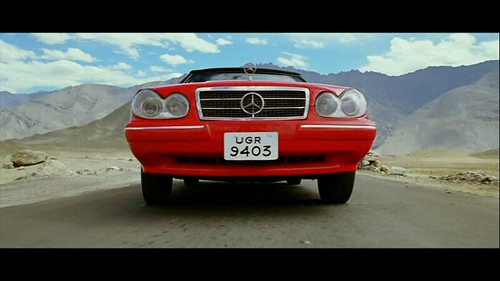
The film opens with a red mercedes SLK 320 on the wild road accompanied by a stereo switching between a little ode to 80s rock ("She's a highway to hell" courtesy Ranjit Barot) and kabhii kabhii (the plaintive voice of the late Mukesh).
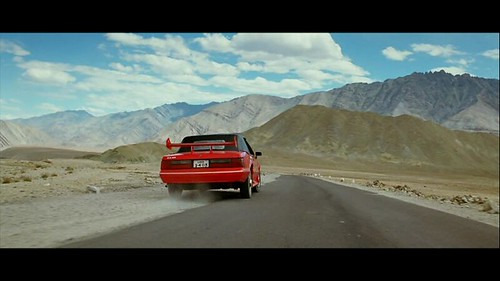
It's a red Mercedes SLK 320 with a spoiler. UGR 9403.
And then it veers out of control and drives off the road, to the side and over the edge. The landscape looks fake, the milestone flying by is bad CG. But the worst is yet to come. A montage of obviously fake VFX shots follows to illustrate the inevitable -- the descent of the car succumbing to gravity into the water below.
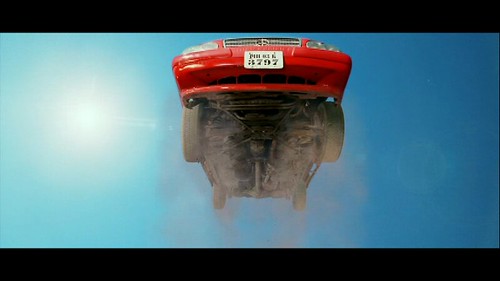
It's at this point that things become confusing. The car's licence plate goes into the witness protection programme in midair relocating, in a manner of registration, to the state of Maharashtra.
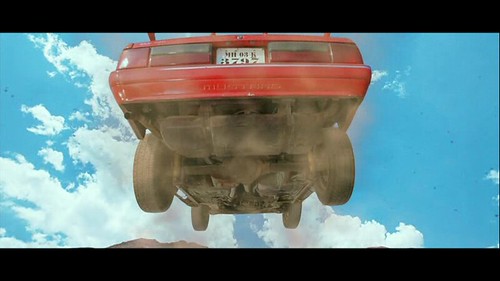
A fine shot of the automobile's derriere laced with dust is marred by the word embossed on the rear bumper. I'm confused -- when did Ford team up with Mercedes?
Several minutes later, we return to the car under water.
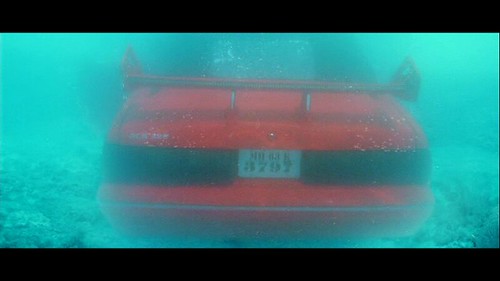
The licence plate continues to be the same as it was before the car hit the water. It is also clear that the car is an SLK 320; I can't see lower part of the bumper, so it's hard to see if the embossed Mustang is still there (I wish I had a better angle).
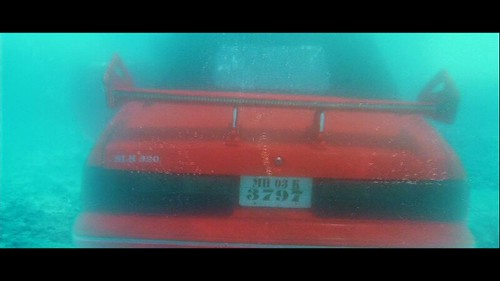
Peculiar. Very peculiar.
Since this is a film laced with references to other films (with, as a later blog post may reveal, the choice of films bears a strong bias for the Yash Raj canon) and especially recent YRF productions, it is possible to construe an explanation for this gaffe and credit it as being a little in-joke. Remember the Mustang fetish in Dhoom? Remember especially that red set of wheels bearing the likes of Esha Deol? That, kemo sabe, was a Mustang. Perhaps bhaiyaajii created his own motor mash-up (Benz+Ford = Bored?). Or perhaps we're just dealing with an overpaid sloppy crew obsessed with bringing fruition to an overbaked balloon of nothing built on an idea that deserved a creative mind.
blunt beaks and stellar opposition
What compels the majority of Indian writers of English to abuse the word against in various blog posts, paid articles and various parochial portals? Does not the damage implied by the collision worry them? Do they fail to appreciate the use of opposite instead? How does one explain some random actress appearing against a superstar? Was it a game of tennis? Was it sumo wrestling? Was it a game of cards? Was it arm wrestling? Or was it squash? It seems to be none of these, for the "writers" (who really have no business wielding the pen in the language) choose this word to mean that said starlet was appearing along with said superstar. They're on the same team, on the same side. Talk about dushaasan appearing against duryodhan in the mahaabhaarat. It's time to rally against the opposition.
Monday, August 24, 2009
a blast of bappi
As we lament the passing of an age of lyrical dross so bad it was hilarious, let us pause to shower laurels on one such master stroke in the late 90s from the jewel-clad master. Boppi-da ensured the cult credentials of the Sunil Shetty/Jeetendra law and odour flick Judge Mujrim with Jolly Mukherjee belting out lailaa o lailaa. Was this Boppi-da's tribute to the Shah brothers? Perhaps we will never know. Meanwhile, we can surely sit back and relish the interplay of language, the blending of metaphors in this abbatoir of rhyme embellished with the obligatory bridge of rap. Presented below is the "neat" version of the song (no repetitions, no loops)
हम तुम दोनों मिल गए
प्यार की tuning हो गयी
हर morning तेरी हो गयी
हर evening तेरी हो गयी
लैला हो लैला तू है लैला
छैला मैं छैला मैं तेरा छैला
आ हा नज़र क्या तेरी है
आ हा कमर क्या तेरी है
आ हा अदा क्या तेरी है
आ हा उम्र क्या तेरी है
आ हा ये गाल टमाटर से
आ हा ये होंठ गाजर से
आ हा तू बोतल शरबत की
आ हा टू गोरी पनघट की
तेरे रूप की बिजली से
मेरे दिल में lighting हो गयी
आ हा तू गुडिया जापानी
आ हा तू परियों की रानी
आ हा तू चाँद पूनम का
आ हा तू कतरा शबनम का
आ हा छलकता जाम है तू
आ हा सुनहरी शाम है तू
आ हा तू model 96
आ हा तू गोरी गोरी miss
मेरे दिल के garden में
तेरे प्यार की कलियाँ खिल गयीं
हर morning तेरी हो गयी
हर evening तेरी हो गयी
Monday, August 17, 2009
kaminey: genesis
[in which it is obvious that I've seen the film]
Where did Kaminey originate? Was it an incident or a film or a book that inspired you?
Four years ago, Mira Nair assembled writers from America, India and Canada to mentor ten students from Asia and Africa. This scriptwriting workshop was held in Kampala, Yuganda[sic]. A young writer from Nairobi showed me a script which was a story about twin brothers and what happens in their life in a span of 24 hours. It was like parallel cutting and I really liked that approach. Mira and I spoke about it at length and both of us felt that it was a typical Bollywood masala movie. I was in touch with that writer for the next six months. He also sent me another draft. Then two-three years later I asked him to sell me the idea. He was in need of money so I sent him some 4000 dollars and bought the script to make any time. I picked up that idea and added Bollywood masala and my dark and serious side to it. So now, one brother stammers and the other has a lisp.
be warned that some elements herein may be regarded as spoilers
Kaminey opens with very little of the dross that inundates most Bollywood releases these days. The dross comprises acknowledgements to various media partners, outdoor partners, brand partners, various names both familiar and unfamiliar, miscellaneous logos and the like (My Name Is Anthony Gonsalves might have set a new record with about 1 minute and 54 seconds of such sycophantic fellatio before the film's title came up).
Vishal's film opens with an acknowledgement to Mira Nair and the Maisha Film Lab in Kampala. Then there are two screens of names (including familiar ones like Abhishek Chaubey) after which we get a screen proclaiming "UTV Motion Pictures presents." The next screen bears the interesting "based on an idea by Cajetan Boy."
Maisha is the brainchild of Mira Nair and aims to be "a film makers laboratory dedicated to developing and supporting visionary screenwriters and directors from East Africa and South Asia." The first lab for screenwriters was held in Kampala, Uganda from August 3rd to August 13th, 2005. The mentors for the workshop were Mira Nair, Matthew Robbins, Vishal Bhardwaj, Steve Cohen, Sabrina Dhawan, and Sooni Taraporevala. Vishal fans will probably recognise the name of Matthew Robbins. One of the 10 screenplays chosen for the workshop was titled Roho and it was written by a Kenyan named Cajetan Boy. Vishal had more in an interview:
Where did Kaminey originate? Was it an incident or a film or a book that inspired you?
Four years ago, Mira Nair assembled writers from America, India and Canada to mentor ten students from Asia and Africa. This scriptwriting workshop was held in Kampala, Yuganda[sic]. A young writer from Nairobi showed me a script which was a story about twin brothers and what happens in their life in a span of 24 hours. It was like parallel cutting and I really liked that approach. Mira and I spoke about it at length and both of us felt that it was a typical Bollywood masala movie. I was in touch with that writer for the next six months. He also sent me another draft. Then two-three years later I asked him to sell me the idea. He was in need of money so I sent him some 4000 dollars and bought the script to make any time. I picked up that idea and added Bollywood masala and my dark and serious side to it. So now, one brother stammers and the other has a lisp.
Vishal didn't stop with merely adding the disabilities, the wide array of colourful characters, his trademark dialogue and the other elements reinforcing his belief in the utility of Bollywood conventions in interesting ways. He also tossed in a credit for Cajetan Boy. And that was not all -- Vishal decides to use the name Cajetan for one of the many characters in his tapestry. This gets us more than a couple (if memory serves me right) of utterances of the name. It is also a credited appearance, so we read the name in the end credits (those who stomped over all the popcorn on the floor the moment the dissolve to black happened can pretend they saw this).
The film's merits notwithstanding, this is one of those simple yet masterful gestures that makes people like Vishal stand out in a sea full of plagiarising halfwits and mendacious morons.
Cajetan, one is happy to report, is pleased with all this.
Friday, August 14, 2009
makes sense and whatever
being a collection of news crumbs about developments that can be explained, are unfortunate and yet predictable (given my cheery cynical disposition) -- things only make me go "what else could I expect?"
Celebrate India's Independence with another round of the twin-blade sword from MARTA -- that's route cuts combined with a fare increase, dearies. The usual reasons unfold -- the refusal of those who manage the affairs of the state to give more than lip service to the importance of public transit being the most familiar. MARTA had done this a few years ago; the consequences are easily explained -- even fewer people will consider trying transit worth their while; even fewer people will see it as a way to save money; the transit system's sole saving grace continues to be the train (and the airport is the most important destination). CCT, meanwhile, continues to remain a 6-day affair, taking time off on Sundays. This continues to a lot of streets in the county viable as locations for I Am Legend: II. Oh, and before I forget, fares will go up by a quarter on the eve of Gandhi Jayanti. Surely some celebrations must be organised at the Martin Luther King Centre (you can take the train).
After promising to fix the much-abused and rather pathetic immigration system and policies of the USA during his campaign and after assuming office, President Barack Obama has rescheduled it for 2010. The current blockbuster is the healthcare (such a contradiction in terms) system. David and Goliath, ladies and gentlemen. I appreciate any effort to make the system more meaningful and useful instead of resembling something like outtakes from Brazil, but being the well-meaning cynic that I am, I'll wait till something happens. Meanwhile, the insurance companies will continue to run as well-oiled businesses funded by the healthy and denied to the sick.
As for all you people out there working with an H-1B and an honest résumé (if you're one of those douchebags with dilated credentials furnished by brethren from the back offices, please ignore this and drink from a can of expired milk) -- rest assured that the government will accept all your money through various agencies. The government also offers faster service at a higher price (remember H-1B renewals, I-140 applications?) -- which makes one wonder what they were doing when offering regular service that took so long.
The rant has ended. Go in peace to shed some more dead presidents.
kaminey: early praise
Vishal Bhardwaj seems destined to be the guinea pig for all sorts of strange SNAFUs associated with film releases. Anurag Kashyap's problems were limited to censor bans. But the creative and talented Mr. Bhardwaj has had to deal with obscurity (Maqbool seems to have gained its admirers and fans almost completely by word of mouth and the occasional articles lavishing praise), hype dying with a whimper (a lot more was written about The Blue Umbrella before it finally hit the marquee, at which point it seemed to slide all the way out), strangely disappointing initial collections followed by a backlash of prudery (Omkara). And now it's the H1N1 wave that has prevented it from hitting the marquee back home in Bombay and Pune. The film has hit the marquee overseas and, as with Omkara, seems destined to get most of its early reviews from abroad (local limited screenings for critics notwithstanding).
And the early notes are promising. Nay! They are extremely encouraging in an eerie way. Raja Sen ends his enthusiastic take with Awefome!; Another positive review ends with praise for the director; Nikhat Kazmi gives it a full-star rating before gushing about it as does the Indian Express and Vasan Bala is drooling over at PFC. Anupama Chopra, writing for NDTV, starts by calling it the best Bollywood film she's seen this year. Taran Adarsh, the reviewer from hell, who pretends to be a critic while looking at films like a baniyaa, also has good things to say, ending with four stars out of five. Lisa Tsering (reportedly "the first Western journalist to write about Bollywood and Indian pop culture for the Indian press") calls it a smart vivid thriller. Baradwaj appreciates Vishal's respect for the audience's intelligence as he unfurls a favourable review. Rajeev Masand gives "this imaginative and original film" four stars out of five. Over at The Hindu, Sudhish Kamath is "dying to watch it again." Minty Tejpal loves the film (adding a disclaimer that he worked with Vishal on the screenplay of The Blue Umbrella) and can't get the tune out of his head.
And if you thought I was just looking at the good notes, allow me to offer Khalid Mohamed's take (the guy can't even spell "Bhardwaj" right, though).
[Cross-posted on the Vishal Bhardwaj blog]
Saturday, August 08, 2009
mind it! see it!
It started in 1993 or 1994 with shorts on Channel [V] featuring a South Indian cowboy mouthing lines and attitude reminiscent of Rajnikant, but with an attitude of his own. The cowboy became an unbeatably original icon of Indian pop/pulp culture and Shashank Ghosh was famous. Well, to be precise, Quick Gun Murugan was famous and Shashank Ghosh was a name that rang a bell for credit watchers and trivia-mongers.
[hindi version]
करमभूमी मेरा आँगन (आँगन (आँगन (आँगन (आँगन ))))
terrace मेरा नील गगन (गगन (गगन))
ये पूरा दुनिया मेरा वतन (वतन (वतन (वतन (वतन ))))
my name is मुरुगन
क्विक गण मुरुगन
[english version]
the (दे) earth (यर्त) is my bed (bed (bed (bed (bed))))
the sky is my ceiling
the whole creation is my native place
my name is murugan
quick gun murugan
Years later, Ghosh made his first full length feature, Waisa Bhi Hota Hai, Part II, an irreverant undersung darkly comic tale of Bombay, the underworld, urban angst, pop fantasies and Bollywood clichés, machismo and the first time we heard of Rabbi Shergill. It was destined to become a cult favourite.
Several years later, word floats about a full-length feature adventure of everyone's favourite South Indian cowboy. Then Shashank Ghosh started blogging on PFC. And then, the film sprang out on screen at IFFLA 2009 and the reviews indicated that all was well.
And now, the trailers have flooded the Internet. Rajendra Prasad with his Sivaji Ganesan looks mouths lines destined to be immortal (I am cowboy / this is my duty); there are odes to The Terminator, Rajnikant and his physics-defying sticks of nicotine, there are tips of the hat to Vijaykant (can you go wrong with these two? you can't!) and the priceless resounding ballast from Tridev:
[hindi version]
करमभूमी मेरा आँगन (आँगन (आँगन (आँगन (आँगन ))))
terrace मेरा नील गगन (गगन (गगन))
ये पूरा दुनिया मेरा वतन (वतन (वतन (वतन (वतन ))))
my name is मुरुगन
क्विक गण मुरुगन
[english version]
the (दे) earth (यर्त) is my bed (bed (bed (bed (bed))))
the sky is my ceiling
the whole creation is my native place
my name is murugan
quick gun murugan
The theatrical trailer snags immortality with the coolest pair of intertitles in a while (they made him a past tense / now he will make their future tense).
There's Nasser as the deliciously named villain, Rice Plate Reddy; Rambha as Mango Dolly and Raju Sundaram as Rowdy MBA. Watch out for Ranvir Shorey and Vinay Pathak. The ears are already licking their drums in glee. Waiting. Waiting. Waiting.
mind it!
Here are the original shorts to watch while you wait: number 1, number 2 and number 3.
update [august 10, 2009]: Siddhartha graciously points me to a video of Mika's song for the film. Ostentatious! ये है rebel without a cow is a stroke of staggering genius.
boppi-da kaa naam: only boppi-da
This is for JR, whose instant message unleashed an investigation of old LP cover scans and the stash of guilty pleasures with Bollywood's own Maaikaal Jeksaan at the composing helm.
For the uninitiated it would be interesting to note that Bappida used the pseudonym Basavalingaiah Hiremath when he sang his songs like Jeele le Jee le and I am a Disco Dancer !!
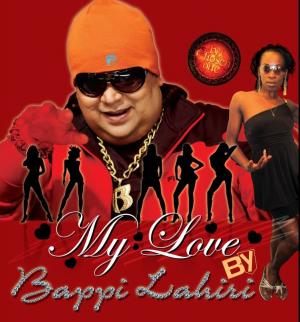
It all started with an instant message and a pointer to a post over at PFC dedicated to Bollywood songs with crazy lyrics (the kind of stuff that can keep a blog running for eons, mates). The fragment of interest was:
For the uninitiated it would be interesting to note that Bappida used the pseudonym Basavalingaiah Hiremath when he sang his songs like Jeele le Jee le and I am a Disco Dancer !!
I'm not one of those Bappi fans who keeps a little altar in the house of the portly plagiarist adorned with gold chains and cheap sunglasses, but his ouevre has been a guilty pleasure -- he has betrayed flashes of brilliance and balanced them with buckets of mediocrity. Toss in a zany accent, a penchant for outrageous lyrics and a warped sense of cool and we get one of the most unique personalities stomping about Bollywood. But I digress. The point is: I've never heard about this pseudonymous business. I have images of the record covers of Tarzan and Chalte Chalte; I have a CD compilation that includes the songs of Disco Dancer; I have several other compilations and record scans of other soundtracks and none (I repeat none) of them choose any appellation other than Bappi Lahiri (the stray Bhappi Lahiri notwithstanding). A fellow Bopper agrees. Unfortunately, it has been quite impossible to find out how this rumour started. It's hard to believe that the real Basavalingaiah Hiremath (a Kannada singer?) indulged in this bit of inspired publicity. The Wikipedia page dedicated to the man cites the results of a Google search as evidence. Pah!
I think it's time for Bappi to sue again.
Wednesday, August 05, 2009
that's what it's all about
I wonder why the verbs mention and discuss were robbed of their transitive status. What could have encouraged someone to completely ignore a free spot for the object and choose to make their own along with the preposition about as a prefix. People have decided to stop discussing things and have started discussing about them -- if you want a ghastly visual to match this, please consider Rajesh Khanna and Nanda cavorting about an unidentified garden in The Train. People have stopped mentioning things and have decided to mention about them -- circumlocutory chaos once again. We've got enough wasted clones of that preposition to fill several galaxies. Trim your utterances and sentences; make them a word lighter. There are places where it will be happier. Think about it.
Saturday, August 01, 2009
a-tishoo (Dhishum)
[link courtesy: Siddhartha]
a rose is a rose
a nose is a nose
a toese is a toese
Himesh has quietly put himself through surgery a couple of months ago and added one more voice, apart from his nasal voice. He has now become the only singer to have two completely different voices and the new voice will be heard in his forthcoming films. He has already recorded songs in his new voice.
Apart from his nasal voice, he has now added a different voice which is a base middle octave. This way, he will have two distinct voices and anybody who indentifies him with his style will never be able to say that the other voice is also his.
a rose is a rose
a nose is a nose
a toese is a toese
Ditching his cap didn't do much for him (his asphyxiated hair might have breathed gulps of relief, however). A tail of numerologically sound, linguistically challenged onomatopoeiac titular adjustments didn't help either. The bearer of the only voice known to offer serious competition to Madame Mangeshkar's silicate shattering sonance has gambled on another attempt to stupefy his fans, extend the destructive reach of his olfactory astra and gone down to South Africa (inspired by the mondegreen that Prem Granth was really Prem Grunt, no doubt) and funded the addition of a new voice to his laryngeal catalogue:
Himesh has quietly put himself through surgery a couple of months ago and added one more voice, apart from his nasal voice. He has now become the only singer to have two completely different voices and the new voice will be heard in his forthcoming films. He has already recorded songs in his new voice.
Watch out for the next edition of the Sneeze Book of World Records.
Those with a knowledge of music theory and acoustics will find something to relish in the utter fiction of the details of the operation:
Apart from his nasal voice, he has now added a different voice which is a base middle octave. This way, he will have two distinct voices and anybody who indentifies him with his style will never be able to say that the other voice is also his.
If anyone knows what base[sic] middle octave means, please drop me a line or drop a comment hereabouts. Meanwhile, we will await the stridulations consequent of the soniferous surgical stint. merii.n aa.Nwaa.Nze.n su.Nno.n!
the origins of a tribute to armaan kohli?
Unknown [May 06, 2007]: There were two reasons I can think of that made me sit and watch Unknown, when a friend had unearthed the film. The first was that it was, for me, just like the title said (I hadn't heard of it, dummy). The second was that it had Jim "They Call Me Jesus" Caviezel. It seemed like a good thing to find out what else he had been in before he was crucified forever. The film's premise was interesting: a few men wake up in a warehouse with no memory of who they are and what has brought them here. If you wanted a high concept version, think Reservoir Dogs meets Memento meets The Usual Suspects. Things are reasonably engaging but there are plot holes that might compete with the Grand Canyon. There's also a certain ebb in the pace at times. However, given that this was a relatively minor flick, there was no hype to damage my reaction and define expectations for me. It also turned out that Caviezel was not the only familiar name on the roster -- one also had Greg Kinnear, Joe Pantoliano and Peter Stormare.
[from the official page]
Acid Factory is about a group of characters whose sense of past has vanished in a haze of coma like sleep they have woken up from only to discover that reality could be a figment of their imagination.
[...]
Five men wake up inside the stolid confines of a factory to find themselves locked in this claustrophobic nowhere land.
[the present] Perhaps what kept me from writing about this film two years ago was someone like the Traveller, who whispered into my ear telling me that I wasn't alone in having seen this minor flick. There was another way of describing this film for the high concept crowd: Think Kaante with a twist. Woo hoo! Lo! After having received a tenured position at Sanjay Gupta Cine-Copiers LLC with the variegated Ek Khiladi Ek Hasina, Suparn Varma announced his next directorial venture -- a film called Acid Factory. As a title, this fit the kind of stuff Sanjay Gupta blessed. The teaser trailer sports the familiar tropes of the Gupta school of filmmaking -- leather-clad alpha male figures, chases, automobile crash ballets with pirouettes to put the worst Bollywood physics to shame. But it's the premise -- something that is hardly evident in the teaser -- that gives it all away:
[from the official page]
Acid Factory is about a group of characters whose sense of past has vanished in a haze of coma like sleep they have woken up from only to discover that reality could be a figment of their imagination.
[...]
Five men wake up inside the stolid confines of a factory to find themselves locked in this claustrophobic nowhere land.
The page continues to reveal more plot details than you would like to know, if you were planning to watch Unknown. But if it's a Bolly-flick you are interested in, plot hardly matters. You're in it for the obeisance to testosterone, for the objectification of the female form, for the coolness of moronic utterances, for the cheap version of a Michael Bay soundscape. The warehouse becomes the titular entity, while Moynahan becomes Mirza in what looks like another unholy ripoff. It's the 21st century and for every No Smoking, Johnny Gaddaar, 15 Park Avenue, Hazaaron Khwaishein Aisi and Dil Dosti, Etc, we still get stuff like this on which star power, cash and kind are showered. Time to return to Streets of Fire ... oops Tezaab. Oh well. Perhaps that old Armaan Kohli classic then. Here are a few tablets to revive your memory, O lover of Bollycrap: hamanashii.n, mai.n kaun huu.N and kitanaa pyaar tumhe.n karate hai.n
Sunday, July 26, 2009
a handful of scribbles
Pokiri [December 11, 2006]: With RGV written all over it, this Mahesh Babu vehicle can appeal only to fans of "Prince." The film is so obsessed with style and the coolness of its star (something that, again, is something only the privileged fanatic masses can see) that it ends up being a parody of its excess. The plot has something to do with the land mafia, but it's mostly about the Prince. Those with an eye for feminine eye candy can spend time analysing the oddities of the bone structure and hip dynamics of Ileana D'Cruz. The songs mix Telugu and Hindi and even features Bollywood staple Kunal Ganjawala on one track. One song adds to the list of Listen to the pouring rain rip-offs. There's a villain who's into S and M. There's some sliding on the knees to get past under a rolling spinwheel. There are surreal lines like I may not be perfect but parts of me are awesome and strange subtitles (s*x-straved[sic] vampires). Don't wait for the Hindi remake; watch the original. Be warned: the DVD was designed by the usual gang of morons, so there's a lot of unskippable content. Use something like VLC on your laptop instead of a regular DVD player to reduce your grief.
Enduring Love [December 18, 2006]: The first movie adapting Ian McEwan (The Good Son doesn't count, because there was no source novel) that I saw taught me what an au pair was. The film opens with a death that's shocking because it happens on a clear innocuous day and in a very matter-of-fact way (since I hadn't read the novel, I had the benefit of ignorance as far as the plot was concerned). A sense of Rashomon and emotional confusion take over as the film walks the thin line between drama and thriller. Nice chilling use of God Only Knows and some interesting use of slow motion followed by quick edits and frenzied camera angles and lenses and sped-up film as Joe rushes home when he finds out that Jed is there with Claire. Watch out the book Awakening The Buddha by Lama Surya Das (yes, LSD). Bland font for the end credits, however. The film's confusion of intent prevents it from being either an engaging psychological experience (something really welcome given the earnest performances) or a less unsubtle version of Fatal Attraction.
The Score [September 21, 2006] (aka 317 946 5839): This film will most likely be remembered more for who was in it rather than what they did in it or the plot. It's about a con with none of the surprises being surprises, peppered with the obligatory yet implausible heist sequence, packed with material for actors to riff with and yet not terribly exciting. The prospect of seeing Robert De Niro and Marlon Brando finally work together and of seeing Edward Norton hold his own foil with these two fine sabres doing their thing is not done justice by a film that only works in parts. One wishes that David Mamet had been involved in scripting stuff for Norton and De Niro; I can't think of anyone who could write anything for the colossal and shockingly unpredictable temperamental Brando. Scenes seem to work simply because we find ourselves watching good actors do their stuff, but the material isn't much up to snuff. You can appreciate some good lighting work by Rob Hahn. The film, however, seems to want to succeed more as a by-the-numbers gadget-laden caper than as something that George Roy Hill might have been at ease with. Oh, did I forget to note that Angela Bassett's here too, wasting her time. Get your kicks by spotting Quake III: Arena.
Thursday, July 23, 2009
oil be damned!
Why am I not surprised that someone named Ramnarain Sahu, a Samajwadi party MP, who happens to be the president of the Rashtriya Teli Rathore Chetna Mahasangh, has decided to nurse objections to the use of the word telii in Kaminey's catchiest song. First the naaiis and now the teliis. All Gulzar needs for a hat-trick is to tickle the ire of another occupational sect. I can't resist thinking of maaliis.
[Cross-posted on the Vishal Bhardwaj blog]
[Cross-posted on the Vishal Bhardwaj blog]
Tuesday, July 21, 2009
family conceit, bollywood style
The Kapoor sisters have it made. In Kambakkht Ishq, the hideous Kareena Kapoor (whose makeup alone is enough to cause the popularity of eyeshadow to dip) gets to wiggle to a song whose chorus goes bebo mai.n bebo. For the uninitiated, Bebo is her nickname, her petname, what people at home call her, what every fan knows. Perhaps this was a tribute to her elder sister, the sometimes more talented and largely less hideous, Karis[h]ma Kapoor, who strutted to a song that went dekho mai.n huu.N karishmaa in Papi Gudia (the Child's Play ripoff, Charles). Or perhaps it was an ode to kRRiShnaa tuu mai.n karishmaa huu.N from Prem Shakti. Who knows?
Incidentally, unless memory fails me, a sequence in Papi Gudia was a filch not from Child's Play but a sequence from either F/X or F/X 2 -- which reminds me to try and find a copy of these delightful Bryan Brown starrers.
Subscribe to:
Posts (Atom)