Sunday, January 24, 2010
a perspective standpoint
The froth from the rant about the egregious abuse of perspective was just beginning to dry when the cult of the evil twin surfaced. The name's standpoint and its exploitation has nothing to do with social science. The template remains the same: from a/an X standpoint. The chief culprits are overpaid bearers of corporate RIMjobs and under-educated code monkeys who climbed up the rungs of the corporate ladder to expound balderdash using Tufte's bête noire. There can be no more effective way to divest oneself of the faculty of simple English than to sit listening to one such wrongdoer confidently hurl inane vacuous phrases like from a management standpoint, from a maintenance standpoint, from a customer satisfaction standpoint (notice the return of the noun-as-adjective kludge of lazy speakers) and from an overall quality standpoint. The irony in it all is lost on such windbags. All you can do is gnash your teeth from a sitting standpoint.
Saturday, January 16, 2010
a (small) purseful of previews
The man who made the interesting Main Madhuri Dixit Banna Chahti Hoon and the Hrishikesh Mukherjee film of 2005 (Main Meri Patni Aur Woh) returns with Striker. When was the last time you saw a trailer that opened with a carrom board? It might be a sports movie of a different kind but it looks like a familiar masala mix. One can only hope it's done reasonably well.
Ben Kingsley and Amitabh Bachchan appear on the same cast roster with Teen Patti. Kingsley supposedly plays a mathematician called Trachtenberg and it's a relief that his character's first name is not Jakow. The only rub is that the film's directed by a lady called Leena Yadav, who was responsible for that creatively misguided blotch of guano called Shabd.
The nicest thing about the trailer for Prakash Jha's next film Rajneeti is not the cast (The promise of Manoj Bajpai -- almost unrecognisable with the extra lard --, Nana Patekar and Naseeruddin Shah is offset by the presence of the likes of Katrina Kaif and Arjun Rampal). It's that voiceover that runs throughout in careful measured effective Hindi. This is not Hinglish. This is pure Hindi. It's disappointing to see the title surface at the end in English and a boring font (had it been in Hindi, we'd have remembered Govind Nihalani, who unflinchingly presented all the credits on his films in Hindi). Jha's recent efforts (Gangaajal and Apaharan) have been only moderately satisfying. One hopes that this supposed take on the Mahabharat (assignment: watch Benegal's Kalyug again) makes up for those.
Saturday, January 09, 2010
a handful of signs
During a recent visit to Chennai, the eyes spotted some interesting signs.
hoome appliances: blenders for रुदाली?
hotel ginger garlic: they named a hotel after a popular paste at Indian stores?
golden edelweiss: Am I alone in thinking that this is a euphemism for guano? There's also the surreal image the meaning conjures (golden noble white?)
baba pile foundation: A treatment clinic for haemorrhoids named after some godman or that famous star vehicle? Curious. Very curious.
balaji's hot spot: Possibly blasphemous. Great name for a fusion club or the first South Indian strip joint.
dutch betrayal
Some of the things movies teach you are funny. There I was watching Body of Lies (soon to be "remade" as जिस्म झूठ का), specifically the aftermath of a terrorist bomb in Amsterdam. That's when I found out what the abbreviation for the local police was. KLPD. I kid you not. Now, if you're Indian and you haven't been living a sheltered PG life or you haven't watched Monsoon Wedding, you know why I'm laughing.
Friday, January 08, 2010
my daddy cyborg
The Tamil Nadu state government, in a familiar political, pig-headed, jingoistic flourish, offers an exemption from Entertainment Tax to Tamil films bearing Tamil names. This is why Godfather hit the marquee as Varalaru. This is also why the next Rajinikanth/Shankar vehicle lost the name Robot and became Endhiran. (I must digress to note that I missed seeing the young old star when he showed up on Pune for a shooting stint for this flick). OscAR Rahman does the musical honours and Vairamuthu shares lyrical duties with Pa. Vijay. The former lyricist whips up a lyrical howl (go to slide 3) with Robovuku thaai mozhi kidaiyadhu, thandhai mozhidhan undu, which supposedly means A robot does not have a mother tongue; it only has a father tongue. Eh? Cyborg ain't got no lingua माता, but he sure got his daddy's licker. Eesh! Excuse me, while I get some Listerine.
word wrap
Seen on the menu in Chow Baby: Your first and only bowl we will wrap up for any additional bowl wrapped up will be 8.99
Were these messages outsourced to the land of IT rowdies or was the person writing it desperately trying to make it in time for a conference with Mother Nature? You were probably so in thrall of the wonderful stir fry on the table that you didn't notice.
Friday, January 01, 2010
kaalaa Tiikaa: DVD style
dear moser baer,
I would like to thank you for doing for DVDs what T-Series did for CDs. It feels much better to buy DVDs for prices like 99, 149 and the like (INR, of course) than 299, 399 and the like (INR, again). After all, Eagle Entertainment, Eagle, Eros, Adlabs, Sony/BMG, YashRaj Films and Shemaroo are also only giving me a DVD. There's nothing to speak of as far as cover and sleeve art are concerned. In fact, there's nothing at all to speak of in the manner of packaging. I will not mention special features, because that is something India does not understand (I must note that there are some exceptions, of course, but they are, after all, exceptions).
I would like to thank you for doing for DVDs what T-Series did for CDs. It feels much better to buy DVDs for prices like 99, 149 and the like (INR, of course) than 299, 399 and the like (INR, again). After all, Eagle Entertainment, Eagle, Eros, Adlabs, Sony/BMG, YashRaj Films and Shemaroo are also only giving me a DVD. There's nothing to speak of as far as cover and sleeve art are concerned. In fact, there's nothing at all to speak of in the manner of packaging. I will not mention special features, because that is something India does not understand (I must note that there are some exceptions, of course, but they are, after all, exceptions).
But I digress. I am sure I am not alone in finding watermarks tossed onto the film frame by DVD companies annoying. All of you companies insist on adding short unskippable films parading your logo on the DVDs; I have wondered why pressing the menu button on my DVD's remote control takes me to this loud movie instead of the menu; but I digress again.
Could you tell me why you insist on retaining your watermark on the entire film? Other DVD companies add their watermarks like screensavers -- they appear for a few several seconds at important moments in the film (songs for regular Bollywood far; random moments in "art" cinema). Knowing that these companies didn't care, I had almost made my peace with this annoying feature that destroyed the movie for me. I would like to just let you know that your decision to make this watermark (how can I call it a watermark when it's so plainly visible?) as permanent as a birthmark, a port-wine stain.
Thank you for not caring.
Thursday, December 31, 2009
great decuman dancing derrieres!

As the year draws to a close, it is time to unveil another gem from Englishkaran. The hour is ripe to introduce the heroine of the film's second half. Namitha's the name of Lady Lipids. She put a bikini to shame in Billa and returns in this film to challenge the limits of human acceptance of size, proportion and taste. Jiggles has a burning desire to win prizes in running. That little detail alone justifies that familiar disclaimer about stuff like this being works of fiction (no stretch is too much). We are treated to enough footage of her running and –- wait for it -- winning!! 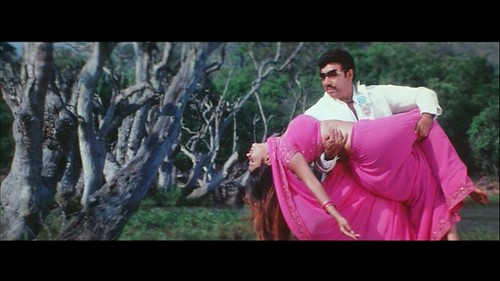 Since she appears in a flashback that is crucial to tie up the loose ends about Sathyaraj's character (whom the title refers to, puTTan), it is not surprising that we have a romantic song and dance sequence featuring the two prancing about in domestic jungle-like setups (pages torn out of books like Rangeela). Given the rather obviously significant difference in size, it would make sense for Namitha to do the lifting and posing. However, convention requires the man to be the lifter, poser and support system for the female form. Consequently, we are treated to visuals of Sathyaraj doing his own stunts (supporting Namitha in various romantic poses) and of Namitha mooning the camera and challenging the widescreen format (on paper this must have been designed as a booty teaser for the lascivious laddies sitting in the dress circle). All this is accompanied by a song whose lyrics employ metaphors from war (the boy is compared to Mohammad Gazni -- who gave his name to two commercial potboilers exploiting anterograde amnesia; the girl and her assets are compared to bastions of defence). It's a strange howlarious mix that could cause you to choke on your lunch.

Without much ado, oglers and gigglers, I present the transcript of the subtitles for this fascinating romantic romp
oh gajini mohammad!
wage a war!
wage a war against the
eighteen year old fortress
overcoming all ups and downs
and passing over forests and hills
venture into the capital city, win over
the head lady and hoist the flag
let the ten fingers ignite
let the flowers bloom in this cannon
oh kattabomman!
come to pay the taxes
come to pay taxes with interest
there is still more
break the bones
make this volcano turn
into a 'cherapunji hill'
would vegetarian suffice for a lion?
can river cauvery be contained in a pot?
use the sari as the mast
to cross the 'river of lust'
you looted me without my knowledge
oh dear! take me to
the place never gone before
i would be with you like
a bow with an arrow
would whitewash the
never dawning night
suffocate me with kisses
why are you so stingy with desires?
oh gajini mohammad!
wage a war!
wage a war against the
eighteen year old fortress
in the beauty of...
cavalry would lose
seeing the footprints
the infantry would lose
at my wink, elephant troops
would become cat troops
soldiers would lose
at your smile
navy would lose
at seeing your navel
not an army but the eye arrows
are enough to defeat you
wind me with your eye keys
and satisfy me, oh dear!
issue an order with your hands and ignite
my dreams with the flowers in your tress
flowers are there, tress is there
snap and ask whatever you want
oh gajini mohammad!
wage a war!
wage a war against the
eighteen year old fortress
overcoming all ups and downs
and passing over forests and hills
venture into the capital city, win over
the head lady and hoist the flag
let the ten fingers ignite
let the flowers bloom in this cannon
let the ten fingers ignite
let the flowers bloom in this cannon
wage a war!
wage a war against the
eighteen year old fortress
overcoming all ups and downs
and passing over forests and hills
venture into the capital city, win over
the head lady and hoist the flag
let the ten fingers ignite
let the flowers bloom in this cannon
oh kattabomman!
come to pay the taxes
come to pay taxes with interest
there is still more
break the bones
make this volcano turn
into a 'cherapunji hill'
would vegetarian suffice for a lion?
can river cauvery be contained in a pot?
use the sari as the mast
to cross the 'river of lust'
you looted me without my knowledge
oh dear! take me to
the place never gone before
i would be with you like
a bow with an arrow
would whitewash the
never dawning night
suffocate me with kisses
why are you so stingy with desires?
oh gajini mohammad!
wage a war!
wage a war against the
eighteen year old fortress
in the beauty of...
cavalry would lose
seeing the footprints
the infantry would lose
at my wink, elephant troops
would become cat troops
soldiers would lose
at your smile
navy would lose
at seeing your navel
not an army but the eye arrows
are enough to defeat you
wind me with your eye keys
and satisfy me, oh dear!
issue an order with your hands and ignite
my dreams with the flowers in your tress
flowers are there, tress is there
snap and ask whatever you want
oh gajini mohammad!
wage a war!
wage a war against the
eighteen year old fortress
overcoming all ups and downs
and passing over forests and hills
venture into the capital city, win over
the head lady and hoist the flag
let the ten fingers ignite
let the flowers bloom in this cannon
let the ten fingers ignite
let the flowers bloom in this cannon

bits and pieces: short notes about movies viewed
Superman Returns: [Friday, June 30, 2006]: it's a yawn in the sky. Over $200 million, months of shooting, marketing and teasers later, Bryan Singer and Warner Bros. rewarded our anticipation with a chick-flick spiced up with nostalgia for the original Superman movies, a digitally recreated Marlon Brando, top-notch heartless SFX, delicious production design and a megalomaniacal villain with a laughable goal.
Iqbal: [Saturday, February 11, 2006]: With this feel-good film about aspirations and cricket based on the classic template in Hollywood for a film about the successful struggle of an unlucky talented sod in sports, Nagesh Kukunoor opens the door into mainstream cinema wider. There are good performances all around (Shreyas Talpade, Shweta Prasad, Yatin Karyekar, Prateeksha Lonkar). Naseer's drunk reminded me, simply because of the kind of character, of Dennis Hopper in Hoosiers. Salim-Sulaiman's songs work well (although आशाएँ gets played too often), but the background score ends up being a tad too intrusive at times. Nagesh shows a good sense of cinema when he often lets visuals do more than dialogue-laden scenes. I also liked how sign language got used in the film without drawing attention to itself (something that would've been standard practice in a regular Bollywood flick). The film loses some of its ground in the predictable third act that relies on setups that don't feel right (the Ranji trophy cricket matches, the inevitable fate of the pivotal game, the Kapil Dev cameo), but it achieves enough in the first two acts to hold its merit.
eklavya: a Shakespearean almost-tragedy of dharmatic proportions
February 17, 2007
Vidhu Vinod Chopra's conceit of years finally finds its home in this film with an iTrans-friendly title. The immensely talented and abrasively outspoken filmmaker finally manages a marriage of story and spectacle with his quietly dramatic and visually magnificent mix of royal custom, intrigue, duty, vengeance and Shakespeare. His pride and confidence in this powerhouse of a simple film are justified. The script makes way for showpieces (the pre-intermission camel/train sequence, the killing of Uday; the killing of Jyoti) while including little details in a manner similar to that lovely little murder mystery called Khamosh made several years ago. There's a lot of craft on display to aid the telling of this tale (lots of low angle shots and even a vertigo zoom).
It's hard not to miss VVC's reference to his oeuvre. Uday (Jimmy Shergill –- or Sheirgill, according to the credits) sits in his private theatre watching Parinda, VVC's last memorable film. The scene unfolding is the killing of Prakash (Anupam Kher) at Kabutarkhana. This is when Eklavya arrives to kill him and, risking either scorn or acclaim, VVC stages the whole killing in darkness (playing on Eklavya's ability to follow sound). As a triviamonger, it's hard not to read into these references. In Parinda, as Karan and Francis make their way through the hotel room, there's a film playing on the television set: the scene in question features a TV set playing the shower scene in Psycho. If memory serves me right, that's Khamosh. And now VVC adds a reference to Parinda in this film. All we have to do now, presumably, is wait to spot a reference to this film and we'll discover the next edition in this series of smaller, more interesting films from the man.
The other setpiece appears near the end of the film as a wonderful tracking shot over chhatriis (thanks to a 175 ft rail erected in 3 days on top of a hill).
The background score is loaded with puriyaa dhaanashrii and there's just one song, चन्दा रे चन्दा रे, with which VVC weaves the familiar Bollywood cinematic device deftly into the narrative; it's a simple melody set in a 14-beat cycle, just like बावरा मन, the Moitra creation from Hazaaron Khwaishein Aisi, which it reminds me of. The mild orchestration denies the song any diegetic value, much like दो नैनों में आँसू भरे हैं from Gulzar's Khushboo. The vocal channels S. D. Burman in the lyricless refrain and the percussion strongly echoes मेघा छाये from Sharmilee.
The credits contain several familiar names (Rajendra Hirani, Pradeep Sarkar as visual director) and twists (in Salil Chowdhury/Do Bigha Zameen fashion, music director Shantanu Moitra has a credit for assistance on the script). There's also an acknowledgement for L K Advani and special thanks to Shah Rukh Khan.
The making of the film has a long history and was something I scoured the Internet for after having watched the film. I have to admit entering the hall with some trepidation and doubt (after all, since Parinda it looked like VVC was still struggling with his craft and the compromise of the Bollywood idiom and churning out unsatisfying fare like Kareeb and 1942: A Love Story). Eklavya: The Royal Guard, thankfully, proved that the craftsman was still alive and kicking. Welcome back VVC.
cape fear: a triumph of departments
J. Lee Thompson's 1962 film is perhaps not as well known to a newer generation of film-goers as the remake directed by Martin Scorsese. This is quite a shame, because the film's a very effective thriller boasting some excellent acting, a creepy score by Bernard Herrmann (whose rejected score for Hitchcock's Torn Curtain adorned Scorsese's remake), great cinematography and sharp editing. I had watched the remake first and it's interesting to see the differences. Being more familiar with Scorsese's oeuvre now, I can see why the key players in the remake are morally unsteady (there are no clear good and bad guys); I can also see how the intense religious baggage (tattoos, quotations from the Bible) of De Niro's interpretation of Max Cady fit perfectly. The original black and white thriller, however, succeeds on its own merits, which, thankfully, are different from those of the remake. Max Cady is clearly sadistic and evil while Max Bowden is, for the most part, a diluted version of Atticus Finch. It's a clear case of good versus evil (with an obvious outcome). Given the inevitability of the proceedings, the excellent writing and performances lend each scene its modicum of suspense and dread. The film also succeeds by implying a lot without either saying or showing much (the word "rape" is never uttered and yet its spectre looms large; a lot of the violence is suggested and not shown, although the film is not completely without violence). The influence of Hitchcock is evident and I wonder if the Psycho house was just a coincidence because this was a Universal release. Given the film's effectiveness, it's hard to believe that it was a financial failure when it was released in 1962 -- perhaps the implied extent of Cady's obsession with Bowden's teenage daughter left people too uneasy for comfort.
Travel Silly, America?
After the unfortunately timed incident on Flight 253, the TSA predictably came up with reactive changes to their airport security process. The second security check at boarding gates from Bombay went from being a slow yet short procedure involving the familiar scanner to a primitive manual effort with very few people rummaging through your carry-on bags with white gloves. I can personally attest to two zippered pockets in my carry-on bag going untouched -- so much for "additional security."
Matters only headed down dark comic/silly lane during the flight. People who checked in were told that the inflight entertainment systems were going to be off for the flight. This may not be such a big deal for a domestic flight (do they have these systems on domestic flights?) but it's traumatic for a 16-hour flight across timezones. Mercifully, they decided to leave the systems on.
The culmination of the silliness came with the announcement that during the last hour before touchdown, everyone had to stay strapped in their seats. No excuses. No exceptions. Nature's call? Defer it. Leak time? Plug it (I can see the market for adult pampers going up). And your laps must be bare. No jackets. No pillows. No blankets.
After getting to a computer several hours later, it was not hard to find out more about these new rules. The "leaked" version was online. Now this is merely "official" confirmation for the silliness anyone flying after December 25 would have experienced. And yet, the TSA goes one step further into the realm of "doh!" by issuing subpoenas to the bloggers who received the "leaked" rules and posted them for all to see. I'm baffled. What's the point? The only reactive people in this battle against terrorism are organisations like the TSA. The terrorists have always made the first move and there's enough in the system for them to exploit and cause more havoc.
Dear administrators of airport security, please reconsider your reactive approach to this mess. I'm sure you can do better.
update [january 01, 2010]: The new year brings good news. The TSA has withdrawn the subpoenas. It's a great plug for the value of public outcry. Of course, the damaged hard disks and the threats issued by the agents will remain as exhibits of an ugly PR mess.
no smoking: random puffs on the soundtrack
[cross-posted on the Passion For Cinema blog]
A sign in the lobby of the marriott said: "welcome trial of K., liberty ballroom A/B", and in smaller letters underneath: "a smoke-free building"
-- K for Fake (Jonathan Lethem)
You have just traversed a hole(?) in space-time
You are no longer confined to physical objects, aspects or surfaces or contained within them
You will now experience power to identify and change the semantic sensory field that influences the final consequences of your journey
You are now at the limits of the multiverse but not beyond the space of this dream(?)
A sign in the lobby of the marriott said: "welcome trial of K., liberty ballroom A/B", and in smaller letters underneath: "a smoke-free building"
-- K for Fake (Jonathan Lethem)
A darkness prevails over the soundtrack of No Smoking. It's the hypnotic darkness of clubs and lounges drenched in shadows and light diffused through clouds of smoke. Vishal and Gulzar serve a surreal stew of potent metaphors, appropriate musical styles (the jazz club song, trance, psychedelia) in their second collaboration on a film that neither directs. This is Vishal's second soundtrack for Anurag Kashyap; the first one was for the yet-unreleased Paanch -- that soundtrack packed some of the best rock songs in Hindi films along with light pop and the plaintive fusion of अँखियाँ चिपकी जाए. It also contained the only other song that I know Deva Sengupta to have sung. He returns after तमस with Ash Tray, where Gulzar adroitly injects the English phrase into an otherwise Hindi song. There is a nice flat texture to the voice and it so appropriately sounds like the voice of a smoker. There were times I thought of Shivaji Chattopadhyay singing ये सफ़र. Vishal seals the wounds of dissonance with his trademark lingering melodic endings and strong arrangements. The arrangements reinforce the feeling that you're sharing the depressing soliloquy of a smoker -- listen to how layers of the chorus intoning धुआँ धुआँ swirl in and strongly about a crescendo conjuring images of fresh smoke blown into the air. This chorus rising from the dark recesses of the song's ambience in what is probably the most compelling metaphor for smoke ever arranged in 2007. The version on CD isn't in standard tuning: I wonder if this was done when mastering the song to preserve a certain texture in the song or if everything was moved a bit up the fretboard.
Everything dark and introspective about Ash Tray is turned inside out by the bucolic कश लगा. It's an exhortation to smoke that works like a folk ditty you'd hear as you walked along the banks of a river in the morning. Vishal joins Sukhwinder Singh and Daler Mehndi in an interesting vocal collaboration and his trademark breathing works in favour of the film's theme. Gulzar bounces from the combustible stacks of cowdung to mixed signals about the addiction (ज़िंदगी के कश लगा हसरतों की राख उड़ा) to his metaphoric pronouncements (ये जहान फानी है बुलबुला है पानी है / बुलबुलों पे रुकना क्या / पानियों पे बहता जा). The second a.ntaraa is evidence of how far Gulzar and Vishal have come since छोड़ आये हम: छोडी हुयी बस्तियां जाता हूँ बार बार घूम-घूम के / मिलते नहीं वो निशाँ छोड़े थे दहलीज़ चूम-चूम के.
The bass in Rekha's voice seems to get chopped as she belts out फूँक दे while the earthy rhythms give the song a percussive immediacy. हयात फूँक दे हवास फूँक दे / ये साँस से सिला हुआ लिबास फूँक दे seem to be the successor to न ग़िलाफ़ न लिहाफ़ ठँडी हवा भी ख़िलाफ़ (or I'm just reading too much into the song). The female voice that opens the song fades away reminding us of the breath of death, before Rekha takes over with another paean to kicking the habit (or rather "blow" it away). Sukhwinder's version hits the surreal without wasting time (पीले पीले से जंगल में बहता है धुआँ). This version is faster and more aggressive. It also boasts a female voice intoning some of the best psychobabble ever heard in an Indian film:
You have just traversed a hole(?) in space-time
You are no longer confined to physical objects, aspects or surfaces or contained within them
You will now experience power to identify and change the semantic sensory field that influences the final consequences of your journey
You are now at the limits of the multiverse but not beyond the space of this dream(?)
जब भी सिगरॅट (why ciggaret instead of cigarette in the track listing?) with its mix of jazz and lounge sets up the right milieu of a club with trails of smoke wafting about. The song unfolds like the thoughts of the compulsive smoker, whose craving has begun to itch as dusk approaches. Gulzar spins out images (शाम होने लगी है/लाल होने लगी है) and similes (उपले जैसा सुलगता हूँ) with ease and aplomb (the eyebrow hardly rises when the smoker/cigarette is compared to a smoldering cow patty). For his first collaboration with Vishal, Adnan Sami croons away in typical style. Sunidhi Chauhan's version opens with a vocal loop (statutory warning) dedicated to the deplorable disclaimer on cigarette packs (the vocal loop also closes the song). The brass riff from the Sami version becomes a wonderful guitar lick in the tradition of Badalamenti's theme for Twin Peaks, Chris Isaak's Wicked Game and Boy George's The Crying Game. Lounge and jazz are replaced by trance. Interestingly, the lyrics remain from a masculine perspective. Belting out the song with characteristic gusto, Sunidhi gets to employ the falsetto to good effect and curiously rolls the 'r' in cigarette just as Sami does.
Vishal and Gulzar manage a coup yet again as they explore the dark, hypnotic world of the smoker where shards of light are drawn through curtains of smoke. This is perhaps the closest a Hindi film soundtrack has come to working remarkably well as a concept album as well.
Tuesday, December 29, 2009
gulzar's lyrics according to B4U
आजा आजा दिल निचोड़ें
रात की मटकी तोड़ें
कोई good luck निकालें
आज गुल्लक तो फोड़ें
तिल तिल तारामीरा bleep
कौड़ी कौड़ी पैसा पैसा, पैसे का खेल
चल चल सड़कों पे होगी ढेन ढेन
and so it goes
रात की मटकी तोड़ें
कोई good luck निकालें
आज गुल्लक तो फोड़ें
तिल तिल तारामीरा bleep
कौड़ी कौड़ी पैसा पैसा, पैसे का खेल
चल चल सड़कों पे होगी ढेन ढेन
and so it goes
Saturday, December 26, 2009
asheem joins the ocean above
Indian Ocean lost Asheem Chakravarty to cardiac failure in the wee hours of Christmas morning. I can't believe I was shaking the great man's hand backstage when the band visited Atlanta for the very first time in 2007. He epitomised the joie de vivre of the band and grabbed all the attention as he effortlessly balanced taans and taals, singing with gusto while churning out rhythmic gifts on the tabalaa. Watching Leaving Home will now be even more poignant. डूब गया है शाम का तारा. RIP Asheem. The ocean will never quite feel the same again.
Sunday, December 20, 2009
innovations in city planning
Zebra crossing, India style (TM): As part of the latest wave of converting roads to one-ways without enough planning, the civic authorities rolled out the most intellectually baffling version of a zebra crossing ever known to civilised man. Here's how it works: once a suitable spot is chosen (using brown magic of some kind), the familiar strip of white stripes is painted over it across the width of the road. At this point, the most obvious next step would be to set up a pair of traffic lights, one light on either side of the road, so that pedestrians could cross when needed while vehicles waited for the light to go green. This is where the immensely gifted pan-chewing minds occupying the various administrative structures in the city unleashed their gift upon the tax-paying residents. They created a speed breaker just before the zebra crossing and pocketed the money for the lights. Lest you start screaming in administrative angst, let me remind you that this ensures compliance with the prevailing state of affairs: a constant race between vehicles and pedestrians for a slice of the road. The speed breaker is a supreme stroke of genius – try sitting with a splitting headache in a rickshaw. By the time the journey's done, your head will probably feel like an Olympic race track. Did I neglect to mention that each speed breaker has its own design? (watch out for the squiggly, the ramp-walking camel, the war veteran and the inverted pothole)
how to destroy the experience of watching a movie on the glass teat
It's a pity that no movie channel learns from Turner Classic Movies, which, IMNSHO, is the only channel that understands its target audience. Everyone else is out to get money from advertising and subject your average middle-class viewer to movie frames decorated with enough logos and tickers to put the Dubai videotapes of yore to shame. There are a couple of differences between the equivalence class of AMC, TNT and their ilk and the equivalence class of the South Asian hatchet job-men (SET Max, 9X, Sahara Filmy, Zee Cinema): the breaks seem longer in IST and the number of unique ads is severely low (in other words, repetition is the "need of the hour"). Here's a simple test: pick one of the South Asian movie channels and watch what transpires for about 40 minutes. If you're lucky you could get by with just one break; if you're unlucky, be prepared for two. Count the number of repeated ads. Don't be surprised to get something greater than 0. This is how bad things are.
cherubooty
Cable TV advertising finds a new low (no pun intended) by treating hapless viewers to the sight of a baby's bouncing naked behind (the product is Huggies Dry Comfort). Gratuitous (3 shots, I say!), shocking (the jaw very nearly becomes part of the wa.Daa sambhar) and exploitative of the gluteus minimus. Where are the taste pundits? Where are those who man (or woman) the ramparts of network decency? Surely a naked butt is a naked butt!? Or is there some unwritten law inherited from the yellowed railway rulebook about exemptions for children under a certain age? Walking the ramp in the emperor's clothes is not quite the same as free travel. Where's my uncensored morning coffee?
PS: Was presented with a shot of an infant derriere in an ad for Mamy Poko. Is this the new secret for high TRPs?
ads and Ishqiya
A Taaza ad makes a great case for the belief that drinking a cup at the right time can give you great ideas for a change in career.
A Colgate MaxFresh ad has us believe that the breath it confers is enough to make a hot ticket attendant horny. (they owe a lot to the Axe elevator ads)
A FasTrack Move On ad has the guy talking to his webcam use the word s*xy
Why, then, does the censor board have a problem with the Ishqiya promo?
Do these people even watch the shocking dross that already runs on television?
Saturday, December 05, 2009
just jhaag
written just after sitting through an episode of यहाँ मैं घर घर खेली and पवित्र रिश्ता
- Alok Nath is alive and kicking! Good grief! The man was around rinsing emotions when we got our first television set; ThespiaNath seems to have perfected a new "bhaarii" tone and now wanders about with a thevar moustache, a brooding drooping anti-smile and a set of facial expressions that make you think he's trying to recover from having consumed a dose of laxative that is well past its expiry date (Of course it took me a while to see the most obvious reason he showed up in this show -- it's a Rajshri production; duh!)
- The script (a grandiose word for this enterprise) and dialogues were written in bullet time and filmed at 100 FPS; nothing else can account to about 15 minutes spent on close-ups, shots featuring a camera trying to adjust its focus and preposterous wide-eyed reaction shots
- The paucity of useful material is quite evident when the most significant thing that happens in 20 minutes (surrounded by zooms in, cuts to XCUs featuring gnashing teeth, appearances of faces in slow motion) is a slap. It's not a simple, effective slap. It's a completely fake exercise in sleight of hand
- These soaps owe a lot to theatre: how else can you explain the expressionist faces that support voiceovers?
- The only lighting scheme employed is what we used to refer to in college theatre as "doing it with generals" -- this means that all you do is turn on every light you have, ignoring the difference between spots and foot lights and you end up with everyone looking like a fresh candle with nary a shadow around; there's no sense of mise en scène; clearly no one looked at something like The X Files to understand how useful lighting can be
- Although it's clear that it's a work of fiction, soaps like this make an even stronger assertion: it's impossible for anyone to behave like this in real life.
Subscribe to:
Posts (Atom)