Wednesday, July 21, 2010
armaan-e-mithun
Mithun Chakraborty might well be following the lead of Raj Kumar Kohli as his son Mimoh tries his luck at the marquee in Vikram Bhatt's film Haunted (nothing to do with the character he plays or the prospective audience of the film) with a new name. It's Mahakshay. Neither Armaan nor Munish helped the Kohli scion. Only time will tell if the Chakraborty चिरंजीव will surive the aliasing.
Saturday, July 17, 2010
buzzword blizzard
The world of management has always, for me, been a rich source of crapspeak. Some of it makes it to those screens in elevators powered by the Captivate Network. The most recent example comprised pieces from a series called 25 Stretch Goals for Management; in compliance with the need for inarticulate brevity the caption became 25 Management Stretch Goals. As I read these I found myself wondering what they really meant:
15. Create a democracy of information. Companies need holographic information systems that equip every employee to act in the interests of the entire enterprise.
All information will now presumably have the right to vote.
18. Create internal markets for ideas, talent, and resources. Markets are better than hierarchies at allocating resources, and companies' resource allocation processes need to reflect this fact.
Baba Sehgal had joked that rap stood for रहें आप परेशान. The world of business came up with its own version, which was completely shorn of all humour and sense: resource allocation processes.
22. Enable communities of passion. To maximize employee engagement, management systems must facilitate the formation of self-defining communities of passion
Employees are encouraged to adopt the spirit of free love from the sixties. All expenditure for substances of pleasure will be eligible for reimbursement.
24. Humanize the language and practice of business. Tomorrow's management systems must give as much credence to such timeless human ideals as beauty, justice and community as they do to the traditional goals of efficiency, advantage, and profit.
Hire beautiful shapely lasses to serve as secretaries and sales associates and enjoy several quarters of profit.
All information will now presumably have the right to vote.
18. Create internal markets for ideas, talent, and resources. Markets are better than hierarchies at allocating resources, and companies' resource allocation processes need to reflect this fact.
Baba Sehgal had joked that rap stood for रहें आप परेशान. The world of business came up with its own version, which was completely shorn of all humour and sense: resource allocation processes.
22. Enable communities of passion. To maximize employee engagement, management systems must facilitate the formation of self-defining communities of passion
Employees are encouraged to adopt the spirit of free love from the sixties. All expenditure for substances of pleasure will be eligible for reimbursement.
24. Humanize the language and practice of business. Tomorrow's management systems must give as much credence to such timeless human ideals as beauty, justice and community as they do to the traditional goals of efficiency, advantage, and profit.
Hire beautiful shapely lasses to serve as secretaries and sales associates and enjoy several quarters of profit.
Friday, July 16, 2010
the indian government latest remedy for poverty: a new symbol
Unable to shake off the baggage of colonial servitude, the Indian government selected a blend of devanaagarii (the obvious choice, since the national language is Hindi and devanaagarii's the script thereof) and roman (we served under the yoke of the British several years ago, thank you very much) as the new symbol for the Indian rupee from five suspiciously similar finalists. This is expected to be as recognisable all around the world as the symbol for the Euro. I hope someone has started taking the necessary steps to get some representation in the Unicode character set. Expect some upgrades to various software toolkits supporting i18n and l10n. All this will keep some people busy and employed and keep the fire burning in their houses. The Indian government surely anticipates this new symbol to have a curative effect on the problems of poverty, illiteracy, drastic economic disparity and corruption. I proud to be Indian. RRRR!
Friday, July 09, 2010
get some bollyDVDs over to dvdtalk
A review over at DVDTalk of a Roger Corman compilation includes the following in the section skewering the video transfer:
Even worse, each transfer is WATERMARKED!!! That's right, a nice little transparent bug sits in the corner of the frame, never going away and announcing the current ownership of the product you are watching. How very proprietary circa 1995. If these were pristine remasters, that would be one thing. But with the shoddy presentation here, such copyright histrionics are ridiculous.
It's time the makers of DVDs in India got their share of such barbs.
Thursday, July 08, 2010
the most expensive film ever?
James Cameron's Avatar did not quite make the record books as the most expensive film ever made thanks to the mystical ways of Hollywood's creative accounting and also the need to adjust the figures of previous record holders for inflation. Herr Cameron and 20th Century Fox have decided to try again by resorting to a trick familiar from the world of DVDs: a special edition. This one will reportedly be released only in 3D. It has 8 extra minutes of Pandoran footage (and possibly a few extra seconds of end credits, if these sequences happen to feature some more extras). This means that hapless consumers, who will venture forth again to the theatres after having already seen the original version, will get to purchase yet another pair of Real3D glasses. Even if they had chosen wisely not to toss the glasses into that collecting bin outside the hall at the end of the screening, they will probably see some opposition at the ticket counter, since, I am told, theatre chains often do not allow you to use your own pair of glasses. Unless you prudently choose a cheaper show (like AMC's AM Cinema), you can expect to spend at least $13 for 8 minutes. That's clearly a record. The only people who are better off in this mess are those precious few who, perhaps wisely in hindsight, did not watch the original release.
Monday, July 05, 2010
retardiffusion
Rediff gets away with inventing garbage just for the sake of silly features once again. This time it's a waste of Internet space called The hottest Bollywood exports. The first slide is dedicated to Freida Pinto. Anyone reasonably familiar with this lass knows that her first feature was Danny Boyle's smash hit Slumdog Millionaire and some song-and-dance gobble of guano produced by Dharma/Chopra/Taurani/Tito/Kohli/Rao/Ghai.
Next up is Ayesha Dharker. There's nothing in her filmography that qualifies as Bollywood, except, perhaps, Saaz and that was not her first film.
Despite making a Bollysplash with Kasoor, Lisa Ray had already tested the waters with a Tamil film. The same holds true for Aishwarya Rai.
The rest of the entrants in the feature appear to qualify for the was first seen in a Bollyflick before she tried her luck elsewhere.
the continuing tale of strange names
The South Indian film industry has been known to import belles (buxom and otherwise) to cavort around leading men. The leading men usually look uncouth and unshaven and seem to suffer from a lack of sleep, short tempers and fewer vocal variations than a cow (or bull, if you like to be precise about that sort of thing). Occasionally, a shave is effected and the grungy persona is replaced with a certain walk that mixes rejected moves by Michael Jackson with a tribute to shuffling skeletons. The lassies, meanwhile, dress in leather, casuals or seductive minimals and try to get their lips around the inflections of the native language (all actual utterances come thanks to another famous star of the area or a dubbing artist).
That said, the industry seems to have moved from merely importing Bollywood familiars (Sonali Bendre) or has-beens (Nagma, Manisha Koirala) to tapping the tree that Bollywood already has an account with: the modelling world. In the past, the likes of the Misses India, Misses World and Misses Universe first made their way into Bollyreels before trying the Southern waters (sometimes after their Bollystock went down the Mariana trench). Nowadays, the other Woods are equally attractive. Consider Ileana D'Cruz, who went straight from modelling to Tollywood and has only recently started exploring Kollywood and Kanada films. There were rumours of a move to Bollywood opposite Shah Rukh Khan in a remake of Athadu (much like Asin's move with Aamir Khan in the remake of Ghajini), but since Ek: The Power of One (duh! no chance of a sequel called 4: A Power of 2) made it to the marquee without either name, one wonders what Ms. D'Cruz's Bollysplash will be.
Then there's the case of Parvati Melton, the daughter of a German father and a Punjabi mother, whose modelling stint in the USA caught the eyes of a producer back home and that set the stage of a career in Tollywood (and a occasional film in Malayalam). Frälein Melton is reputed to combine "the beauty of Aishwarya Rai, the looks and charm of Sushmita Sen, the physique of Shilpa Shetty, and the smile of Shriya"; if that is indeed the case, this was a great deal for investors and represnted a much lower cost than hiring those four.
And this brings us to Taapsee Pannu (anagram: Peanut Paens). The wikipedia page tells us that she is an ethnic Punjabi (if anyone knows what that means, please drop a comment here) and the obligatory rediff profile notes that she is a qualified engineer in computer science (again, enlightening comment please). The ambiguity of these attributes notwithstanding she seems to have credentials for the job: epidermal accolades (Miss India winner for Best Skin), an adequate score in the departments of height (tall), pulchritude (beautiful) and performance (a number of modelling assignments, both print and television, under her belt). She also has very clear reasons for choosing to take the cinematic dive:
Initially, I wanted to be a full-time model and never thought I could act. As time went by, modelling became not that exciting or enjoyable, as posing in front of the camera became monotonous.
Also, I felt my name was not being highlighted. The name gets highlighted only in films. One gets to do something new, meet new people every day and travel while doing films. Every day is a challenge and something new happens too. So I wanted to act.
Also, I felt my name was not being highlighted. The name gets highlighted only in films. One gets to do something new, meet new people every day and travel while doing films. Every day is a challenge and something new happens too. So I wanted to act.
She also has great things to say about her experience shooting for Jhumandi Naadam and other things that were asked of her:
the language: The South Indian and North Indian languages are different; the sound is different, the meaning is different.
her co-star Manoj Mancha: Manoj is full of energy. Even on a bad day, he is on top. His energy level is tremendous.
diet: I make sure I eat a balanced diet -- fruits and vegetables. I eat only when I'm hungry. One shouldn't restrict oneself by overeating or eating less.
fitness: I have a dancing background, so my fitness is taken care of. Even now as and when I get time, I dance.
her co-star Manoj Mancha: Manoj is full of energy. Even on a bad day, he is on top. His energy level is tremendous.
diet: I make sure I eat a balanced diet -- fruits and vegetables. I eat only when I'm hungry. One shouldn't restrict oneself by overeating or eating less.
fitness: I have a dancing background, so my fitness is taken care of. Even now as and when I get time, I dance.
Wednesday, June 30, 2010
v for verisimilitude
One of the many videos over at NDTV's portal confirms the following:
- despite the fervent attempts of those who wish to preserve the dignity of subjective and objective pronouns, who is soon set to acquire whom with all its assets and promptly effect a reduction in force to stand alone to represent subjects and objects
- date joins the list of unfortunate verbs in danger of losing their status as transitive verbs (unless those who made this headline were trying to imply that Sonam Kapoor was working on an archaeological project)
- NDTV, like Rediff, is guilty of manufacturing quotes that make catchy headlines and attribute them to the helpless speaker in the article or video
Saturday, June 26, 2010
the first casualty is language
Predators, the "reboot" of the Predator franchise is all set to hit theatres on July 09. It's produced by Robert Rodriguez and directed by Nimród Antal (who made familiar genre material engrossing and suspenseful in Vacancy). It's got Danny Trejo, whose face alone tells several stories. It's got Laurence Fishburne looking more like Mohanlal than the skinny Tyron Miller from Apocalypse Now. There's a lot of material up to whet your appetite until the big deal shows up at the marquee. There's a lot of repeated footage and there's one line uttered by Danny Trejo that is likely to be more horrifying than anything the film has in store for you, especially if you cringe each time you hear someone uttering one of those incorrect verbs derived from nouns: Does this look like a team-orientated group of individuals to you?
this plan is stupid
Alien vs. Predator: Requiem is the second child of the marriage of the Alien and Predator franchises and continues to mine the field of prequels trying to set things up for the Weyland-Yutani corporation while exploring Darwinian evolution for the predatory species on display. This child works slightly better than the first one, which was a boring mindless disaster. But its success is not because of the people behind it managed something interesting like Freddy vs Jason. It's because of dialogue that's mostly uninspiring and sometimes funny (Eddie, people are dying; we need guns; I'm not getting killed for no $6.25 an hour); it's because of the tendency to introduce characters, generate some interest in them and get them bumped off (we sometimes find out the person's name after he/she has been reduced to carnage). The film also seems to offer lessons in morality and comeuppance in a rather bizarre way: A woman on TDY (an interesting gender twist offering a sop of empowerment) returns to her husband and daughter (who loves her father) and the mother/daughter relationship is too cold to mean anything; the mother is disappointed at the state of affairs; enter an attacking alien at night, who consumes the father, while the mother and daughter escape; Now mother and daughter will get a chance to bond and revive their relationship. If you are a fan of either franchise, you can spend your time nodding at the references. You can also sit and wonder if Dunnison, CO was chosen because of the beer cans labelled for Aspen, CO in Alien.
You may also notice that the Predator's entry once the aliens are loose on Earth owes a debt to the classic entry of the Terminator: Arnold Schwarzenegger played the Terminator and also played Alan "Dutch" Schaeffer, who survived the encounter with the Predator in Guatemala. Since this encounter technically occurs in the future, the makers of this film are probably suggesting that the Terminator also had something in common with the Predator. Perhaps the Predator transferred its katra to Schaeffer and he went on to sell his secrets to Cyberdyne, except he did it after he went through the witness protection programme and became Sergeant Candy. You see, it explains everything.
If you are not a fan (why the hell are you watching this then?), you can learn what a 10-66 is (radio code for a suspicious person), spot Nokia cellphones and posters for ICOM 756 PRO II. Aside from showcasing the Predalien as it evolves in life, this film really offers naught in the departments of engaging story, satisfying thrills and sartorial gore. It's all splatter and no guts. [January 31, 2009]
Sunday, June 20, 2010
rediff reviews: all words, no matter
Rediff.com should consider hiring a competent editor for its movie reviews. It should also consider hiring some professional writers instead of bloggers. One of the many new additions over the weekend has been Pavithra Srinivasan's review of Raavanan. This review, as with several on the portal, doesn't offer much in content. It also does this with a strange choice of punctuation and the use of incomplete sentences -- a style more appropriate for amateur blogs -- and clichés. Here are a few examples of lazy writing that could have been fixed had there been a useful editorial presence involved. The original text is presented in italics.
But whether the movie satisfies the enormous hype it's generated story-wise, is something else, altogether
Had I edited this piece, I would have replaced it's with it has, simply because although the contraction it's is used for both it is and it has, I am more likely to read this as it is first, before figuring out that the writer meant it has. Note the adventurous use of the comma in a most inappropriate place.
The scene: The forested areas in the vicinity of Ambasamudram, or Megamalai, as it's so eloquently expressed in the local papers. Areas that are inaccessible to outsiders; only the local residents know the place; even then, its treacherous.
Note the use of incomplete sentences and the strange use of semi-colons. The incorrect use of its appears along with the correct it's (which now stands for it is). The last two fragments also seem to be predicated on the unproveable assertion that if the residents of a town or village know an area well, it no longer remains treacherous.
Intensely loyal to his people, his background is supposed to be a gory one.
As constructed, the sentence implies that his background was loyal to his people. The writer surely meant to convey two separate ideas and was driven by deadlines or laziness (or both) to combine them into a single senseless sentence.
There's a hurried song, "Kalvare", that shows her love for her husband and she does exhibit her loyalty to him throughout the film but it's does secondhand, in the way she resists Veera's attempts to subdue her.
One of the two uses of "does" in this extract is incorrect. I leave it to the erudite reader to determine which one that is.
Her dialogues are corny, artificially arrogant; one of her first lines is to taunt Veera with a recital that's so jarring you can barely believe it.
This fragment employs the word recital in a curious way. There is nothing in the review that helps you understand what recital the reviewer is referring to: a recital of music? a recital of verse? a narration of some other kind?
He's in character, sympathetic as the situation demands it, and comes across as realistic, despite the caricature-like portrayal.
This is another confusing line. If the actor is in character, how can the portrayal be caricature-like? Perhaps the reviewer means to suggest that this part is poorly written and the actor playing it improves things with his interpretation.
There are no twists and turns, nothing in the narration that shows intelligence leaving the viewer detached, with nothing to relate to.
This is a fragment that works better when spoken aloud with the appropriate pauses. The commas are misplaced and more than one sentence would have helped matters greatly.
Had I edited this piece, I would have replaced it's with it has, simply because although the contraction it's is used for both it is and it has, I am more likely to read this as it is first, before figuring out that the writer meant it has. Note the adventurous use of the comma in a most inappropriate place.
The scene: The forested areas in the vicinity of Ambasamudram, or Megamalai, as it's so eloquently expressed in the local papers. Areas that are inaccessible to outsiders; only the local residents know the place; even then, its treacherous.
Note the use of incomplete sentences and the strange use of semi-colons. The incorrect use of its appears along with the correct it's (which now stands for it is). The last two fragments also seem to be predicated on the unproveable assertion that if the residents of a town or village know an area well, it no longer remains treacherous.
Intensely loyal to his people, his background is supposed to be a gory one.
As constructed, the sentence implies that his background was loyal to his people. The writer surely meant to convey two separate ideas and was driven by deadlines or laziness (or both) to combine them into a single senseless sentence.
There's a hurried song, "Kalvare", that shows her love for her husband and she does exhibit her loyalty to him throughout the film but it's does secondhand, in the way she resists Veera's attempts to subdue her.
One of the two uses of "does" in this extract is incorrect. I leave it to the erudite reader to determine which one that is.
Her dialogues are corny, artificially arrogant; one of her first lines is to taunt Veera with a recital that's so jarring you can barely believe it.
This fragment employs the word recital in a curious way. There is nothing in the review that helps you understand what recital the reviewer is referring to: a recital of music? a recital of verse? a narration of some other kind?
He's in character, sympathetic as the situation demands it, and comes across as realistic, despite the caricature-like portrayal.
This is another confusing line. If the actor is in character, how can the portrayal be caricature-like? Perhaps the reviewer means to suggest that this part is poorly written and the actor playing it improves things with his interpretation.
There are no twists and turns, nothing in the narration that shows intelligence leaving the viewer detached, with nothing to relate to.
This is a fragment that works better when spoken aloud with the appropriate pauses. The commas are misplaced and more than one sentence would have helped matters greatly.
Friday, June 18, 2010
the stars shine down: and down was where sheldon was headed
The 90s marked a decline in the quality of Sidney Sheldon's writing (something I noted not so long ago). He started with a sequel to one of his earlier successes. He followed that up with The Doomsday Conspiracy (post coming soon) and then The Stars Shine Down, another by-the-numbers tale of a strong woman who had tasted success, fame and power after a tough childhood and youth, after surviving a cruel world full of lascivious evil men. The book taught me what to do a Dun and Bradstreet on a firm meant, but made up for it with the Italian flashback, which was marked with the most violence I remember in any Sidney Sheldon book (take your pick from dismemberment of private parts, murder and rape -- not necessarily in that order, mind you). It's a pulpy page-turner with a twist you don't really care about. I leave you with yet another description of intimate achievement, as could only be written by Mr. Sheldon:
They were making love, and it was without a beginning or an ending, a river that swept him along faster and faster, and the tide began to pull at him, sucking him down and down, deeper and deeper, into a velvet darkness that exploded into a thousand stars. And the miracle was that it happened again, and once again, until he lay there panting and exhausted.
"I can't believe this," he said.
"I can't believe this," he said.
Same here.
movie morons
dear A P International,
I recently attempted to watch a DVD that you had supposedly produced -- it's hard to miss your name since you made sure that you stuffed several seconds of unskippable content as soon as the DVD player began playing the DVD. You made sure I looked at a bland (and occasionally gaudy) montage of your catalogue. I also like how you made sure that the DVD menu was not a simple one but a little movie in itself. I was so relieved to get to one of the items under it, but when I hit the Menu button on my remote control, I was quite shocked to be taken not to the main menu but back to your unskippable auto-fellating slideshow. Live long and prosper.
I recently attempted to watch a DVD that you had supposedly produced -- it's hard to miss your name since you made sure that you stuffed several seconds of unskippable content as soon as the DVD player began playing the DVD. You made sure I looked at a bland (and occasionally gaudy) montage of your catalogue. I also like how you made sure that the DVD menu was not a simple one but a little movie in itself. I was so relieved to get to one of the items under it, but when I hit the Menu button on my remote control, I was quite shocked to be taken not to the main menu but back to your unskippable auto-fellating slideshow. Live long and prosper.
PS: Calling chapter one of the movie "starting of movie" was a stroke of pure genius.
PPS: needless to say, you were quite compliant with the rules of the Conglomerate of Indian DVD Makers in presenting your logo on the screen (bottom right, to be precise) during the songs (or "interludes" that appear to be songs). Unsubtle to the core. Evermore.
woe anglais
The sign on the truck that drove past the intersection included the words "fresh-baked cookies." Fresh-baked? Since when did adverbs (freshly) get replaced by adjectives and a hyphen (fresh-)?
Yahoo! Mail now shows me a column to the right called "Trending now"; I don't remember seeing trend used as a verb but Merriam-Webster confidently provides an entry for it. Coincidentally, there's an article dated today over at The Economist about this trend (no pun intended). It's titled verbing nouns; that's a nice title, but when did verb become a verb?
Monday, June 14, 2010
W: stone me twice
any kind of government will do, as long as it's a democracy
Oliver Stone's W. assembles a great cast led by a marvelleous performance by Josh Brolin as the worst American president in several years in a film that is remarkably restrained; in fact, if you considered Born on the Fourth of July, Platoon and Natural Born Killers as representative films of the director, you'd possibly be stupefied to find out that Stone had helmed this. This doesn't imply that W. was a terrible film. With a judicious mix of the present and flashbacks, interesting musical cues and research, Stone delivers the tale of a less-than-worthy son, who struggled hard to get out of his father's shadow and unfortunately strode into national politics despite knowing little to nothing about governing a nation. It's a muted horror story, especially for those who have lived through both his presidential terms. There's also humour and a sampling of the famous howlers that GWB delivered to the press. The film curiously works as an intimate look at famous figures from the outside. The distance is telling, because at the end I felt short-changed: I would have loved to see some balance for Thandie Newton's role as Condoleezza Rice, some more frames for Ellen Burstyn as Barbara Bush and perhaps a more intimate exploration of the man who seemed to succeed by pure determination and by being able to seem to endear to the hearts of many.
Saturday, June 12, 2010
are you afraid of the dark?: the whimper of whipped sheldon
Sidney Sheldon was one of those writers you had to read at some point growing up back home. He, along with Irving Wallace, Harold Robbins, Clive Cussler, Robin Cook and Robert Ludlum (to name just a few) marked a new phase of reading as you grew up. You had graduated from reading The Hardy Boys and Nancy Drew (it's the same blessed syndicate, so don't start getting wise about boys reading adventure books meant for girls; besides, there were guys who devoured everything that came from Mills and Boon). His books were easy to read, peppered with mercifully brief passages demonstrating that the author had done some background research, seasoned with twists and topped with the occasional scene of intimacy (referred to in most publicity blurbs as "steamy s*x scenes"). Given the prudish state of education back home, you often got a lesson in anatomy thanks to Messrs. Sheldon, Wallace and Robbins.
Then you graduated to the next milestone of reading and left Sheldon's books behind. Years later, you experienced a moment of nostalgia and were tempted to take a look at the books, which entertained you as you were growing up. But you had grown up, you had read more, you had read about these authors, you had read about the structure of popular writing and you had also developed a certain withdrawn suspicion of the stuff that had entertained you -- you had "realised" how manipulative some of it had been. But you still yielded to temptation and picked up a few of those old page-turners.
Are You Afraid of the Dark? is one of only two novels by Sheldon published in the 2000s. It also ended up being his last book. Unfortunately, it did not offer any hope for the quality of writing, which has begun a steep descent in the 90s (coincidentally, this was the time I had stopped reading his stuff, otherwise the disappointment would have been severe enough to dispel any nostalgia several years later). The novel packs the familiar tropes (conspiracy, women protagonists -- a Sheldon trademark, twists, intimacy) along with sloppy writing and some outrageous howlers that would be more at home in sophomoric writing than in something written by the man who wrote The Naked Face. One wonders the "invaluable contribution" of his assistant Mary Langford, to whom special thanks go in the opening, involved writing most of this book (Sheldon was about 87 years old at the time and I wonder just how much writing he actually got done). Here's an extract from chapter 32 (page 235):
When they walked in, Diane went to the card vending machine
to purchase an hour of Internet access.
When she came back, Kelly said, "Where do we start?"
"Let's ask the computer."
They found an empty cubicle and sat down.
Kelly watched as Diane logged on to the Internet. "What happens now?"
"First we do a Google search to find the names of the other victims who were employees of KIG."
Diane typed "www.google.com" and then typed in her search criteria: "obituary" and "KIG."
to purchase an hour of Internet access.
When she came back, Kelly said, "Where do we start?"
"Let's ask the computer."
They found an empty cubicle and sat down.
Kelly watched as Diane logged on to the Internet. "What happens now?"
"First we do a Google search to find the names of the other victims who were employees of KIG."
Diane typed "www.google.com" and then typed in her search criteria: "obituary" and "KIG."
Why do I think this stinks? Perhaps because it just seems so amateur (I wasn't expecting William Gibson or Neal Stephenson, mind you).
Having our leading ladies use the names of famous writers (Emily Brönte, Harriet Beecher Stowe, Mary Cassatt) makes sense only in a world where such names would not raise suspicion. The book isn't without its moments. I liked how the sequence where Diane and Kelly argue and hate each other's guts worked like a sequence between the leads in a buddy film (since Sheldon loves to put women in the lead, he could have done a Thelma and Louise but he decides to try Lethal Weapon with Melanie Gibson and Danielle Glover). I also liked the little surprise at the end of chapter 41 but the xylocaine in Chapter 43 destroys it. The two ladies unravel the mystery of KIG (Kingsley International Group) and we get an ending that should satisfy at least a few people, who took the trouble to read till the last chapter. It's time to return to the stuff from the 70s and 80s and wash off this unpleasant experience. I will leave you with my favourite sample of sloppiness. This is what an editor should prevent the writer from doing.
Chapter 38: he [Sam Meadows] dropped his shorts, and his organ was engorged.
Chapter 43: he [Harry Flint] dropped his shorts, and his member was stiff and turgid.
Chapter 43: he [Harry Flint] dropped his shorts, and his member was stiff and turgid.
Thankfully, the book did not have more male characters inclined to doing this sort of thing. I dropped the book and its pages were thin and lifeless.
Thursday, June 10, 2010
recommended additions to every software developer's lexicon
There's a thread over on Stack Overflow dedicated to jargon from the world of programming. Some of these are old nuggets familiar to fans of Dilbert and The Jargon File; others are eye-opening revelatory catalysts for belly-aching laughter. My favourites so far are the taxonomy of bug reports, the amazing moniker (why didn't I ever think of this before?) for the Sun standard for braces and a delicious alternative to spaghetti code. If you've been a student of computer networks, hot potato and hot potatoes seem so appropriate as slang for HTTP and HTTPS. Excuse me while I fetch my guts.
joyce
behind locked doors a woman under the influence in the bedroom where the wild things are up in the air when it rains before the devil knows you're dead saw shadows squirm away from her on the waterfront one day in september across the universe under siege from dusk till dawn following heavenly creatures in the mood for love in bruges
Wednesday, June 09, 2010
axioms of bollywood
In traditional logic, an axiom or postulate is a proposition that is not proved or demonstrated but considered to be either self-evident, or subject to necessary decision. Therefore, its truth is taken for granted, and serves as a starting point for deducing and inferring other (theory dependent) truths. [source: wikipedia]
Everyone knows that the simplest way to disguise yourself in Bollywood is to wear a pair of sun glasses. In order to accommodate a slightly more intelligent mainstream audience, the said pair of sun glasses has ceded the throne to a beard stuck on with insufficient spirit gum.
Last names are irrelevant in the Bollyverse. Honorifics are applied directly to first names (Mr. Suresh, Miss Mala) and the surname is only heard, if at all, in court scenes when summons are read. The 90s have tried to reinstate the importance of the last name, but the likes of Tyson, Jibran, Jorrat and Jindal never really entered the standard court room at Filmistan.
No fingerprints will ever be left behind on any item of evidence by any police officer or any investigating entity; the only films that are allowed to violate this directive are those in which the guilty party happens to be a police officer or investigator either pretending to go through the motions or arriving to clear his/her tracks.
metafun
I had heard of Mort Walker thanks to the Beetle Bailey strips adorning the Sunday Times. Years later, I found out about the The Lexicon of Comicana and relished the pleasure of screaming grawlixes! as an alternative to cussing (mostly in private, however, for fear of being strapped and led away in a white van). The lexicon helped me bridge the gap between his most famous comic strip and what was to offer me the most interesting comic book experience since Watchmen, The Dark Knight Returns and Sandman, his collaboration with Jerry Dumas.
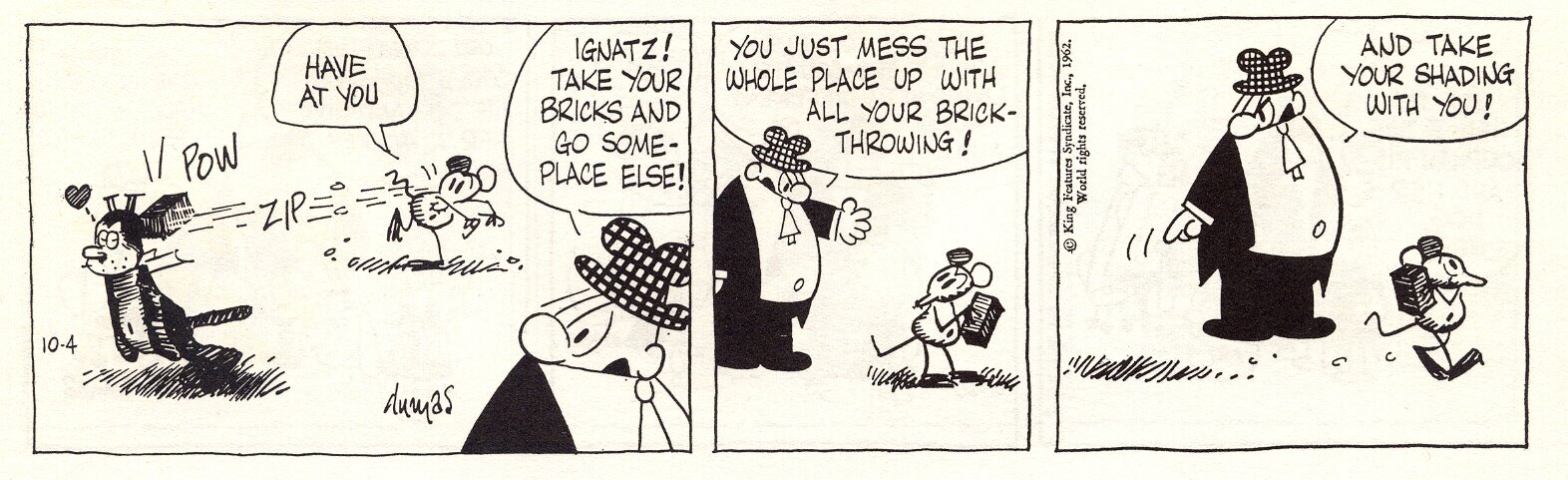
Sam, the title character of Sam's Strip, runs the comic strip Sam's Strip and is fully aware of being in the comic strip that he runs. Each strip offers a gag (and the occasional political nod) featuring Sam, his unnamed sidekick (later to be christened Silo in a follow-up series) and cameos from other characters from the world of comics (Blondie, Popeye, Charlie Brown) and fiction (Humpty Dumpty) and real life (Charlie Chaplin). The gags and jokes often challenge the world of comics -- characters know about the conventions of the strip they exist in; all the tropes (gloom clouds, black eyes, sleep logs) of comic strips are available in a cartoon prop closet; there are howlers and groaners, nice and terrible puns, interesting takes on famous jokes and scores of famous names dropped about.
The collection subtitled "The Comic About Comics" offers all the strips along with an introduction and an appendix of notes. Highly recommended.
Subscribe to:
Posts (Atom)