Wednesday, April 07, 2010

comatose and brain-dead

With Intervention, Robin Cook dares to venture into Dan Brown territory. I could have said Umberto Eco territory (purely for Foucault's Pendulum, but it would do Eco's reputation injustice while implying (incorrectly) that Robin Cook was capable of being more than a writer of serviceable medical thrillers.

begin flashback

I was an avid reader of genre fiction years ago and Robin Cook was one of the many whose books I picked off the shelves of the Popular Book House library and turned the pages of. Memories can tend to become more favourable over the years and this might account for my impression that I was entertained. There was a lot of information in the pages -- Cook was, like Crichton (who, interestingly, helmed the first of two cinematic adaptations of Cook's ouevre, Coma) and Grisham, to name a couple, the kind of writer who wove proof that he had done his research into the narrative. I do not recall having trouble finishing any of his books. Not being able to glide from cover to cover should have, in retrospect, told me that I had found a book that demanded more and would be more important than these potboilers. I remember quitting Cook when a book I picked up had a protagonist with the same name as a book I had read a week or so before. That, for me all those years ago, was the last straw. I could tolerate the guy hopping around in the medical milieu and finding places to stuff a thriller's narrative elements. But running out of names (or was it the same protagonist?) was just a sign of laziness.

end flashback

Intervention, now that I have turned over the back cover to look at the author posing with a smile in his house (presumably), seems like harsh punishment for daring to challenge my decision to abandon this guy's ouevre years ago. If Cook was good in his older novels, this novel makes them look like literary masterpieces. Cook stretches beyond his turf (the medical thriller) and tries to pluck clumps of grass from the Brown verdant fields of religious conspiracy and revelation. In doing so, he shows us why Irving Wallace's The Word is a far superior richer work. He also makes Dan Brown look like a nominee for the Pulitzer Prize. The characters are stock, the abuse of literally is appalling and the final portion of the book throws up a twist that comes early enough to make the rest of the limp conclusion even worse than it is -- Cook abandons a mix of narrative and dialogue and churns out hasty pages that look like a poor submission in an essay competition. If anyone's about to make an impulsive selection as I did and is looking for some advice, here it is: this dish stinks.

Sunday, April 04, 2010

the appropriation of abbreviations

CPU used to mean Central Processing Unit until Oracle decided to use the abbreviation to refer to Critical Patch Updates; apparently patches did not seem to exciting for some corporate lover of cornflower blue.

Tuesday, March 30, 2010

discombobulated? become a TV reporter

One of the many videos enjoying Internet air time after Ms. Mirza and Mr. Malik announced their decision to get married is this brief, typically pointless piece of fluff where two unseen reporters -- a dude confused in Hindi and a dudette tongue-tied in what appears to be English -- bandy sentences with Ms. Mirza's poised confident press-savvy mother. The video opens with Loquacious Lalita asking the first question, which alone is enough to send the jaw dropping while you decide to roll on the floor laughing (transcribed to the best of my ability given the limited support in the English language for onomatopoeia):

ma'am sania mirza has made such a huge decision now so you know like can you just um say that ah like what she's made such a big decision in her life the first so what do you want to say on that

[march 31, 2010]: Elsewhere, Ms. Mirza, while dealing with another motley crew, delivers a response that will look familiar to students of computer science working with threads on an operating systems assignment -- it's what happens when you let two threads write to the same chunk of memory in abandon: The date is the 15th for the reception of April. April, come she may, surely.

Monday, March 29, 2010

by any other name

Carol Reed's Oliver! is only the second musical I have been able to not just stomach but enjoy (the first was, and will always be, Singing in the Rain). Shorn of what I had come to see as Reed's trademark (canted camera angles in claustrophobic expressionist alleyways), the film is engaging as a musical while still retaining some of the dark drama of the original Dickens work (Although Fagin is not frightening enough, Bill Sikes might well be the most terrifying character in a any G-rated film as far as memory goes). The end credits of the film had me in splits for completely different reasons. How in the name of nomenclature could anyone have a career with a name like Graham Buttrose? IMDB seems to agree.

petrified

There's the Peter Principle, which guarantees that all incompetence in a hierarchy will find its right place. There's the Dilbert Principle, which assures me that incompetence is rewarded by promotion (the side effect of which is sometimes to remove such incompetence away from places it can be too dangerous for). There's the Software Peter Principle, which tells me about the effect on software of all those latent incompetent qwerties, who deserved to get promoted but were not bombastically incompetent enough. But nothing could have prepared me for the dazzling simplicity of the Dunning-Kruger effect. Their thesis, which won an Ig Nobel award, is fun to read, but if you're looking for a gist, here goes:

  • Incompetent individuals tend to overestimate their own level of skill.
  • Incompetent individuals fail to recognize genuine skill in others.
  • Incompetent individuals fail to recognize the extremity of their inadequacy.
  • If they can be trained to substantially improve their own skill level, these individuals can recognize and acknowledge their own previous lack of skill.

Put another way, this is all about people who are so dumb that they don't know how dumb they are. This reminds me of the story from a guy about his daughter and her singing. As a toddler, she insisted on singing loudly and clearly with nary a clue about how out-of-tune she was and how terrible it was for the ears of her listeners. He described her as unconsciously incompetent. As her days in school went by, she finally began to realise just how much her singing sucked. She was now consciously incompetent. She then started taking lessons and became a good singer. She now knew that she sang well and her listeners were now far better off. She had become consciously competent. After years of practice and performance, she became an artist of sorts. She had finally become unconsciously competent (People like Charlie Parker and John Coltrane who churned out endless runs of complicated yet masterful notes were in the upper crust of this category). The Dunning-Kruger effect seems to describe all individuals, who, for reasons unknown to quantum physicists and zoologists, appear to be atavistically inclined: they are destined to achieve new nadirs in unconscious incompetence.

Thursday, March 25, 2010

do you understand?

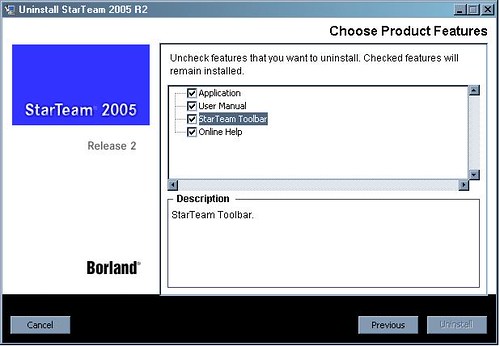
Here's something from the vault of silly screens. It was before Halloween when I was uninstalling StarTeam. The uninstaller presented me with a screen of options. It took me a while to unravel the combination of assertions and negations and make sense of what was expected. Surely the people who designed this screen are related to those who write code like if (!true != !false).

runners

Wednesday, March 24, 2010

rubies from rediff

Ever-so-busy Amogh points me to the recent edition in Rediff's chats. This one features Malaysrilankan beauty queen Jacqueline Fernandez (of course she's part of Bollywood!). The most common thing in the chat is a greeting from every Shyam, Kamala and Tukaram who logs on. Thanks to how the slide show is now implemented, it's hard to give you absolute URLs, dear reader. Thus I must ask you to click "Next" on the first page to get to the second page. The gem arrives at the end of the page:

abdulwahab asked, Hi, Which is your favourite Hindi filim?
Jacqueline answers, I love Dev D and Devdas! Both types of cinema interest me a lot.

Monday, March 22, 2010

super power gets cycle-savvy

According to a Wired article, the Federal government of the United States of America has now decided to consider pedestrians and cyclists to be as important as motorists when deciding which projects to fund as far as infrastructure and the like (you know, roads, mass transit, rail). It's been so long since 1776 that you realise the big draw of the USA is not that the government has a better sense of what is required to improve the quality of life (communities of people instead of isles of isolation and over-emphasised privacy, connected places, more than one way to get from place to place). The big draw has always, IMNSHO, the dollar. The big bucks. Take that away and let's see what happens. Let's not even start with "health care" (what a paradoxical phrase).

Saturday, March 20, 2010

the curious case of the dog

image courtesy: indiafm.com
It happened when I was reading the Scribner hardback edition of Stephen King's Under the Dome (ISBN: 978-1-4391-4850-1). The material seemed familiar and the King flourishes abounded. I was prepared for reading what looked like a return to territory last explored in The Mist and The Tommyknockers. The trouble started in chapter 4 of the section called "the good of the town, the good of the people." I was now familiar with Julia Shumway and her 15-year old Corgi named Horace. Chapter 4 begins with her getting ready for a night walk with Horace when her cellphone rings. It's Colonel James Cox of the US Army. Page 122. The conversation is about to end when, on page 125, a strange thing happens. The dog's name changes to Hector. This transformation lasts till the end of the chapter on page 127. What started with Horace -- waiting by the door, more than ready for a nighttime expedition now that he was cleaned out and fed -- pricked up his ears and looked around at her becomes Hector continued waiting patiently by the door and At the door, Hector pricked up his ears.

[march 30, 2010]: "Are you sure you have an authentic copy?" asks Sarika. This prompts me to check Google Books. Lo! The version available there (relax, it's just a preview, you passengers of the Black Pearl) is a corrected one. Closer examination reveals that it's a Simon and Schuster illustrated edition; the ISBN's the same, but this is most likely a newer version. I guess that makes the Scribner first editions collector's items.

knock on would

PC is charged! screams the headline of an article in the Hindu in which we are told that the winner of the National Award for 2009 for Best Actress was thrilled to have found out that I am one of the youngest actresses to win the National Award. Aside from being another article that confirms the title of her next film with Vishal Bhardwaj (Saat Khoon Maaf), this fluff piece only merits mention for offering another case of abuse of would (And by the end of the year I would be doing some high-class action in the sequel of Don). Did the former Miss India say that? Would she say that? Or should we blame someone named Anuj Kumar for paraphrasing piecemeal quotes tossed to a roomful of people from the fourth estate? Would anyone really know?

Monday, March 08, 2010

the ex-wife wins

Surely a record. I'm just relieved that Cameron's Avatar didn't win the Oscar for Best Picture. It would've been their राजा हिन्दुस्तानी. Yay for Pixar (no surprise methinks) and here's hoping more people watch Near Dark and Strange Days. I knew watching Blue Steel years ago would turn out to be pivotal for me. Refreshing IMDB's main page is so much better than sitting through the ceremony

Saturday, March 06, 2010

axis2: the sequel reeks

(outpourings biased by a series of unfortunate events)

I recently returned to the natatorium of web services with the most variations of alphabet soup, the most fertile bed of specifications, some unfortunate acronyms (it's the time to DISCO ... get yourself some ROPE ... and who can forget SOAP?) and enough layers around an old idea to make it look like an adorned overfed pachyderm. The tools seemed to have improved; or perhaps they had just grown to have stronger armour to withstand the onslaught of specifications and protocols. Axis, the most popular open-source toolkit for web services had made way for Axis2. Axis2, it turned out, had decided to try and beat the WS soup nazis at their own game. It came up with its own complex design (ADB, AARs) and its own alphabet soup (an object model called AXIOM).

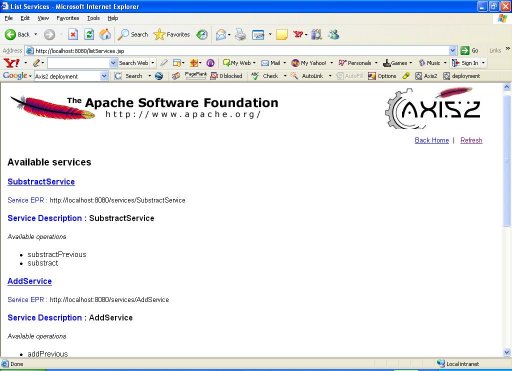
Getting started was not a problem, but once you started using the beast, you began to see the cracks. A simple client needed 18 JARs and notched a footprint of several megabytes. You saw all the typos (When users sends SOAP messages) and poor grammar (User care able to set his own mime-boundary string using this property) in supporting articles and in the documentation (Substract?). You also saw how careless the documentation was at times (the supporting text files for the 1.5.1 distribution contain URLs for the 1.4 distribution). You were taken aback at how incomplete (why have two articles on configuration parameters, when you could have just added some more javadoc? Then there was lack of support for enums, which is unfortunate because you just lost a clean strong way to enforce some constraints on parameter values. It's also a bit silly since J2SE 1.5 is the JDK of choice and the support for enums represented one of the most useful things that came with that version. If you wanted to try using minOccurs or maxOccurs, you were out of luck again. It all started looking like a giant step back for WS-kind.

Let's not even get started on interoperability or support for Spring. There's a very limited view of the world as far that last thing is concerned and it's a gross violation of the larger view that the developers of Spring have adopted. It's time to look at something simpler and more useful. After all, getting an elephant to guard your house soon becomes an economic problem (there's also the pachydump to consider).

(a few hours later). Oh great! Despite tall claims, Axis2 has severe problems with basic inheritance.

(a few days later). I am of the opinion that the quality of logging in any project says a lot about the quality of the project itself. This makes Axis2 suck even more. Let's start with org.apache.axis2.context.AbstractContext and scroll down to the method debugPropertySet(String key, Object value). The following block of code contains enough to send your lunch back up your throat:

log.debug("==================");
log.debug(" Property set on object " + identity);
log.debug("  Key =" + key);
if (valueText != null) {
    log.debug("  Value =" + valueText);
}
log.debug("  Value Class = " + className);
log.debug("  Value Classloader = " + classloader);
log.debug(  "Call Stack = " + JavaUtils.callStackToString());
log.debug("==================");

What a great place to practise your minimal competence in ASCII art. The fun doesn't end here. Let us turn our attention to org.apache.axis2.util.JavaUtils and specifically to the method callStackToString.

/**
 * Get a string containing the stack of the current location.
 * Note This utility is useful in debug scenarios to dump out 
 * the call stack.
 *
 * @return String
 */
public static String callStackToString() {
    return stackToString(new RuntimeException());
}

/**
 * Get a string containing the stack of the specified exception
 *
 * @param e
 * @return
 */
public static String stackToString(Throwable e) {
    java.io.StringWriter sw = new java.io.StringWriter();
    java.io.BufferedWriter bw = new java.io.BufferedWriter(sw);
    java.io.PrintWriter pw = new java.io.PrintWriter(bw);
    e.printStackTrace(pw);
    pw.close();
    String text = sw.getBuffer().toString();
    // Jump past the throwable
    text = text.substring(text.indexOf("at"));
    text = replace(text, "at ", "DEBUG_FRAME = ");
    return text;
}

Turn up the logging for org.apache.axis2 to see what I mean. Your log file will start looking like Armageddon and none of the traces will offer any useful information. The lack of respect for both performance and the usefulness of information is, however, appalling.

[march 23, 2010]: I should have just seen if Hani Suleiman had anything to say about Axis2. Guess what? He already said his piece in 2006. It's all there in the bile. If only I had read this first: I agree about the documentation, the language, the quality of code (System.out.println calls instead of logging calls; a complete lack of logging in core code, which means that I have exactly no idea what's going on behind the scenes even with the Axis2 code in front of me). Heck! I agree about everything. I wonder how the ASF let such a sub-par project into its fold. I leave you with a sample log message (some details have been removed in the interests of privacy) from the morass of one of the numerous builders floating in the source tree: Build the OMElelment obfuscatedFieldNameBy the StaxSOAPModelBuilder
Saturday, February 27, 2010

ellison calling bollywood

Serves me right for not finishing the collection Dreams with Sharp Teeth I had bought several months ago. The final story in that compilation was something called Shatterday (go read it to figure out where that name came from). It's all about this guy called Peter Jay Novins who accidentally dials his home phone number and ends up talking to himself at the other end. It's been adapted for television too. That nugget of a premise should suffice to encourage you, dear reader, to utter three words: Karthik calling Karthik. You can be sure of one thing -- Karthik's a South Indian (the h is the giveaway, cotton-brain!). IMDB tells me his last name is Narayan, which still leaves some room for doubt, but I'll put my bets on दक्षिण. Perhaps someone should let Mr. Cordwainer Bird know.

Monday, February 22, 2010

another groaner

If Vijay Mallya's daughter got married to a Chinese guy and decided to emulate Miss World 1994, what would she become? A Mallya-Lee.

Sunday, February 21, 2010

the soup is hot, the soup is cold

I am not a fan of epics. I just can't enjoy all that fancy fighting and valour in skirts, armour and something other than a bulletproof vest. Since history is often distorted, I can't even expect to get information wrapped in entertainment. This means that the only reason I set my butt down to watch Joseph L. Mankiewicz's epic peplum Cleopatra would have to be masochism. This was the restored 4-hour cut (the opening and closing overtures might contribute a few more minutes) and what scares me is that this came from an original 6-hour cut that Mankiewicz had hoped -- wisely, I must say -- to see as two 3-hour pieces, Caesar and Cleopatra and Antony and Cleopatra. The names make more sense than the title of this elephant. It's a problem much like that with Inder Kumar's Raja (where we were all relieved that the film was not as much about Sanjay Kapoor at all).

The lines caught my attention more than anything else: there's innuendo, sarcasm (perhaps unintended), chauvinism (were she not a woman one would consider her to be an intellectual) and even my breasts are full of love and life; my hips are rounded and well apart; such women, they say, have sons. There is promise of a different kind of humour in lines like officially divine, at last, but it would seem that one would have to turn to the Carry On team or Monty Python to milk that cow. Cleopatra's when i am ready to die, i will die presages the Oracle in The Matrix series (or perhaps, the Oracle was Cleopatra in some alternative world).

At some point, I started seeing political allegory in the film. I started thinking of the Romans as the US of A meddling in the affairs of other countries. I couldn't think of an entity in the present day to match Egypt as it struggles to protect its art from the Romans and tries to convert its advantage in supplies to one of power. Some of the dialogue would fit rather well in a modern-day adaptation: there is no such thing as an unnecessary war, the way to prevent war is to prepare for it. If someone takes this idea to fruition, I just hope it's with a film that's not as butt-unfriendly as this one.

Saturday, February 20, 2010

what the hell happened to rosemary?

I am still trying to figure out what significance Béla Bartók's Mikrokosmos had in Lamberto Bava's most famous film, Demons. The fake splatter gore and the host of heavy metal songs on the soundtrack are the attractions; the straightforward narrative sans political commentary of any kind is not. I wish they had chosen to retain the Italian instead of dubbing everything into English. The resultant psychobabel of a film is a murder by numbers effort; the victims are people invited to a special preview at a theatre called Metropol, whose walls are covered with posters of films like No Nukes, Four Flies on Grey Velvet (co-written and directed by Dario Argento who also co-wrote and produced this film), AC/DC: Let There Be Rock. I wonder if the Coca Cola vending machines and that can in the car represent product placement. The opening titles are underscored by a riff that sounds familiar; the theme sounds like Rockit served with a dash of Vangelis. But it's the heavy metal songs that dominate the proceedings once the screaming and killing begin. The finale is introduced by one of the greatest surprises I have seen in a long long time, but the twist over the end credits unfortunately reinforces a cliché. This is Romero stripped of allegory; if you don't mind the aphasic dialogue and like your gore served up funny, you will enjoy this.

get ready for the pulp

In the wake of the release of Daylight Robbery, there are signs of an increasing interest in this "revival" of Indian pulp fiction. Siddhartha points me an article over at Tehelka about Surendra Mohan Pathak (you've heard of Sudarshan, of course).Sudarshan raises the stakes with another article at Tehelka written by the Pastor of Pulp himself -- it's a review of a recent translation of two Ibn-e-Safi works along with notes about the author, who got an endorsement from the Dame of crime writing herself. He also tells me about an article in the Hindustan Times that includes a conversation with the man. Splatter me!

[march 28, 2010]: It takes me about a fortnight to shout out "He's famous!" after Sudarshan gets his mugshot and an interview in The Hindu. Awesome!

Wednesday, February 17, 2010

groaner

If they decide to make a sequel to Mili, they should call it Mil(l)isecond.

Monday, February 15, 2010

my name is thackeray and i am a hypocrite

Following SRK's remark of regret that no Pakistani cricket player had been bought by the IPL clubs, the Shiv Sena, a party famous for its extremist bigotry, unleashed its fury and threats at the star. The Sena then decided to make his forthcoming film My Name is Khan (released on Friday last week) the target of a boycott of violence (something they've been rather successful at). CM Chavan went through the motions of warning the Sena, assuring all protection to Khan and his can of film and then expressing his hope that good sense would prevail. Then the Sena decided not to kill the commercial goose and then went stateless like everyone's favourite kind of EJB and went back to threaten ape poop on the film's future. The state did what it could: 1000 sainiks were detained. Several cinema theatres and multiplexes, knowing fully well that no form of law and order either on paper or in practice would help them against the might of the Shiv Sena, decided not to screen the film. People, however, wanted their star. There are some things that defy the laws of physics; the Sena didn't stand a chance. The Sena refused to consider this a failure. They continued to chastise the administration and pat themselves on their backs.

Meanwhile, disaster struck in Pune. A bomb went off at German Bakery. The tragedy was followed by the usual mix of vacuous news reports and angry tweets (mixed with several tweets loaded with information) that cursed the politicians, the police and the government. The crowning flourish came now from Uddhav Thackeray. He decided to blame the CM and his "immature politics" and alleged that the blast had happened because the CM had sent all the security over to protect the Khan and the film. Sigh. Will all the people who support the Shiv Sena and dare to possess a smidgen of sound common sense please tell me exactly why they continue to support this confederacy of dunces?

Saturday, February 13, 2010

i want more sand in the desert

That's what Vittorio De Sica screams at one point in After the Fox. One wonders if Nagesh Kukunoor was running this film in his head when he wrote Om Puri clamouring for more balls in Bollywood Calling. The line in the Italian/English film is loaded with more bite, however. You see, De Sica is playing a director named Vittorio De Sica directing what is evidently a peplum in the desert. De Sica also directed this farce that makes digs at directors like John Huston (the reference to him playing Moses being the most obvious one), Fellini (the brooding artist and his angst; the film's climax featuring an exhortation in the defence of art), Antonioni and De Sica himself. Victor Mature plays Tony Powell, an alter ego of himself -- at one point in the film we see an old film starring Tony Powell playing in a theatre: the film is really Easy Living, which starred Victor Mature himself. Tony Powell isn't even his real name -- it's Tony Ampulski (a dig, perhaps, at Italian actors who became famous with English names in the dubbed versions of their films -- Bud Spencer and Terence Hill, anyone?). The film, written by Neil Simon, mixes over-the-top characterisations with very funny lines (you're even more beautiful in real life than you are in person, great jokes (the Fox reading a book by Stanislavski, truck drivers reading Playboy, politically incorrect use of the veil) and also a film within a film. If you love movies and you know your movie trivia, you'll enjoy Peter Sellers hamming it away as Aldo Vanucci; you'll nod your head when Aldo Vanucci talks to Miss Okra through a girl in a bikini, because you saw the first sequel in the Austin Powers canon and that had a similar scene in it. [June 28, 2009]

Saturday, February 06, 2010

cacophony

Deepika Padukone (pronounced पाडुकोण) saying anything. That grating accent must go. Remake Reshma aur Shera with the Big B's character changed to a woman and give her that role. There will surely be an award or two. That should suffice to encourage the silence. Alternatively, one implores RGV to rope her in for a native part in one of his forthcoming films. He loves having घाटs in his flicks and they lend credible colour and texture to the goings-on set mostly in Bombay, Pune and their 'burbs.

Lucky Ali should sing a song for Farhan Akhtar. Why hasn't someone considered this yet? Perhaps because Farhan Akhtar chose to warble his own way in Rock On!!

Someone should make a movie starring The Nasal Warrior in which his character sports a feminine alter ego with the voice of Lata Mangeshkar. The title? How about काँच को क्या आँच?

Friday, February 05, 2010

to become the first superpower to developer super powers

It's a hotel room in Kuwait. George Clooney sits on the bed and explains a Jedi warrior to Ewan McGregor. This is probably the movie joke that's easiest to understand in The Men Who Stare At Goats. If you know why "Ask Angela Lansbury" is funny, pat yourself on the back. If you don't, it's hard to tell you why without ruining the experience of a classic film (and I don't mean this one) for you. Jeff Bridges taps into Jeffrey Lebowski as he plays Bill Django, who, after an epiphany during the Vietnam War, goes hippy and returns to found the New Earth Army -- an army of modern-day Obi Wans. George Clooney plays Lyn Cassady with his mix of star power and whimsy. His straight face gets all the laughs you can ask for while the content of McGregor's voiceover keeps you smiling. Kevin Spacey, as the villain of the piece, seems to be trying to explore nooks and crannies in the ham sandwich showroom. This drama of men is not a dark brooding allegorical meditation like Apocalypse Now or Platoon or even the starkly straight-faced Full Metal Jacket. There isn't anything terribly profound in the goings-on even though the dark comedy skewers popular culture and American silliness while reinforcing everything we might have thought was wrong with the army. With several quotable lines, the only problem is that this quirky and bizarre flick works without any bite. It seems to miss the optimum trajectory.

Wednesday, February 03, 2010

SMP returns

Sudarshan is back. After The 65 Lakh Heist, he and Blaft are back with Daylight Robbery. Blaft now lets you buy the awesome items in their catalogue from them without having to waste time in the aisles of bookstores searching in vain or talking to clueless store attendants. The word heist was, from personal experience, not a very helpful word, when one evaluated the reactions of the aforementioned attendants (no habla heist). If you're in desiiland and you want to let Sudarshan know that you think this is cool too, head over to Blaft's website and order a copy.

Saturday, January 30, 2010

revivah


Mawidge...Mawidge is what brings us together
-- the impressive clergyman (The Princess Bride)

[January 07, 2007] One could think of a few reasons why Sooraj Barjatya would want to unleash upon the modern masses a film like Vivah that lives in a sandbox of the yesteryears, of the innocence of the family dramas of the 70s and the early 80s, of the simple events that formed the foundation of Hrishikesh Mukherjee's canon. The most important one is to ensure that Alok Nath continued to receive a welfare cheque (this was before Rajshri took over the idiot box and sent Alok Nath back to where he came from, plumper, older, slower and donned in garbs so ornate as to put Sanjay Leela Bhansali's costume designer to shame). A minor reason is the warped sense of the world that Barjatya nurses. It's a world without shades; there is only good and evil (which can be counted upon to repent and come over to the good side in less than 3 hours). It's a world where emotions are thicker than the pancake syrup in Waffle House or IHOP, sweeter than the most generously glazed doughnut from Krispy Kreme. It's a world that should simply cease to exist. It's a regressive nightmare that purports to offer a form of optimism that is more dangerous than the darkness nihilistic cynical view of the world you might find.

The film has very little to hold your attention. The script is a poor blend of Satyam Shivam Sundaram, tired dross of love without event and Rajshri tropes. The songs are terrible (Ravindra Jain, who delivered many a memorable song for Rajshsri products in the past, does his reputation a great disservice), the sets are a tribute to unsubtle artifice, there is nothing you can call "acting" (although there's a lot of blah-blah, posing, glaring and gesticulation) and there are musical cues added to underscore moments of "comedy." The events, as they are, occur in fictional places named Madhupur (if only someone had renamed it Sweetwater in the subtitles) and Somasarovar (Lake Luna, people).

If you care about subtitles, watch out for (sister:sister) (sister-in-law:sister-in-law), soiree (for संगीत). If you care for lazy background scores, keep your ears perked up for the Doom fireball sound as the camera tracks the fire.

Just in case your dropping jaw made you forget who was responsible for this Clockwork Orange Cocktail, the protagonist is called Prem, there's a wedding at the heart of it all and there's a wedding band playing दीदी तेरा देवर दीवाना. If you missed the presence of his lucky mascot, watch out for a poster of Salman Khan in a phone booth as well as two posters of Saawan ... The Love Season (yes, that film with the crazy song).

Mercifully, neither Herr Nath nor Herr Barjatya have dared another big-screen venture. Unfortunately, they decided to take their terror to the glass teat. Luckily, I don't watch TV.

no objections to disclosure


there is no such thing as [sic] free lunch
-- Raj Malhotra (Akshay Kumar)

[May 29, 2006] Known for giving Priyanka Chopra the role that earned her a Filmfare Award for Best Villain (and becoming only the second woman to do so), Aitraaz also offered several songs from the Nasalite that became hits, characteristic Bollywood hamming, extremely poor scripting and dialogue. With producer Subhash Ghai's blessings, the Burmawalla brothers took Disclosure, stripped (no pun intended) it of anything that might prevent their copy from getting the U certificate (they settled for U/A). The background score from Salim-Sulaiman evokes memories of Enigma, while the subtitles department goes gaga turning "ladies room" into "living room," तलातुम into "quagmire" and 987 into 973. A variation on Carmina Burana plays every time Priyanka Chopra's character, Sonia, is seducing her next victim. The songs are silly enough: गेला गेला features Akshay Kumar and Kareena Kapoor on the beach doing a stupid dance while four babes of varying dimensions are wearing bikinis and sashaying on a boat in the background; I wanna be with you (ये दिल तुम पे आ गया) features Akshay Kumar and Priyanka Chopra taking a family-friendly shower together, having a jacuzzi moment and then ending up in bed (curtains please); I wanna make love to you is shot in one take (interesting) with Priyanka Chopra delivering an act of seduction and shooting playing cards from a deck into Akshay Kumar's face just as the song goes into जुआ जुआ प्यार का.

Every film I remember by the Brothers Ripoff has boasted a sign with an egregious spelling mistake; this one butchers इत्तेफ़ाक़ (it becomes इत्तफाक).

There's as much "sensitive" content in this film as can be expected from a Bollywood bowl hoping to reel in the moolah without offending the prudes, the housewives and the "innocent" youngsters. Consider the scene where a groups of guys at a restaurant go drooling over a picture of Sonia on the cover of a magazine before one of them takes the magazine (to a private place, no doubt).

Consider also the following lines from an exchange between Sonia and Raj (Akshay Kumar):

sonia: show me you're an animal raj; show me you're an animal

raj : तुम s*x के लिए मुझ पर मेहरबान हो ...

sonia: what do you think eh? i'm a bitch; i'm a slut; a bloody prostitute?
raj : do you think i'm a male prostitute जो तुम मुझे अपने दिए हुए post और पैसे के बदले में इस्तेमाल करो? no!

Things take a turn for the worst as the film hurtles slowly to the inevitable climactic courtroom drama. Bollywood's continued ineptitude with this rather common setpiece is obvious when Paresh Rawal calls Akshay Kumar to the stand during his opening statement. Annu Kapoor's character (named राम चौतरानी, the most interesting name in the film) gets a line of dialogue laced with different synonyms in Hindi for tush. He also gets to make sweeping pronouncements like समाज में दो किस्म के लोग रहते हैं: औरत ज़ात, मर्द ज़ात. He tops this all with the immortal line खरबूजा खुद चाकू को मजबूर कर रहा था कि आ ... काट! come and slice me!. There's a nice shot of Priyanka Chopra sitting in the witness box; it's a silhouette with a decent use of light. It's the only saving grace of a film that largely seems to have been made in the absence of a technical crew of any kind.

The moral of the film is two-fold: it is extremely convenient to have a lawyer as your neighbour; it is really convenient to have a wife who has an LLB.

This film also contained, for those of you who were not busy ogling at Kakista Kapoor and Ms. Ooh-La-La, a reference to next year's Bewafaa, which Akshay Kumar and Kareena Kapoor starred in; what else can one make of Akshay Kumar turning to Kareena Kapoor just after uttering और ये वो वफ़ा है जो आदमी को बेवफा होने नहीं देती? I leave you with Kareena Kapoor's immortal axiom.

mrs sonia, bitch वो होती है जिसको अपने बच्चे के बाप का पता नहीं होता

the dangers of surveys

Sudarshan has a new post up in which he gives it (Tehelka's survey of Indian readers of English writing) those ones (justifiable barbs and objections). The post only goes to show us the familiar danger of any kind of survey. Your two problems are the sample set (the people you survey) and the questions you ask (if you ask questions like all those moronic reporters on India's numerous channels, the respondent often just has a boolean reply for you). Tehelka's survey seems to have suffered from both problems.

There are a few interesting things in the result. The appearance of Chetan Bhagat is not surprising, but the absence of Shobha Dé (whose ouevre clogged several rows of shelves in places like Crossword) is strange. "Indians" supposedly spend 360 post-colonial rupees on books every month. This means that Penguin is probably not doing so well, because you'd only get a book and a sixth from their catalogue. Most readers, according to the survey, read for learning; the most popular books are those with action and adventure, the thrillers and mysteries. Combine these two and you have to wonder what people learn. I sign off by remaining stumped at how frequently the Bard figures in this survey. Do you really expect me to believe that the unabridged Shakespeare is so popular? This is the stuff that dreams are made on. Oh, and please get a new keyboard and someone who understands why turning on CAPS LOCK IS SUCH A BAD IDEA!

Wednesday, January 27, 2010

why

were people clapping so often and indulging in standing ovations for President Obama's State of the Union address? Perhaps I'm too jaded from all those pep talks from corporate executives laced with crapspeak, loaded with words of familial encouragement in the aftermath of layoffs (oh, sorry, "reductions in force"). He trounced DADT, delivered the familiar litany of "healthcare reform" and "immigration reform." The sense of déjà vu was strong. Some people probably need and welcome this motivational stream, but I'd like to see some exhibits. I'll wait. (Someone should have put a cushion on the podium ... the thump of his hands was ominous).

Tuesday, January 26, 2010

liberty gets a memo

On January 11, 2010 at EWR, many H-1B holders aboard Continental Airlines flight CO 49 found themselves at the mercy of the CBP. All this thanks to a new memo from Donald Neufeld, Associate Director, Service Center Operations, USCIS. The memo tried to explain what a valid "employer-employee relationship" meant when one considered H-1B petitions. I found just one post online that talked about the memo and had more details about the incident itself. I was unable to find more about the people who were deported. The actions of the CBP clearly qualified as a "means to the end" -- authorities have been trying to crack down on the consulting firms of questionable repute that have long given the H-1B a bad name. The measures taken at EWR probably achieved this to some extent. It is quite likely that some of these people were lax with the documents they had to carry on their person. It is also likely that some were taken by surprise and behaved in a manner that made them vulnerable to unfortunate coercion. The details of the actions invite a sense of discomfort -- can someone really get away with "hunting for Indian H-1B workers"? with "remarks about why these H-1B workers earned more than U.S. workers and that they should not be paid so much"? The CBP and TSA have always been particular about noting their professionalism and courtesy in such matters. Then how did such events come to pass? The lack of sufficient coverage is also disturbing. Without such coverage, it is hard to get facts. Without facts, it is difficult to raise a voice in protest, to ask that power not be abused thus? Surely that is not too much to ask, is it?

what if someone pretending to be confucius used Eclipse

depecrated (deserves to be execrated); chinese internationalisation (whatever); this abstract class houses default and common implementation for some interfaces (very observant); all tranctional processing classes are responsible for calling this method and for providing what action is provided (schizoid indecision); used to identify newly instantiated instances (काला टीका?); later is to be (absolutely). This is a heck (what the hack!).

Someone would get paid for writing code that invoked the toString() method on an instance of java.lang.String. Meanwhile, in the woods, someone talks about methods consuming a lot of memory consumption (Borges would be proud, no doubt).

Monday, January 25, 2010

those dusty cans of nitrate

White Zombie [January 29, 2007]: It's hard to be interested in horror films and their history and not have heard of White Zombie. Besides, once you've seen Bela Lugosi as Murder Legendre sporting Jack Pierce's makeup, you can't quite forget that close-up. The film's a cheapie that reuses sets on the Universal lot, but has, to its credit, some moments rich in atmosphere. There's unfortunately not much to applaud in the acting department. Lugosi is himself and makes this perhaps his most memorable role after having sealed the fate of his career playing the sanguinary Count. The background score makes up for the film's limited use of dialogue and there's a chant you hear over the opening credits that sounds like the parent of the chant of initiation in Finding Nemo.

Chak De! India [October 06, 2007]: After directing the wonderful Ab Tak Chhappan (aah, the iTrans-friendly title), Shimit Amin quit RGV's Factory (something that a lot of the talented people there have been doing for the last few years). When he landed at Yash Raj Films, it was hard to contain the surprise and shock. The fear was that he had sold out. Talent had turned pragmatic. When he roped in Shah Rukh Khan (not surprising since SRK's the leading contract player of sorts there and over the fence at Dharma Productions), one could only fear the worst. Then we found out it was a sports film (now, how many of those do you have?). We then noticed that Jaideep Sahni (the man who wrote Jungle, Company Bunty aur Babli and Khosla ka Ghosla), another RGV expat, was handling the writing and the lyrics. All this set the stage for something that might satisfy both camps -- those who cared for films that looked like they were made by people who had their wits about them and those that cared merely for star vehicles. As it turned out, this engaging ensemble effort did. Shah Rukh Khan did another Swades, but with far less grandeur. There seemed to be no moments for the camera. Kabir Khan instead seemed like a man who had borne the religious bigotry and the bad luck of failure well and who had let it drive his rage to snag one last shot at glory, even though it would be from the shadows. The structure of the film was familiar to those used to watching all those sports films about underdogs that played on cable television here in the US and on Star Movies back home (The Miracle, Hoosiers). The film unfolded with one familiar flourish after another, but each was delivered with competence. What you got at the end was something that you could watch without adjusting your derriere on the couch or letting your mind drift to times better spent. There were great scenes (Bindiya Naik coming on to Kabir, the locker room speech that could have become a crowd-pulling rabble rouser but ended up being more of something else) seasoned with clichés both welcome and unwelcome. You got interesting characters (Kabir Khan, Bindiya Naik) who shared the screen with stock characters played well. All this still didn't acquit Amin. One had to wait for his next film to find out what turn he wanted to take.

Sunday, January 24, 2010

what songs can teach you about grammar

the good things: Get Together (made famous by The Youngbloods) boasts an understanding of the difference between each other and one another in its most famous line: come on people now, smile on your brother, try to love one another right now.

the bad things: In their third studio album Phantom, The Fixx cut a track, whose title became another of the many woeful examples of the failure to understand the difference between few and less. The track was called Less Cities, More Moving People.

a perspective standpoint

The froth from the rant about the egregious abuse of perspective was just beginning to dry when the cult of the evil twin surfaced. The name's standpoint and its exploitation has nothing to do with social science. The template remains the same: from a/an X standpoint. The chief culprits are overpaid bearers of corporate RIMjobs and under-educated code monkeys who climbed up the rungs of the corporate ladder to expound balderdash using Tufte's bête noire. There can be no more effective way to divest oneself of the faculty of simple English than to sit listening to one such wrongdoer confidently hurl inane vacuous phrases like from a management standpoint, from a maintenance standpoint, from a customer satisfaction standpoint (notice the return of the noun-as-adjective kludge of lazy speakers) and from an overall quality standpoint. The irony in it all is lost on such windbags. All you can do is gnash your teeth from a sitting standpoint.

Saturday, January 16, 2010

a (small) purseful of previews

The man who made the interesting Main Madhuri Dixit Banna Chahti Hoon and the Hrishikesh Mukherjee film of 2005 (Main Meri Patni Aur Woh) returns with Striker. When was the last time you saw a trailer that opened with a carrom board? It might be a sports movie of a different kind but it looks like a familiar masala mix. One can only hope it's done reasonably well.

Ben Kingsley and Amitabh Bachchan appear on the same cast roster with Teen Patti. Kingsley supposedly plays a mathematician called Trachtenberg and it's a relief that his character's first name is not Jakow. The only rub is that the film's directed by a lady called Leena Yadav, who was responsible for that creatively misguided blotch of guano called Shabd.

The nicest thing about the trailer for Prakash Jha's next film Rajneeti is not the cast (The promise of Manoj Bajpai -- almost unrecognisable with the extra lard --, Nana Patekar and Naseeruddin Shah is offset by the presence of the likes of Katrina Kaif and Arjun Rampal). It's that voiceover that runs throughout in careful measured effective Hindi. This is not Hinglish. This is pure Hindi. It's disappointing to see the title surface at the end in English and a boring font (had it been in Hindi, we'd have remembered Govind Nihalani, who unflinchingly presented all the credits on his films in Hindi). Jha's recent efforts (Gangaajal and Apaharan) have been only moderately satisfying. One hopes that this supposed take on the Mahabharat (assignment: watch Benegal's Kalyug again) makes up for those.

Saturday, January 09, 2010

a handful of signs

During a recent visit to Chennai, the eyes spotted some interesting signs.

hoome appliances: blenders for रुदाली?

hotel ginger garlic: they named a hotel after a popular paste at Indian stores?

golden edelweiss: Am I alone in thinking that this is a euphemism for guano? There's also the surreal image the meaning conjures (golden noble white?)

baba pile foundation: A treatment clinic for haemorrhoids named after some godman or that famous star vehicle? Curious. Very curious.

balaji's hot spot: Possibly blasphemous. Great name for a fusion club or the first South Indian strip joint.

dutch betrayal

Some of the things movies teach you are funny. There I was watching Body of Lies (soon to be "remade" as जिस्म झूठ का), specifically the aftermath of a terrorist bomb in Amsterdam. That's when I found out what the abbreviation for the local police was. KLPD. I kid you not. Now, if you're Indian and you haven't been living a sheltered PG life or you haven't watched Monsoon Wedding, you know why I'm laughing.

Friday, January 08, 2010

my daddy cyborg

The Tamil Nadu state government, in a familiar political, pig-headed, jingoistic flourish, offers an exemption from Entertainment Tax to Tamil films bearing Tamil names. This is why Godfather hit the marquee as Varalaru. This is also why the next Rajinikanth/Shankar vehicle lost the name Robot and became Endhiran. (I must digress to note that I missed seeing the young old star when he showed up on Pune for a shooting stint for this flick). OscAR Rahman does the musical honours and Vairamuthu shares lyrical duties with Pa. Vijay. The former lyricist whips up a lyrical howl (go to slide 3) with Robovuku thaai mozhi kidaiyadhu, thandhai mozhidhan undu, which supposedly means A robot does not have a mother tongue; it only has a father tongue. Eh? Cyborg ain't got no lingua माता, but he sure got his daddy's licker. Eesh! Excuse me, while I get some Listerine.

word wrap

Seen on the menu in Chow Baby: Your first and only bowl we will wrap up for any additional bowl wrapped up will be 8.99

Were these messages outsourced to the land of IT rowdies or was the person writing it desperately trying to make it in time for a conference with Mother Nature? You were probably so in thrall of the wonderful stir fry on the table that you didn't notice.

Friday, January 01, 2010

kaalaa Tiikaa: DVD style

dear moser baer,
I would like to thank you for doing for DVDs what T-Series did for CDs. It feels much better to buy DVDs for prices like 99, 149 and the like (INR, of course) than 299, 399 and the like (INR, again). After all, Eagle Entertainment, Eagle, Eros, Adlabs, Sony/BMG, YashRaj Films and Shemaroo are also only giving me a DVD. There's nothing to speak of as far as cover and sleeve art are concerned. In fact, there's nothing at all to speak of in the manner of packaging. I will not mention special features, because that is something India does not understand (I must note that there are some exceptions, of course, but they are, after all, exceptions).

But I digress. I am sure I am not alone in finding watermarks tossed onto the film frame by DVD companies annoying. All of you companies insist on adding short unskippable films parading your logo on the DVDs; I have wondered why pressing the menu button on my DVD's remote control takes me to this loud movie instead of the menu; but I digress again.

Could you tell me why you insist on retaining your watermark on the entire film? Other DVD companies add their watermarks like screensavers -- they appear for a few several seconds at important moments in the film (songs for regular Bollywood far; random moments in "art" cinema). Knowing that these companies didn't care, I had almost made my peace with this annoying feature that destroyed the movie for me. I would like to just let you know that your decision to make this watermark (how can I call it a watermark when it's so plainly visible?) as permanent as a birthmark, a port-wine stain.

Thank you for not caring.

Thursday, December 31, 2009

great decuman dancing derrieres!

runners

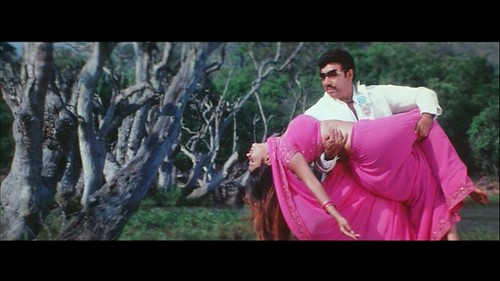
As the year draws to a close, it is time to unveil another gem from Englishkaran. The hour is ripe to introduce the heroine of the film's second half. Namitha's the name of Lady Lipids. She put a bikini to shame in Billa and returns in this film to challenge the limits of human acceptance of size, proportion and taste. Jiggles has a burning desire to win prizes in running. That little detail alone justifies that familiar disclaimer about stuff like this being works of fiction (no stretch is too much). We are treated to enough footage of her running and –- wait for it -- winning!! didHisOwnStunts Since she appears in a flashback that is crucial to tie up the loose ends about Sathyaraj's character (whom the title refers to, puTTan), it is not surprising that we have a romantic song and dance sequence featuring the two prancing about in domestic jungle-like setups (pages torn out of books like Rangeela). Given the rather obviously significant difference in size, it would make sense for Namitha to do the lifting and posing. However, convention requires the man to be the lifter, poser and support system for the female form. Consequently, we are treated to visuals of Sathyaraj doing his own stunts (supporting Namitha in various romantic poses) and of Namitha mooning the camera and challenging the widescreen format (on paper this must have been designed as a booty teaser for the lascivious laddies sitting in the dress circle). All this is accompanied by a song whose lyrics employ metaphors from war (the boy is compared to Mohammad Gazni -- who gave his name to two commercial potboilers exploiting anterograde amnesia; the girl and her assets are compared to bastions of defence). It's a strange howlarious mix that could cause you to choke on your lunch.
widescreenMoon

Without much ado, oglers and gigglers, I present the transcript of the subtitles for this fascinating romantic romp

oh gajini mohammad!
wage a war!
wage a war against the
eighteen year old fortress
overcoming all ups and downs
and passing over forests and hills
venture into the capital city, win over
the head lady and hoist the flag
let the ten fingers ignite
let the flowers bloom in this cannon

oh kattabomman!
come to pay the taxes
come to pay taxes with interest
there is still more
break the bones
make this volcano turn
into a 'cherapunji hill'
would vegetarian suffice for a lion?
can river cauvery be contained in a pot?
use the sari as the mast
to cross the 'river of lust'
you looted me without my knowledge
oh dear! take me to
the place never gone before
i would be with you like
a bow with an arrow
would whitewash the
never dawning night
suffocate me with kisses
why are you so stingy with desires?

oh gajini mohammad!
wage a war!
wage a war against the
eighteen year old fortress

in the beauty of...
cavalry would lose
seeing the footprints
the infantry would lose
at my wink, elephant troops
would become cat troops
soldiers would lose
at your smile
navy would lose
at seeing your navel
not an army but the eye arrows
are enough to defeat you
wind me with your eye keys
and satisfy me, oh dear!
issue an order with your hands and ignite
my dreams with the flowers in your tress
flowers are there, tress is there
snap and ask whatever you want

oh gajini mohammad!
wage a war!
wage a war against the
eighteen year old fortress
overcoming all ups and downs
and passing over forests and hills
venture into the capital city, win over
the head lady and hoist the flag
let the ten fingers ignite
let the flowers bloom in this cannon

let the ten fingers ignite
let the flowers bloom in this cannon
lowAngleMenace

bits and pieces: short notes about movies viewed

Superman Returns: [Friday, June 30, 2006]: it's a yawn in the sky. Over $200 million, months of shooting, marketing and teasers later, Bryan Singer and Warner Bros. rewarded our anticipation with a chick-flick spiced up with nostalgia for the original Superman movies, a digitally recreated Marlon Brando, top-notch heartless SFX, delicious production design and a megalomaniacal villain with a laughable goal.

Iqbal: [Saturday, February 11, 2006]: With this feel-good film about aspirations and cricket based on the classic template in Hollywood for a film about the successful struggle of an unlucky talented sod in sports, Nagesh Kukunoor opens the door into mainstream cinema wider. There are good performances all around (Shreyas Talpade, Shweta Prasad, Yatin Karyekar, Prateeksha Lonkar). Naseer's drunk reminded me, simply because of the kind of character, of Dennis Hopper in Hoosiers. Salim-Sulaiman's songs work well (although आशाएँ gets played too often), but the background score ends up being a tad too intrusive at times. Nagesh shows a good sense of cinema when he often lets visuals do more than dialogue-laden scenes. I also liked how sign language got used in the film without drawing attention to itself (something that would've been standard practice in a regular Bollywood flick). The film loses some of its ground in the predictable third act that relies on setups that don't feel right (the Ranji trophy cricket matches, the inevitable fate of the pivotal game, the Kapil Dev cameo), but it achieves enough in the first two acts to hold its merit.

eklavya: a Shakespearean almost-tragedy of dharmatic proportions

February 17, 2007

Vidhu Vinod Chopra's conceit of years finally finds its home in this film with an iTrans-friendly title. The immensely talented and abrasively outspoken filmmaker finally manages a marriage of story and spectacle with his quietly dramatic and visually magnificent mix of royal custom, intrigue, duty, vengeance and Shakespeare. His pride and confidence in this powerhouse of a simple film are justified. The script makes way for showpieces (the pre-intermission camel/train sequence, the killing of Uday; the killing of Jyoti) while including little details in a manner similar to that lovely little murder mystery called Khamosh made several years ago. There's a lot of craft on display to aid the telling of this tale (lots of low angle shots and even a vertigo zoom).

It's hard not to miss VVC's reference to his oeuvre. Uday (Jimmy Shergill –- or Sheirgill, according to the credits) sits in his private theatre watching Parinda, VVC's last memorable film. The scene unfolding is the killing of Prakash (Anupam Kher) at Kabutarkhana. This is when Eklavya arrives to kill him and, risking either scorn or acclaim, VVC stages the whole killing in darkness (playing on Eklavya's ability to follow sound). As a triviamonger, it's hard not to read into these references. In Parinda, as Karan and Francis make their way through the hotel room, there's a film playing on the television set: the scene in question features a TV set playing the shower scene in Psycho. If memory serves me right, that's Khamosh. And now VVC adds a reference to Parinda in this film. All we have to do now, presumably, is wait to spot a reference to this film and we'll discover the next edition in this series of smaller, more interesting films from the man.

The other setpiece appears near the end of the film as a wonderful tracking shot over chhatriis (thanks to a 175 ft rail erected in 3 days on top of a hill).

The background score is loaded with puriyaa dhaanashrii and there's just one song, चन्दा रे चन्दा रे, with which VVC weaves the familiar Bollywood cinematic device deftly into the narrative; it's a simple melody set in a 14-beat cycle, just like बावरा मन, the Moitra creation from Hazaaron Khwaishein Aisi, which it reminds me of. The mild orchestration denies the song any diegetic value, much like दो नैनों में आँसू भरे हैं from Gulzar's Khushboo. The vocal channels S. D. Burman in the lyricless refrain and the percussion strongly echoes मेघा छाये from Sharmilee.

The credits contain several familiar names (Rajendra Hirani, Pradeep Sarkar as visual director) and twists (in Salil Chowdhury/Do Bigha Zameen fashion, music director Shantanu Moitra has a credit for assistance on the script). There's also an acknowledgement for L K Advani and special thanks to Shah Rukh Khan.

The making of the film has a long history and was something I scoured the Internet for after having watched the film. I have to admit entering the hall with some trepidation and doubt (after all, since Parinda it looked like VVC was still struggling with his craft and the compromise of the Bollywood idiom and churning out unsatisfying fare like Kareeb and 1942: A Love Story). Eklavya: The Royal Guard, thankfully, proved that the craftsman was still alive and kicking. Welcome back VVC.

cape fear: a triumph of departments

J. Lee Thompson's 1962 film is perhaps not as well known to a newer generation of film-goers as the remake directed by Martin Scorsese. This is quite a shame, because the film's a very effective thriller boasting some excellent acting, a creepy score by Bernard Herrmann (whose rejected score for Hitchcock's Torn Curtain adorned Scorsese's remake), great cinematography and sharp editing. I had watched the remake first and it's interesting to see the differences. Being more familiar with Scorsese's oeuvre now, I can see why the key players in the remake are morally unsteady (there are no clear good and bad guys); I can also see how the intense religious baggage (tattoos, quotations from the Bible) of De Niro's interpretation of Max Cady fit perfectly. The original black and white thriller, however, succeeds on its own merits, which, thankfully, are different from those of the remake. Max Cady is clearly sadistic and evil while Max Bowden is, for the most part, a diluted version of Atticus Finch. It's a clear case of good versus evil (with an obvious outcome). Given the inevitability of the proceedings, the excellent writing and performances lend each scene its modicum of suspense and dread. The film also succeeds by implying a lot without either saying or showing much (the word "rape" is never uttered and yet its spectre looms large; a lot of the violence is suggested and not shown, although the film is not completely without violence). The influence of Hitchcock is evident and I wonder if the Psycho house was just a coincidence because this was a Universal release. Given the film's effectiveness, it's hard to believe that it was a financial failure when it was released in 1962 -- perhaps the implied extent of Cady's obsession with Bowden's teenage daughter left people too uneasy for comfort.

Travel Silly, America?

After the unfortunately timed incident on Flight 253, the TSA predictably came up with reactive changes to their airport security process. The second security check at boarding gates from Bombay went from being a slow yet short procedure involving the familiar scanner to a primitive manual effort with very few people rummaging through your carry-on bags with white gloves. I can personally attest to two zippered pockets in my carry-on bag going untouched -- so much for "additional security."

Matters only headed down dark comic/silly lane during the flight. People who checked in were told that the inflight entertainment systems were going to be off for the flight. This may not be such a big deal for a domestic flight (do they have these systems on domestic flights?) but it's traumatic for a 16-hour flight across timezones. Mercifully, they decided to leave the systems on.

The culmination of the silliness came with the announcement that during the last hour before touchdown, everyone had to stay strapped in their seats. No excuses. No exceptions. Nature's call? Defer it. Leak time? Plug it (I can see the market for adult pampers going up). And your laps must be bare. No jackets. No pillows. No blankets.

After getting to a computer several hours later, it was not hard to find out more about these new rules. The "leaked" version was online. Now this is merely "official" confirmation for the silliness anyone flying after December 25 would have experienced. And yet, the TSA goes one step further into the realm of "doh!" by issuing subpoenas to the bloggers who received the "leaked" rules and posted them for all to see. I'm baffled. What's the point? The only reactive people in this battle against terrorism are organisations like the TSA. The terrorists have always made the first move and there's enough in the system for them to exploit and cause more havoc.

Dear administrators of airport security, please reconsider your reactive approach to this mess. I'm sure you can do better.

update [january 01, 2010]: The new year brings good news. The TSA has withdrawn the subpoenas. It's a great plug for the value of public outcry. Of course, the damaged hard disks and the threats issued by the agents will remain as exhibits of an ugly PR mess.

no smoking: random puffs on the soundtrack

[cross-posted on the Passion For Cinema blog]

A sign in the lobby of the marriott said: "welcome trial of K., liberty ballroom A/B", and in smaller letters underneath: "a smoke-free building"
-- K for Fake (Jonathan Lethem)

A darkness prevails over the soundtrack of No Smoking. It's the hypnotic darkness of clubs and lounges drenched in shadows and light diffused through clouds of smoke. Vishal and Gulzar serve a surreal stew of potent metaphors, appropriate musical styles (the jazz club song, trance, psychedelia) in their second collaboration on a film that neither directs. This is Vishal's second soundtrack for Anurag Kashyap; the first one was for the yet-unreleased Paanch -- that soundtrack packed some of the best rock songs in Hindi films along with light pop and the plaintive fusion of अँखियाँ चिपकी जाए. It also contained the only other song that I know Deva Sengupta to have sung. He returns after तमस with Ash Tray, where Gulzar adroitly injects the English phrase into an otherwise Hindi song. There is a nice flat texture to the voice and it so appropriately sounds like the voice of a smoker. There were times I thought of Shivaji Chattopadhyay singing ये सफ़र. Vishal seals the wounds of dissonance with his trademark lingering melodic endings and strong arrangements. The arrangements reinforce the feeling that you're sharing the depressing soliloquy of a smoker -- listen to how layers of the chorus intoning धुआँ धुआँ swirl in and strongly about a crescendo conjuring images of fresh smoke blown into the air. This chorus rising from the dark recesses of the song's ambience in what is probably the most compelling metaphor for smoke ever arranged in 2007. The version on CD isn't in standard tuning: I wonder if this was done when mastering the song to preserve a certain texture in the song or if everything was moved a bit up the fretboard.
Everything dark and introspective about Ash Tray is turned inside out by the bucolic कश लगा. It's an exhortation to smoke that works like a folk ditty you'd hear as you walked along the banks of a river in the morning. Vishal joins Sukhwinder Singh and Daler Mehndi in an interesting vocal collaboration and his trademark breathing works in favour of the film's theme. Gulzar bounces from the combustible stacks of cowdung to mixed signals about the addiction (ज़िंदगी के कश लगा हसरतों की राख उड़ा) to his metaphoric pronouncements (ये जहान फानी है बुलबुला है पानी है / बुलबुलों पे रुकना क्या / पानियों पे बहता जा). The second a.ntaraa is evidence of how far Gulzar and Vishal have come since छोड़ आये हम: छोडी हुयी बस्तियां जाता हूँ बार बार घूम-घूम के / मिलते नहीं वो निशाँ छोड़े थे दहलीज़ चूम-चूम के.

The bass in Rekha's voice seems to get chopped as she belts out फूँक दे while the earthy rhythms give the song a percussive immediacy. हयात फूँक दे हवास फूँक दे / ये साँस से सिला हुआ लिबास फूँक दे seem to be the successor to न ग़िलाफ़ न लिहाफ़ ठँडी हवा भी ख़िलाफ़ (or I'm just reading too much into the song). The female voice that opens the song fades away reminding us of the breath of death, before Rekha takes over with another paean to kicking the habit (or rather "blow" it away). Sukhwinder's version hits the surreal without wasting time (पीले पीले से जंगल में बहता है धुआँ). This version is faster and more aggressive. It also boasts a female voice intoning some of the best psychobabble ever heard in an Indian film:


You have just traversed a hole(?) in space-time
You are no longer confined to physical objects, aspects or surfaces or contained within them
You will now experience power to identify and change the semantic sensory field that influences the final consequences of your journey
You are now at the limits of the multiverse but not beyond the space of this dream(?)

जब भी सिगरॅट (why ciggaret instead of cigarette in the track listing?) with its mix of jazz and lounge sets up the right milieu of a club with trails of smoke wafting about. The song unfolds like the thoughts of the compulsive smoker, whose craving has begun to itch as dusk approaches. Gulzar spins out images (शाम होने लगी है/लाल होने लगी है) and similes (उपले जैसा सुलगता हूँ) with ease and aplomb (the eyebrow hardly rises when the smoker/cigarette is compared to a smoldering cow patty). For his first collaboration with Vishal, Adnan Sami croons away in typical style. Sunidhi Chauhan's version opens with a vocal loop (statutory warning) dedicated to the deplorable disclaimer on cigarette packs (the vocal loop also closes the song). The brass riff from the Sami version becomes a wonderful guitar lick in the tradition of Badalamenti's theme for Twin Peaks, Chris Isaak's Wicked Game and Boy George's The Crying Game. Lounge and jazz are replaced by trance. Interestingly, the lyrics remain from a masculine perspective. Belting out the song with characteristic gusto, Sunidhi gets to employ the falsetto to good effect and curiously rolls the 'r' in cigarette just as Sami does.

Vishal and Gulzar manage a coup yet again as they explore the dark, hypnotic world of the smoker where shards of light are drawn through curtains of smoke. This is perhaps the closest a Hindi film soundtrack has come to working remarkably well as a concept album as well.

Tuesday, December 29, 2009

gulzar's lyrics according to B4U

आजा आजा दिल निचोड़ें
रात की मटकी तोड़ें
कोई good luck निकालें
आज गुल्लक तो फोड़ें
तिल तिल तारामीरा bleep
कौड़ी कौड़ी पैसा पैसा, पैसे का खेल
चल चल सड़कों पे होगी ढेन ढेन

and so it goes

Saturday, December 26, 2009

asheem joins the ocean above

Indian Ocean lost Asheem Chakravarty to cardiac failure in the wee hours of Christmas morning. I can't believe I was shaking the great man's hand backstage when the band visited Atlanta for the very first time in 2007. He epitomised the joie de vivre of the band and grabbed all the attention as he effortlessly balanced taans and taals, singing with gusto while churning out rhythmic gifts on the tabalaa. Watching Leaving Home will now be even more poignant. डूब गया है शाम का तारा. RIP Asheem. The ocean will never quite feel the same again.

Sunday, December 20, 2009

innovations in city planning

Zebra crossing, India style (TM): As part of the latest wave of converting roads to one-ways without enough planning, the civic authorities rolled out the most intellectually baffling version of a zebra crossing ever known to civilised man. Here's how it works: once a suitable spot is chosen (using brown magic of some kind), the familiar strip of white stripes is painted over it across the width of the road. At this point, the most obvious next step would be to set up a pair of traffic lights, one light on either side of the road, so that pedestrians could cross when needed while vehicles waited for the light to go green. This is where the immensely gifted pan-chewing minds occupying the various administrative structures in the city unleashed their gift upon the tax-paying residents. They created a speed breaker just before the zebra crossing and pocketed the money for the lights. Lest you start screaming in administrative angst, let me remind you that this ensures compliance with the prevailing state of affairs: a constant race between vehicles and pedestrians for a slice of the road. The speed breaker is a supreme stroke of genius – try sitting with a splitting headache in a rickshaw. By the time the journey's done, your head will probably feel like an Olympic race track. Did I neglect to mention that each speed breaker has its own design? (watch out for the squiggly, the ramp-walking camel, the war veteran and the inverted pothole)

how to destroy the experience of watching a movie on the glass teat

It's a pity that no movie channel learns from Turner Classic Movies, which, IMNSHO, is the only channel that understands its target audience. Everyone else is out to get money from advertising and subject your average middle-class viewer to movie frames decorated with enough logos and tickers to put the Dubai videotapes of yore to shame. There are a couple of differences between the equivalence class of AMC, TNT and their ilk and the equivalence class of the South Asian hatchet job-men (SET Max, 9X, Sahara Filmy, Zee Cinema): the breaks seem longer in IST and the number of unique ads is severely low (in other words, repetition is the "need of the hour"). Here's a simple test: pick one of the South Asian movie channels and watch what transpires for about 40 minutes. If you're lucky you could get by with just one break; if you're unlucky, be prepared for two. Count the number of repeated ads. Don't be surprised to get something greater than 0. This is how bad things are.

cherubooty

Cable TV advertising finds a new low (no pun intended) by treating hapless viewers to the sight of a baby's bouncing naked behind (the product is Huggies Dry Comfort). Gratuitous (3 shots, I say!), shocking (the jaw very nearly becomes part of the wa.Daa sambhar) and exploitative of the gluteus minimus. Where are the taste pundits? Where are those who man (or woman) the ramparts of network decency? Surely a naked butt is a naked butt!? Or is there some unwritten law inherited from the yellowed railway rulebook about exemptions for children under a certain age? Walking the ramp in the emperor's clothes is not quite the same as free travel. Where's my uncensored morning coffee?

PS: Was presented with a shot of an infant derriere in an ad for Mamy Poko. Is this the new secret for high TRPs?

ads and Ishqiya

A Taaza ad makes a great case for the belief that drinking a cup at the right time can give you great ideas for a change in career.


A Colgate MaxFresh ad has us believe that the breath it confers is enough to make a hot ticket attendant horny. (they owe a lot to the Axe elevator ads)

A FasTrack Move On ad has the guy talking to his webcam use the word s*xy

Why, then, does the censor board have a problem with the Ishqiya promo?

Do these people even watch the shocking dross that already runs on television?

Saturday, December 05, 2009

just jhaag

written just after sitting through an episode of यहाँ मैं घर घर खेली and पवित्र रिश्ता

  • Alok Nath is alive and kicking! Good grief! The man was around rinsing emotions when we got our first television set; ThespiaNath seems to have perfected a new "bhaarii" tone and now wanders about with a thevar moustache, a brooding drooping anti-smile and a set of facial expressions that make you think he's trying to recover from having consumed a dose of laxative that is well past its expiry date
  • (Of course it took me a while to see the most obvious reason he showed up in this show -- it's a Rajshri production; duh!)
  • The script (a grandiose word for this enterprise) and dialogues were written in bullet time and filmed at 100 FPS; nothing else can account to about 15 minutes spent on close-ups, shots featuring a camera trying to adjust its focus and preposterous wide-eyed reaction shots

  • The paucity of useful material is quite evident when the most significant thing that happens in 20 minutes (surrounded by zooms in, cuts to XCUs featuring gnashing teeth, appearances of faces in slow motion) is a slap. It's not a simple, effective slap. It's a completely fake exercise in sleight of hand

  • These soaps owe a lot to theatre: how else can you explain the expressionist faces that support voiceovers?

  • The only lighting scheme employed is what we used to refer to in college theatre as "doing it with generals" -- this means that all you do is turn on every light you have, ignoring the difference between spots and foot lights and you end up with everyone looking like a fresh candle with nary a shadow around; there's no sense of mise en scène; clearly no one looked at something like The X Files to understand how useful lighting can be

  • Although it's clear that it's a work of fiction, soaps like this make an even stronger assertion: it's impossible for anyone to behave like this in real life.

Friday, November 27, 2009

itsy bits and phrases

Someone at ADP seems to have been sending website development work to IT yutzes with questionable chops in the English grammar department. How else can one explain an FAQ item titled I clicked a pay date and my statement isn't displaying. One wonders what the statement should display? Its blooming rear? Itself? Its innards? Bravery? Cowardice?

The next time you explore someone's Picasa Web Albums after following some URL in an email, look at that innocent line below each photograph: Sign in to like this photo. It's an interesting way of trying to appear friendlier than the average note on web pages to sign in to drop comments and the like, but it has this vibe of Big Brotherly love in it.

When Sears prompts you for a user name and password for your online profile, there's a cute hint below the text box for the password warning you that Your password is cAsE SeNsItIve. It's cute but it gives me the feeling I get when I read chatspeak.

Wednesday, November 25, 2009

a sight to raise you up (on the last day)

I love the many annoyances of Vista: from the beautiful dialog boxes that tell you nothing in eye-pleasing fashion to the extra barricades laid to make even an evening walk seem like a hop and skip in Purgatory; from the refusal to come to terms with whatever works to the insistence of let even the simplest task be left unencumbered. After having nearly given myself a homemade Ghajini cut (right down to Aamir's evil Spock-ian sneer of constipated rage), I can only resign myself to chuckles at the silly creativity in the error message I saw most often while I tried to get a laptop to understand what "being on the network" meant (it was only a reboot that rendered this melange of metal incapable of sending its packets across over the fence of the modem to named parties on the outside -- that I can ping it on the local network is an example of black humour in Class C). Some creative dunderhead decided to exacerbate the pain of having to switch to Administrative mode by giving it a phrase of its own. To see this phrase, all you have to do is run something like "ipconfig /flushdns" in the command window you managed to open after searching high and low for a shortcut. Since you didn't bother to use the intuitive "Run as Administrator" option in the context menu, you will now see the beatific message the requested operation requires elevation.

This suggests several possible things: perhaps administrative commands can only be run in a rarefied environment much like that in hill stations or up in the stratosphere or perhaps even in space (where no one can hear you installing updates); perhaps such commands require a bust uplift; perhaps one needs to be in an elevator going up to the penthouse when one attempts to effect a clearing of the DNS cache; perhaps one needs to be free of all vestiges of the disgust that one has been feeling so far -- flush with a smile.

Just give me some unbleached bathroom tissue instead.

PS: if anyone knows how to fix my problem, drop me a line. Until then don't even tell me that Windows 7 is better. Escaping with multiple fractures is likely to be preceived as better than death, but it ain't holdin' no candle to whooshing through life without a scratch.

Monday, November 16, 2009

accidental people

How does it feel to realise one day that you've missed the abuse of with in the United States? How does it feel when you don't understand why people stopped visiting other people and choose instead to visit with them? When did visiting with start getting used for the "visitee" instead of the sidekick? Your brother no longer visits your aunt with you; he visits with your aunt (and you are presumably left playing games on the Wii at home).

If you thought that was bad, consider what happened to meeting people. You may no longer meet with an accident; your efforts are no longer permitted to meet with failure or success. This is because people no longer merely meet their friends; they meet with them. Friends are accidents; friends are epitomes of success or failure. More is right. Less is ancient. Any efforts to thwart this winning streak of incorrect lard will be met with failure.

now it's 7: husband one locked in

If the buzz is to be given credence, Vishal's next will be called Seven (or 7) and not 7 Husbands. Given the insurmountable strength of David Fincher's moody piece on the Internet, one can see problems when using Google to find out more. The buzz also tells us that Vishal has, after much persistence, signed up the first of the seven: Mohanlal. Given Vishal's track record, this might undo the damage done by RGV's fiery in-sippy-d flick and bolster the ouevre established with Company. Now muster your best Malayali impression and repeat after me लोहा गरम है.


[Cross-posted on the Vishal Bhardwaj blog]

Thursday, November 12, 2009

geekish crapspeak

Apache POI 3.5 hit the stands last month (woo hoo!) and infoQ had a nice post about this that talks about the implications of and concerns about Microsoft's participation in the support for OOXML. Near the middle of the article we get a quote from Vijay Rajagopalan, Microsoft's technical lead for the POI project. The quote begins with this interesting line (my emphasis):

Enabling developers to accomplish their common tasks with OpenXML file formats is our highest order bit.

Those of you who managed to make sense of the binary world of computers will have, no doubt, figured out that highest order bit is nothing but the most significant bit, which happens to be the bit in the position of greatest value. The number 2 gets the highest power when you get the highest order bit or the most significant bit of a binary number. In plain English (a variant on its way to extinction) this means that "Enabling developers to blah blah blah" is the most important thing for them (Now why didn't you say so?!). I can't help thinking of signed binary numbers -- the most significant bit acquires veto status, flipping the number above or below 0. Does that imply vacillation? Or "constantly changing priorities?"

On an unrelated note, does anyone know why you would want to call a zip file an installer?

Wednesday, November 11, 2009

welcome to thackerayville?

Since I'm not a newsmonger, the bit of news about Raj Thackeray's Misguided Nationalist Scum showing up to throw a tantrum at MAMI 2009 in Bombay a few days ago escaped my eyes until a random search for news about Anurag Kashyap took me a video on Youtube. Herr Kashyap is quoted as using the adjective अश्लील for HeWhoInsistsOnSpeakingOnlyInMarathiButEndsUpUsingEnglishOccasionally. The tantrum was because the MNS had decided that a certain Danish film at the festival was obscene. This is a case of sticky fingers, of course unless the confedracy of dunces had decided to pronounce judgement based on random selection.

What came as a big surprise for me was my inability to find a news article that contained the title of this "guilty" film. "Danish film" made me think of Lars von Trier's latest film Antichrist, which has been the critical hot potato this year and which also qualified for a summarily dismissive stamp of "obscene." The screening schedule tells me that the film was on display. Should I just connect the dots or did I just miss the definitive news article?

Wednesday, November 04, 2009

bollywood RFC

Real-life beau Saif Ali Khan and peep Kareena Kapoor are reportedly turning up the steam in Kurbaan -- the audience draw coefficient of them as an on-screen pair has been augmented by flashes of skin (don't believe the rumours -- Ms KK has already shown her bare back in Omkara, which also starred Saif Ali Khan). The CD bears an interesting soundtrack from Salim-Sulaiman mixing rock -- Vishal Dadlani returns after singing for the Merchant brothers in 8 X 10 Tasveer, Sufi, hindustani classical (puriyaa dhaanashrii, unless I'm mistaken). The photographs adorning the sleeves of the CD tell you that things are going to be bolly-dark, bolly-bloody (some love stories have blood on them -- the blood of mosquitoes swatted on the storyboards, no doubt). It's that desaturated colour scheme with an emphasis on the sanguine.

But the promo bears the real goods. You have Om Puri's voiceover to tell you that he's probably a terrorist and this is slated to be another film in the "Bollywood 9/11" genre (see also: New York). Skip the skin and watch the captions (the scarlet fetish continues). The best one works not just as a warning to the cautious reader but also, if you think abbreviations, a tip of the hat to computer science: Feel The Pain.

Wednesday, October 21, 2009

deus ex musica: kollywood kenodoxy

It is time now, O faithful followers of Kollykrap, to return to uncovering the gems of Englishkaran. largeFlower We turn our lens to two other people on the cast roster. The first is la femme Madhumitha (for those unfamiliar with the South Indian fetish for the 'h' as a suffix, please read this as Madhumita). She plays a lass named Sandhya who bears the conventional undiscovered great voice (aka Shreya Ghoshal). For the first half of the film, she's also our heroine. She happens to sing a song surrounded by pastoral props and that song manages to make it to a CD that plays in the car of a famous music director named Deva played, dear attentive reader, by Deva himself. Deva is also the second person, who interests us today, because he also happens to be the music director of the film; put another way, dear reader with a nose of navel-gazing nods, Deva gets to pretend to be impressed by a voice carrying a tune that he composed. It comes with complete orchestration, of course -- something that, in the world of desii-wood, you get for free (especially in farms, fields, jungles and any other place that was chosen to host a ProTools exhibition). Of course, Deva appears pleased with the discovery and makes an attempt to sign the lass up (She don't look like no Shreya Ghoshal, but she shoor sounds like 'er).
Now, with your permission, dear bearer of a patient pair of eyes, I will leap across the intermission to the tail of the film, where, to our bountiful befuddlement, we find that the lass has managed to flit past all obstacles and made it to the recording studio to sing (gasp!) another of Deva's compositions. This song, dear anxious ones, is what you have been waiting for. Here is the complete unadulterated dump of the subtitles accompanying the fictitious warbling in a fictitious world.


oh friend! oh friend!
my dear friend!
touch the peak sans wings!
oh friend! oh friend!
my dear friend!
touch the peak sans wings!
oh friend! oh friend!
my dear friend!
bundle the sorrow and
throw into the fire
moon doesn't have legs
still, isn't it walking in the sky?
clouds doesn't have hands
still, isn't it swimming?
streams doesn't have a mouth
but don't they sing?
oh friend! oh friend!
my dear friend!
touch the peak sans wings!
without curves
can we climb mountains?
flowers smile even
if they live for a day
don't the kites fly sans wings?
waterfall doesn't bother for
the fall and yet it smiles
oh friend! rubber tree has
many wounds on its body
oh friend! it secretes milk
despite the wounds
whatever vanishing in the west
doesn't mean death
east has never forgotten to brighten
the stitching needle
has only one eye
it doesn't feel for its disability
but it stitches clothes
troubles are not thorns but
a ladder to a forthcoming success
even if a torch is held upside down
it would glow upwards
no heights sans sorrows
rainbow won't be visible
if you bow down
make a floor design
after the full stop
sleep with one eye until you succeed
oh friend! oh friend!
my dear friend!
touch the peak sans wings!
oh friend! oh friend!
my dear friend!
bundle the sorrow and
throw into the fire


devaa

Saturday, October 17, 2009

it's all in the details

It happened when I was watching Three Days Of The Condor a week ago. I had caught the film on some cable channel years ago and surprisingly seemed to remember most of the important details and events in the film. I had completely forgotten what Condor (Robert Redford) managed to find out through the course of the film; I had also missed the 70s thriller earmarks the film bore: All The President's Men (Redford was in that too), The Parallax View are just two other examples. I also hadn't earned my share of viewed films to understand the various techniques employed in the film. cleanup Watching it again was thus, in several ways, quite rewarding. I have also started noticing all those little details that excite trivia-mongers: licence plates, phone numbers (both fake and the unfortunately real), posters, marquees, commercial brands (subtle product placement) and little things that pop up in the wee corner of the frame. That annoying tic surfaced during the scene when a clean-up crew arrives to "dust" the American Literary Historical Society (the cover for a CIA hub whose crew lay dead). As the van passed I noticed the name of the company: Augean Cleaning Service Inc. Although clearly a front in the context of the film, the firm probably doesn't exist in real life (Google gave me nothing). If it's an invention for the film, it's a great one. Here's why. Augean clearly refers to the King Augeas in Greek mythology, most famous for his stables that housed the most cattle in the nation. These stables were never cleaned until Hercules got his famous assignment (the 12 Labours). The fifth labour was cleaning out these stables. Now you see why the name makes sense. Bravo.
 
Creative Commons License
This work is licensed under a Creative Commons Attribution-NonCommercial-NoDerivs 3.0 Unported License.