Friday, May 28, 2010

where have i heard it before?

Does anyone remember Anu Malik's non-film album Ho Raha Hai Sama? That's right; it's the one with the song धुआँ धुआँ हो रहा है समा (yeah yeah, लगी लगी ये दिल की लगी न समझो इसे दिल्लगी). That album had a song called पागल पागल, whose tune was quite familiar and simple to remember: the Cambridge Chimes made famous by the Big Ben. To put it politely, Malik quotes the melody and riffs on it; to put it plainly, he stole it. The case for theft isn't a strong one, because the authorship of the melody is disputed and the tune's probably in the public domain. Fans of R. D. Burman will probably see another source of inspiration -- the mood of रात Christmas की थी.

दे दे दे दे दिल दे दे मुझको might have been the most famous song on Alisha's album Bombay Girl released by the now-deceased Magnasound in the early 90s, but the title track was guilty of quoting (filching?) the famous riff from Na Na Hey Hey Kiss Him Goodbye. Wonder if producer Leslie Lewis had something to do with that.

The brothers Pandit have never been subtle about the influence of R. D. Burman on their music. शहर की परियों from Jo Jeeta Wohi Sikandar (whose a.ntaraas owed a debt to जीना क्या from Dhan Daulat) finds a cousin in जान-ए-मन जाने दो from Dhoondte Reh Jaaoge; the source? क्या हुआ यारों from Bundal Baaz.

Last year, Suhel Rais Khan, the song of legendary sitar player Ustad Rais Khan, delivered a new album called Jazbah to the masses. The album featured him sharing the microphone with the likes of Shreya Ghoshal, Bhupinder Singh, Mitali and Sadhna Sargam on a melange of semi-classical pop. The opening song मेरी आँखों में owes a debt to the late R. D. Burman: All you have to do is cue up किसी से दोस्ती from Dil Diwana.

Wednesday, May 26, 2010

travis von trapp: are you singing to me?

A review of Harry Brown in the Daily Mail includes this:

Harry Brown makes any Quentin Tarantino film seem like The Magic Roundabout. Makes Taxi Driver look like The Sound Of Music. Makes The Long Good Friday feel like a Pixar movie

This makes me wonder about the ultimate saccharine fuzzy family-friendly feel-good film: what kind of movie would make The Sound Of Music look like Taxi Driver?

Monday, May 24, 2010

linty barroom

It appears that you can count on the French (and especially Jean-Pierre Melville) to take a mystery thriller and lace it with tragedy and world weariness. The most recent example for me was Tell No One. In the hands of a genre hack, this film might well have been a flashy tank of cliché laced with anxious motifs and herrings. But director Guillame Canet makes judicious use of good performances, an understated use of action sequences and serves up an engaging drama embellished with a background score employing bass, dissonance and chords and bends on an electric guitar.

It turned out the film was based on a novel by an American writer named Harlan Coben. All this was not without precedent (Truffaut had adapted David Goodis; René Clément had adapted Patricia Highsmith). There was just one problem: I had not heard of Harlan Coben. This was unfortunate, because he's quite famous and well-lauded. So I did the only thing I could: I ventured forth to the public library to mend my ways. I picked up Tell No One (still unread), Fade Away, Drop Shot and Promise Me.

The last three happened to be be part of the canon dedicated to his creation Myron Bolitar, a star college basketball player with a degree from Harvard Law School, who is now a sports agent, who ends up becoming a gumshoe while trying to protect or defend the interests of his clients. His closest friend and associate is, perhaps, the most curious character I have seen in detective fiction. Windsor "Win" Lock-Horne III is rich, smart, extremely loyal and coldly dispassionate; he could be trading trivia about the West/Ward Batman TV show or crisply sending a couple of no-good goons to their maker. Then there's Esperanza Diaz, Myron's associate at his company MBSportsReps; Esperanza used to be a professional wrestler bearing the moniker "Little Pocahontas." Then there's Coben penchant for loading the books with witticisms and word play. It's the kind of wisecracking that brought the 007 films to their knees in the days of Roger Moore, but it seems to work rather well here. Consider the following extract from Fade Away:

"[...] It took a while to get the ducks all in a row. It's a balance, you know. Got to keep the ducks on an even keel. Losing Greg really knocked the wind from our sails, but we finally got those ducks back up. Now you come along, see. Clip doesn't tell us why , but he insists we add you to the roster. Fine, Clip is the big chief, no question. But we worry about getting our ducks back sailing straight, you see?"
The mixing of metaphors was making Myron dizzy. "Sure, I don't want to cause any problems."
"I know that." He stood, put the chair back with a sweeping motion. "You're a good guy, Myron. Always were a straight arrow. We need that now. A team-comes-first kinda guy, am I right?"
Myron nodded. "A straight-sailing duck."

All the Bolitar novels pack in multiple twists at the end and, if you've been a good reader of thrillers with obligatory twists, you can probably figure out what's going to unfold. To Coben's credit, he doesn't write to set you up for a big payoff. He just writes matter that's straight and engaging with characters that are fun to follow. It's also a relief that Coben doesn't indulge in the bestseller fetish for dumping paragraphs of informative discourse as evidence of the writer having spent hours in the library and on the Internet. All three Bolitar novels have been "unputdownable" and I hope the rest are just as entertaining.

Saturday, May 22, 2010

disregard all bells

I picked up Up the Down Staircase from the shelf in the library for two reasons. The first was simply because it had been on that shelf for weeks with the title plastered on the jacket in an interesting font and layout. The second was because I was interested in what else Robert Mulligan had done besides To Kill A Mockingbird, which might be the film he is most famous for. The film stars Sandy Dennis as a teacher with ideals and dreams in her first teaching assignment at an inner-city school. If you've seen Who's Afraid of Virginia Woolf?, it is hard to forget Sandy Dennis; the neurotic interpretation of characters is evident in her portrayal of Sylvia Barrett. The film also covers aspects of a teacher's life often not seen in movies of this genre -- the emphasis on forms and procedures is reminiscent of its use for satire in The Ipcress File. I can't think of another film that contained references to Delaney cards. You also hear of nerts and darklings in addition to references to Emily Dickinson and Idylls of the King. That's not bad for a visit to the school. [February 05, 2010]

Thursday, May 20, 2010

tropical muse

Siddhartha points me to one of the many articles dedicated to the cyclone assailing South-East India: Cyclone Laila Kills 12 screams the headline. The reasons for choosing the name are clear, but I can't help wondering that the guy who chose this name was watching Madhur Bhandarkar's revelatory opus Aan: Men at Work featuring that Sunidhi Chauhan club song that began thus:

एक लैला ने दिल उछाला है
सारे आलम को मार डाला है

The subtitles, for those who were not as privileged as I to witness them, were one juliet has offered her heart/she has killed the whole atmosphere.

Sunday, May 16, 2010

word clouds for reels

Two Mules for Sister Sara: Boetticher's original screenplay was transformed to suit the players. Don Siegel directs Clint Eastwood singing The Ballad of Sam Hall and Shirley MacLaine, who despite reportedly having enjoyed working on the film bravely serves up a performance of gusto and the occasional loudness. There are moments that remind you of Sergio Leone and Ennio Morricone's score reinforces the feeling (there's a motif that seems to quote from one of his cues for The Good the Bad and the Ugly. [September 26, 2009]

It is difficult to forget Paul Scofield after his performance as Thomas More in A Man for all Seasons. Fred Zinnemann's film opens with a shot of the hands of Orson Welles, who plays Cardinal Wolsey. It's a small part that prevents Welles from even think of stealing the show from Scofield. [April 03, 2009]

Saturday, May 15, 2010

LA in atlanta

As he drove the golf cart slowly towards the second model unit, the couple considered the irony: The location was bland, eerie. The populace looked scary. A montage would look like it had come out of Training Day or Colors. But the apartment they had just seen had a great floor plan. The rooms felt spacious instead of merely being so by virtue of geometry. It was strange, however, to see a walk-in closet attached to the secondary bedroom while the master bedroom was relegated to a carpeted aisle sandwiched between a simple wall closet and a washbasin.

Their attention went back to him as he talked about noting the tag on a car, an Infiniti. The reason: a smashed windshield. Lest we think that he was doing a great job as a sardonic wit, he pulled up next to the said car. The guilty rock lying next to the front wheel added to the texture of the event. The lady who pulled up in her SUV nearby noted that she had seen this when she returned at 2 AM. Nobody seemed shocked or surprised or even alarmed. It was like people talking about the pollen in the Spring.

The perfect coda came when he asked the couple if they could guess who owned this place back in the 70s and the 80s. The answer, quite unguessably, was Larry Flynt.

Thursday, May 13, 2010

they said it

This Rediff article is one of the few going gaga about Ashutosh Gowariker signing on Karl Walter Lindenlaub (हा कोण?) for Buddha (hopefully the conclusion of what will, several years later, be known as his Period Trilogy). After formally noting what a joy (what a joy) it was to work with Lindenlaub, Gowariker goes on to justify the choice of English as the language of the film:

The first important decision that Dr Modi (producer) took was to make Buddha in English and that got me immediately interested because I have always felt that when it comes to religion, you must cater to an international audience, especially so in the case of Buddha.

The hunt for a "new face" to play सिद्धार्थ गौतम is on. Once they find him, expect an article titled Buddha मिल गया.

caffeinated predictability


He knows the benefits of coffee because it helps to free decision making. (Laughter.) Thank you very much. So let's have some coffee because it helps to free decision making. (Laughter.) Thank you very much. So let's have some coffee because it helps to free decision making. (Laughter.) Thank you very much. So let's have some coffee because it helps to free decision making. (Laughter.) Thank you very much. So let's have some coffee because it helps to free decision making. (Laughter.) Thank you very much. So let's have some coffee because it helps to free decision making. (Laughter.) Thank you very much. So let's have some coffee because it helps to free decision making. (Laughter.) Thank you very much. So let's have some coffee because it helps to free decision making. (Laughter.) Thank you very much. So let's have some coffee because it helps to free decision making. (Laughter.) Thank you very much. So let's have some coffee in the morning to get us all extremely excited.

{generated by selecting coffee as all the inputs to tedPAD}

Wednesday, May 12, 2010

a stalker in a taurus

Jim Jarmusch's Broken Flowers is less layered than Dead Man, less adventurous than Ghost Dog: The Way of the Samurai and not as unpredictable as Coffee and Cigarettes. But it's still a nice, calm little story with a great cast (Bill Murray, Jeffrey Wright, Sharon Stone, Francis Conroy, Jessica Lange, Tilda Swinton, Julie Delpy), a wonderfully eclectic soundtrack and product placement (MSN, MapQuest, Ford, Budget): Don Johnston, a ladies man in his youth has done well in computers and lives life listening to music and watching old films. An innocuous pink envelope arrives on the day his current girlfriend is moving out -- the envelope contains a letter from one of his former girlfriends telling him that he has a 19-year old son who may be out looking for his father. The only problem is that the girlfriend does not write her name. Don's neighbour Winston (Wright) convinces him to track the writer of the letter down. What follows is a journey from one interesting encounter to another.

Bill Murray turns in another performance dominated by his ability to convey a lot by appearing to do nothing. Call it expressive nothingness, if you will. Jarmusch raises the stakes with the ladies and only underscores the humour of Murray's performance. He is ably supported by Jeffrey Wright in a performance that is as different from his turn in Syriana as it is from his interpretation of Felix Leiter in Casino Royale. The film offers several mysteries, most of which remain unresolved even as the end credits roll. But it is undeniably a familiar trope -- the road movie -- attacked in a most charmingly unfamiliar way. And I'm sure the fact that Pell James and Chloe Sevigny were also in Zodiac has no bearing on the proceedings. [June 28, 2008]

Sunday, May 09, 2010

It's All About Love: apocalyptic ailings

Thomas Vinterberg's It's All About Love has Joaquin Phoenix and Claire Daines playing a couple on the verge of a divorce in a world that's falling apart. There are flying Ugandans, there is snow in July, people are falling dead all over the place because they have no love, and there is a brother (played by Sean Penn), who used to be afraid of flying, but now can't do anything but fly about in a plane. There's also some intrigue tossed in perhaps to add some vim to this often sober exploration of love in a time out of joint (I stole that from Philip K Dick who appropriated it from the Bard). The DVD transfer looks and sounds gorgeous and, if you have the patience to sit through a not-so-moving love story set in a world resigned to its doom, offers a fairly rewarding viewing experience. [june 23, 2008]

Saturday, May 08, 2010

the things people do and still get paid

The programmers who are paid well and get promoted while being completely ignorant of the implications of a package name for a Java source file. While it seems stentorian to expect everyone to read the Java Language Specification (Chapter 7, in this case, and section 7.2.1 to be precise), it surely isn't too much to ask that people heed the complaints of javac when it fails to successfully compile files whose package names have nothing to do with where the file is located on the disk.

The programmers who flaunt experience with the newer versions of the JDK (5.0 and 6.0) on their résumé but ignore javac's warnings about all the raw types abundant in their freshly written code, simply because they do not understand why the compiler has a problem with code that works.

The programmers who just don't understand why XSLT (from the wikipedia page: XSLT (XSL Transformations) is a declarative, XML-based language used for the transformation of XML documents...) does not work on a document that is not XML.

Friday, May 07, 2010

acronymous apathy

SEVIS. PIMS (more here). SAVE. And now REPAIR. The incongruity is getting a bit more unsubtle. The high concept version is "a healthcare reform proposal for immigration." 'Tis nothing but a case of total flatulence in the absence of excrement.

Thursday, May 06, 2010

the song remains the same

I've been listening to CDs I had heard years ago and as The Best of Simon and Garfunkel spun away, I thought of songs like The Boxer that I had kept listening in a loop. I realised that, years later, things hadn't changed. As soon as the guitar opened the track, I knew that I hadn't forgotten all the things I had relished so long ago: Paul Simon's way with words, the arrangements (the brass, the piccolo trumpet, the pedal steel) and the catchy refrain.

All lies and jest
Still, a man hears what he wants to hear
And disregards the rest

The undergraduate days back home were when I got an education in rock. I had managed to cover some ground with Pink Floyd and The Beatles thanks to spending time in the reference section of The British Council Library. Unfortunately, I had only heard of Led Zeppelin. I had not managed to hear even a single song by the band. This was before the omnipresence of Wikipedia and the numerous portals of streaming radio. The music shops around town lacked an interesting back catalogue. I had struck gold with some Beatles tapes (Sergeant Pepper's Lonely Hearts Club Band) and Pink Floyd albums still adorned the shelves, but as far as Plant, Page, Bonham and Jones were concerned, there was just nada. Zilch. Until the day I struck gold on a music store in Pune camp. Innocently sitting on a rack amidst other random unsold tapes was Physical Graffiti. In retrospect, this double album serving as my introduction to the band was rather risky; it's almost like introducing someone to the The Beatles with The White Album. The Zeppelin double, however, was arguably less sprawling in its excess than The White Album. I was hooked as soon as the snarling energetic unapologetic riff of Custard Pie opened the album. As the mix of wah-wah, clavinet, harmonica and (once I paid close attention) the risqué lyrics faded away, I was a fan.

Monday, May 03, 2010

united i stand

From one of the many news items about the proposed merger of Continental Arilines and United Airlines:

"The only people happier than Jeff and I today is our corporate sales team," Tilton said.

An example of the abuse of I (explored hereabout earlier) in the corporate uppersphere. There's the minor matter of trying to match people and is (one could argue about the true subject in that sentence), but it's not worth it. It's truly sad that such gaffes appear instead of the familiar bag of bland yet safe crapspeak (you know, stuff about the union being a strategic initiative in order to serve their customers and patrons better and marking a positive step forward down the runway of air travel).

Sunday, May 02, 2010

all those reels ago

War of the Worlds [april 29, 2007]: This take on the H. G. Wells classic gets the Steven Spielberg treatment complete with great special effects mixed well into a narrative founded in a focus on the immediate believable trope called the family. Cruise was, as he was in Minority Report, bearable enough and Dakota Fanning stays under aural control for the most part. All things considered, the only significant thing in the film for me was that bravura piece of SFX responsible for the opening attack; at the end of a long sequence of death rays and mayhem is this shot of Cruise and the others driving out of the city. That icing on the cake is worth the rest of this film, which, sadly, ends disappointingly. Morgan Freeman's narration, a device that didn't work for me, only underscores the whimper.

Willie Dynamite [july 15, 2007]: Willie is an ambitious pimp in New York City driving a Cadillac (what else) whose plates read WILLIE in the front and DYNAMITE at the back. The funky theme song introduces us to him as he walks with "seven women in the palm of his hand" and this is how we see him. The directness of the visuals is just one of the problems of the film. The other is the rather bland direction of what could have been a fine tragedy bolstered by strong earnest performances. The outrageous costumes, the overtly emphasised acting and dialogue delivery (especially in the meeting of the pimps) stick out like elephant's legs with mumps; they would have fit so well had Gilbert Moses III been more adventurous. Great title, cool music, little else.

This Man Can't Die [january 11, 2007]: If only Bollywood had relied more on Spaghetti Westerns for plot, narrative elements and cinematic style than just music, we'd have had a far better crop of revenge dramas. Consider Gianfranco Baldanello's tale of revenge laced with a persistent catchy guitar theme (as well as an appropriation of Morricone's theme from A Fistful of Dollars) and some nudity to keep the lascivious lads happy. There are murdered parents and a raped mute sister to offer motivation and there are a few twists for good effect. Toss in an interesting saloon brawl and you've got yourself a half-decent flick. I leave you with the lyrics of the song written to the guitar theme, sung almost like a tribute to the theme song for Thunderball:

life is the only precious thing god's given to you
life is too marvellous, too bright to make a man die
if no one can give his own life without someone who cares
it's a shame that you cannot forgive another man

life is too marvellous for you as well as for me
love is the common precious thing to take and to give
if no one can give his own life without someone who cares
it's a shame that you cannot forget your hate

Friday, April 30, 2010

a denial of self and other croutons

Amogh points me to a TOI blog post dedicated to an incident featuring a passport office in India refusing the accept a passport it issued as valid proof of identification.

In the year 2011, Bollywood will likely see a new face making her début. The name's Manasvi Mamgai and she's just been crowned Pantaloons Femina Miss India World 2010 (which means she gets to represent India in October's Miss World contest). That last name, despite being interesting, will probably not make it to the marquee.

If you believeust the headlines of articles you would think Udita Goswami was truly confused. On one hand, she insists I am not here to please anyone and on the other she says I won't disappoint my fans (the stock photograph accompanying the article seems to reinforce this claim). When she finally tells you what kind of films she really wants to do, you know there's trouble:

I wouldn't want to play a glamourous, sexy role now. It's just by chance that I got these kind of roles after my first movie. But now, I am looking forward to doing a happy role, where I can just be myself and enjoy myself. I want to play a girl my own age, who loves to have fun. I am looking forward to doing a movie where I get to see happy people on the sets. I really want to do a romantic comedy

Thursday, April 29, 2010

kibble and quibble

The words that David Foster Wallace circled in his copy of the American Heritage Dictionary and the interest in them remind me of the interest in Vladimir Nabokov's use of exotic, esoteric and often precise (frass, for example, which I filched in an old post).

The abuse of the word blog to refer to a post gets some attention in a Visual Thesaurus post. I've been furious about this abuse by the misinformed masses for a while and also disappointed at its growing frequency (as with a lot of abuse that succeeds in establishing itself as accepted usage). The protest seems a little too late, however, and perhaps even a futile exercise. But, as with pedantry, it shouldn't dissuade those in the right from standing by their guns.

strong lines

The time has come to recognise another strong body of contribution to the well that is Bollywood dialogue. The label says Taaqatwar, David Dhawan's ode to Manmohan Desai, Bollywood clichés, stock music and kitchen sink cinema. A gentleman named Anwar Khan is responsible for seasoning this goulash with zingy lines that have made kino clunkers worth everyone's while over chicken and booze on Friday nights. The film itself deserves a separate post acknowledging the numerous references to Bollypop and convention. This entry, however, focuses only on the contributions officially credited to Anwar Khan.


माल चाहे दो हज़ार का हो, दो लाख का हो या दो करोड़ का हो, footpath पे आकार दो कौड़ी का हो जाता है

ये दो टके का officer officer नहीं हमारे लिये cancer है cancer

हम वो शैतान हैं जो बिना दाम के जान ख़रीद लेते हैं तो दुकान क्या चीज़ है?

दुनिया चाँद तक पहुँची है और मुझे (beat) इंतेक़ाम के आसमाँ तक पहुँचना है पिताजी

तेरी जबान है क्या whole-sale की दुकान है?

क़सम Jesus की मुंजाल ख़ुराना को जब तक खल्लास नहीं कर डालेगा, अपुन Jesus की शकल भी नहीं देखेगा

ये ज़माना रावण का है; नज़र उठा के देख; चारों तरफ़ रावण ही रावण हैं; छोटी कुर्सी पर छोटा रावण बड़ी कुर्सी पर बड़ा रावण; लोहे की कुर्सी पर मज़बूत रावण; लकड़ी की कुर्सी पर कमज़ोर रावण

watch the hands

That's what they tell you if you're keen on figuring out how a magician's magic worked. That's how you spot the legerdemain. The presdigitation. The sleight of hand. Someone gave most TV anchors in India the idea that a magician's actions were the best guide for on-screen behaviour. This explains why all those anchors on countdown shows, all those "reporters" on various "news" channels, all those "interviewers" in celebrity snuff pieces look like they were trying to do one of the following:
  • trying to do card tricks with neither cards nor tricks
  • trying to practise sign language
  • trying to wash invisible windows
  • trying to get exercise for the axilla

Unfortunately, some of these on-screen shenanigans end up seeming rather unfortunately ... inappropriate. Consider this "interview." The "interviewer" looks like he's either trying to audition for a commercial for Steak N' Shake burgers or trying to describe innovations in personal flotation devices. The latter gives you another way of looking at all such videos online. Consider it the equivalent in the world of online videos of the clinomaniacal suffix appended to those random lines found in fortune cookies.

Wednesday, April 28, 2010

reverse name mangling

Don't you get worried when you can't put your full name on forms in the US? Or in the corporate address book that most probably has the woefully inadequate fields First Name and Last Name (why didn't the designers think of such obviously essential fields like Family Name, Village Name, Genus and Phylum?). Yes, I'm talking to you Dasarath Venkata Subramania Varaprasad Balaji and Colonel Julius Nagendranath Wilfred Singh. Doesn't your temperature rise when you hear 'em knock the sails out of all the love and adoration infused in your big long tongue-twisting name by those who named you? Aren't you enraged when the mutilators of your moniker are shameless enough to butcher your name even when you've been accommodating enough to just provide a first name and last name? Here's your chance to take revenge. All you to do is be prepared with an arsenal of names of the Indian disposition and proceed to convert the American names to suitable alternatives that are kinder to the tongue. Then proceed to use them instead of the originals (make sure you protect yourself with COBRA if you do this at work and have a good lawyer in any case). Here are a few examples to get your started: Chris becomes Krishna (although several Krishnas have probably changed to Chris to accommodate their capitalist masters); Scott becomes Saket; Mike becomes Mukul (it's easy to see how when you consider "Michael"); Smith becomes Samanth; Jones could become Joshi or Jonnalagadda; David Koppel becomes Dawood Koppula, but it might smell of the case of Sikhs named Abdullah Khan and Dost Akbar; Norris Pendegrass becomes Naresh Pendharkar. The rest is up to you hippomonstro-sesquippedaliomaniacs. Play it again Sameer.

Saturday, April 24, 2010

flashback

Julie Taymor's Across the Universe offers a heady mix of references to all things about and by the Beatles as well as an assortment of interesting videos (J. M. Flagg's famous poster and the Statue of Liberty for I Want You (She's So Heavy) to help you pass the time while the film makes its way to the end. Neither the performances (barring, perhaps, Dana Fuchs as Sadie and Martin Luther McCoy as Jojo) nor the cameos (Salma Hayek as the nurses in Happiness is a Warm Gun or Bono as Dr. Robert belting out I Am The Walrus or Eddie Izzard as Mr. Kite or Joe Cocker -- nudge nudge wink wink -- singing Come Together) can make up for a screenplay that remains but a strand connecting trivia. [January 08, 2009]

TMNT must represent the first time a live-action franchise was rebooted using CGI. The first animated TMNT film begins with the clichéd sound of the Doom fireball and then decides to use voice-over for back story. It makes up for these missteps with some great production design for the cityscape; the dark alleys and the lighting make this film worth one's while.

Sunday, April 18, 2010

they said it

Bipasha Basu in an interview for rediff.com after topping the Maxim annual hot 100 list several months ago:

We have to ask: In your opinion, who is the hottest of them all? Minus you, of course!

The industry today has so many beautiful women, each one of them with their own brand of sex appeal. It's hard for me to peg one down, especially as they are all hot in their own way. Besides, I never really look at women, I'm an all-man woman.

Celina Jaitley introducing something she wrote for the TOI:

Being a public personality I feel it's my duty to let my fans know what I think about 'love'. Love, I feel, is what makes everything in this world go round and mind you, it could be 'love' or merely the 'absence of love' which can change a person's life forever.

Saturday, April 17, 2010

pour some detergent on me

Siddhartha sends me a pointer to yet another interview where keeping the brain running rewards you with some laughs. Jagmohan Mundhra, the IIT alumnus who moved from making exploitation soft-core yawners to mixing titillation and issues with films like Kamala is all set to unleash a psychological thriller called Apartment (not to be confused with that old classic). The film stars two lasses who have stacked their beamers in Bollywood with their acting chops, Tanushree Dutta and Neetu Chandra. The narrative, of course, demands that epidermal vistas be provided. So it's no surprise that both the kittens have lapped up a chance to tantalise the ignorant souls who hoped to get a breakfast tray. This will be strictly family-rated droolery, Freunde und Freundinen, but one cannot talk sense to those whose minds are churning out tunes to 'em Clair-de-Lunes. Those of us who know better can chuckle by reading Neetu Chandra's interview, in which some attempt is made to make all this seem artistic by comparing her bathing in a bathroom to a sequence with much more relevance in the bleak classic Chakra. Having noted that the lass and the interviewer have missed the point of the Smita Patil starrer, we can move on to the other funny bits.

We first have evidence of competition:

Were you awkward or uncomfortable?
I went about it very professionally. Initially, I was nervous but later, after seeing the scene and the way it was shot, I am confident it will go down well. They also showed me Tanushree's shower scene with Rohit in her lavish apartment and then there is my bathing scene in a run-down broken bathroom. I am sure there will be comparisons.

We then move on to a behind-the-scenes (no pun intended) take on the sequence:

Were you really bare, as it seems in the photograph?
Well it shows that I am nude but I don't want to comment beyond that. It can be a trick of the camera too. Do you think any actress would pose for a scene like this without wearing anything?

Technical trickery can hide or reveal a lot of things, but one must not forget the Bollytropes that are immune to it (Rani Mukerji's voice, Celina Jaitley's inability to act, Emraan Hashmi's cult of personality).

Wednesday, April 14, 2010

a hexadecimal dollar's worth of laughs

I am embarrassed at not having stumbled upon George Vaccaro's blog dominated by posts about his encounter with surreal customer service at Verizon that refused to acknowledge the influence of units of measure on financial calculations. You can listen to the recording of the phone call here and read a transcript here. Here's a sample to make sure you actually follow those links.

G: Do you recognize that there's a difference between "point zero zero two dollars" and "point zero zero two cents"?
[pause]
M: Point zero zero two dollars?
G: Do you recognize that there is actually...
M: ...and point zero zero two cents.
G: Yes, do you you recognize there's a difference between those 2 numbers?
[pause]
M: No.
G: Okay, is there a difference between 2 dollars and 2 cents?
M: Well, yeah, sir..
G: Well okay, is it.. is there a difference between .002 dollars and .002 cents?
M: .002 dollars and .002 cents.
G: Yes, is there a difference between..
M: Sir, sir, they're.. they're both the same if you, if you look at 'em on paper-wise

G: [big sigh] Okay, I think I have to do this again. Do you recognize that there's a difference between one dollar and one cent?
A: Definitely.
G: Do you recognize there's a difference between half a dollar and half a cent?
A: Definitely
G: Then, do you therefore recognize there's a difference between .002 dollars and .002 cents
A: No.
G: No?
A: I mean there's... there's no .002 dollars.

Saturday, April 10, 2010

what happens to the taste of coffee now?

James Gosling has decided to "move on" from Oracle. This must surely be significant in the list of changes and happenings since Oracle's acquisition of Sun. Oracle now owns both the HotSpot JVM and JRockit; it owns BEA WebLogic and controls the fate of Glassfish (which, interestingly, owes something to code from Oracle TopLink -- itself an acquired product -- donated by Oracle years ago). Gosling's been supportive of JavaFX and didn't quite like the state of the JCP, another thing that Oracle will control. My thoughts about the future of Java since Oracle's acquisition of Sun have not been positive. They were surely biased by what I saw happening to Orion and TopLink after Oracle had acquired them. Gosling's departure, unfortunately does not help matters. It suggests that a lot may be wrong with the direction Oracle intends to go with Java. Still, Java is bigger than anything else that Oracle has acquired and one will have to wait to see how things shape up.

Friday, April 09, 2010

the first husband leaves

Saat Khoon Maaf is what the Vishal/Priyanka flick written by Ruskin Bond is called and the roster of the seven bridegrooms has looked interesting ever since it started out with Mohanlal. Alas, the list which also features Naseeruddin Shah, Neil Nitin Mukesh, Irrfan Khan and Anu Kapoor will be missing the thunder from down under, because, reportedly, Mohanlal is no longer of the film. Little else is known yet. Perhaps it's just a joke. Perhaps it's not. Only time will tell.

[Cross-posted on the Vishal Bhardwaj blog]

Wednesday, April 07, 2010

comatose and brain-dead

With Intervention, Robin Cook dares to venture into Dan Brown territory. I could have said Umberto Eco territory (purely for Foucault's Pendulum, but it would do Eco's reputation injustice while implying (incorrectly) that Robin Cook was capable of being more than a writer of serviceable medical thrillers.

begin flashback

I was an avid reader of genre fiction years ago and Robin Cook was one of the many whose books I picked off the shelves of the Popular Book House library and turned the pages of. Memories can tend to become more favourable over the years and this might account for my impression that I was entertained. There was a lot of information in the pages -- Cook was, like Crichton (who, interestingly, helmed the first of two cinematic adaptations of Cook's ouevre, Coma) and Grisham, to name a couple, the kind of writer who wove proof that he had done his research into the narrative. I do not recall having trouble finishing any of his books. Not being able to glide from cover to cover should have, in retrospect, told me that I had found a book that demanded more and would be more important than these potboilers. I remember quitting Cook when a book I picked up had a protagonist with the same name as a book I had read a week or so before. That, for me all those years ago, was the last straw. I could tolerate the guy hopping around in the medical milieu and finding places to stuff a thriller's narrative elements. But running out of names (or was it the same protagonist?) was just a sign of laziness.

end flashback

Intervention, now that I have turned over the back cover to look at the author posing with a smile in his house (presumably), seems like harsh punishment for daring to challenge my decision to abandon this guy's ouevre years ago. If Cook was good in his older novels, this novel makes them look like literary masterpieces. Cook stretches beyond his turf (the medical thriller) and tries to pluck clumps of grass from the Brown verdant fields of religious conspiracy and revelation. In doing so, he shows us why Irving Wallace's The Word is a far superior richer work. He also makes Dan Brown look like a nominee for the Pulitzer Prize. The characters are stock, the abuse of literally is appalling and the final portion of the book throws up a twist that comes early enough to make the rest of the limp conclusion even worse than it is -- Cook abandons a mix of narrative and dialogue and churns out hasty pages that look like a poor submission in an essay competition. If anyone's about to make an impulsive selection as I did and is looking for some advice, here it is: this dish stinks.

Sunday, April 04, 2010

the appropriation of abbreviations

CPU used to mean Central Processing Unit until Oracle decided to use the abbreviation to refer to Critical Patch Updates; apparently patches did not seem to exciting for some corporate lover of cornflower blue.

Tuesday, March 30, 2010

discombobulated? become a TV reporter

One of the many videos enjoying Internet air time after Ms. Mirza and Mr. Malik announced their decision to get married is this brief, typically pointless piece of fluff where two unseen reporters -- a dude confused in Hindi and a dudette tongue-tied in what appears to be English -- bandy sentences with Ms. Mirza's poised confident press-savvy mother. The video opens with Loquacious Lalita asking the first question, which alone is enough to send the jaw dropping while you decide to roll on the floor laughing (transcribed to the best of my ability given the limited support in the English language for onomatopoeia):

ma'am sania mirza has made such a huge decision now so you know like can you just um say that ah like what she's made such a big decision in her life the first so what do you want to say on that

[march 31, 2010]: Elsewhere, Ms. Mirza, while dealing with another motley crew, delivers a response that will look familiar to students of computer science working with threads on an operating systems assignment -- it's what happens when you let two threads write to the same chunk of memory in abandon: The date is the 15th for the reception of April. April, come she may, surely.

Monday, March 29, 2010

by any other name

Carol Reed's Oliver! is only the second musical I have been able to not just stomach but enjoy (the first was, and will always be, Singing in the Rain). Shorn of what I had come to see as Reed's trademark (canted camera angles in claustrophobic expressionist alleyways), the film is engaging as a musical while still retaining some of the dark drama of the original Dickens work (Although Fagin is not frightening enough, Bill Sikes might well be the most terrifying character in a any G-rated film as far as memory goes). The end credits of the film had me in splits for completely different reasons. How in the name of nomenclature could anyone have a career with a name like Graham Buttrose? IMDB seems to agree.

petrified

There's the Peter Principle, which guarantees that all incompetence in a hierarchy will find its right place. There's the Dilbert Principle, which assures me that incompetence is rewarded by promotion (the side effect of which is sometimes to remove such incompetence away from places it can be too dangerous for). There's the Software Peter Principle, which tells me about the effect on software of all those latent incompetent qwerties, who deserved to get promoted but were not bombastically incompetent enough. But nothing could have prepared me for the dazzling simplicity of the Dunning-Kruger effect. Their thesis, which won an Ig Nobel award, is fun to read, but if you're looking for a gist, here goes:

  • Incompetent individuals tend to overestimate their own level of skill.
  • Incompetent individuals fail to recognize genuine skill in others.
  • Incompetent individuals fail to recognize the extremity of their inadequacy.
  • If they can be trained to substantially improve their own skill level, these individuals can recognize and acknowledge their own previous lack of skill.

Put another way, this is all about people who are so dumb that they don't know how dumb they are. This reminds me of the story from a guy about his daughter and her singing. As a toddler, she insisted on singing loudly and clearly with nary a clue about how out-of-tune she was and how terrible it was for the ears of her listeners. He described her as unconsciously incompetent. As her days in school went by, she finally began to realise just how much her singing sucked. She was now consciously incompetent. She then started taking lessons and became a good singer. She now knew that she sang well and her listeners were now far better off. She had become consciously competent. After years of practice and performance, she became an artist of sorts. She had finally become unconsciously competent (People like Charlie Parker and John Coltrane who churned out endless runs of complicated yet masterful notes were in the upper crust of this category). The Dunning-Kruger effect seems to describe all individuals, who, for reasons unknown to quantum physicists and zoologists, appear to be atavistically inclined: they are destined to achieve new nadirs in unconscious incompetence.

Thursday, March 25, 2010

do you understand?

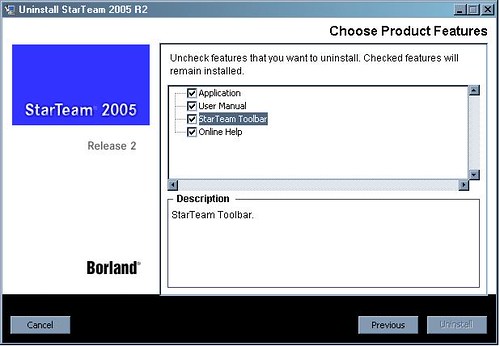
Here's something from the vault of silly screens. It was before Halloween when I was uninstalling StarTeam. The uninstaller presented me with a screen of options. It took me a while to unravel the combination of assertions and negations and make sense of what was expected. Surely the people who designed this screen are related to those who write code like if (!true != !false).

runners

Wednesday, March 24, 2010

rubies from rediff

Ever-so-busy Amogh points me to the recent edition in Rediff's chats. This one features Malaysrilankan beauty queen Jacqueline Fernandez (of course she's part of Bollywood!). The most common thing in the chat is a greeting from every Shyam, Kamala and Tukaram who logs on. Thanks to how the slide show is now implemented, it's hard to give you absolute URLs, dear reader. Thus I must ask you to click "Next" on the first page to get to the second page. The gem arrives at the end of the page:

abdulwahab asked, Hi, Which is your favourite Hindi filim?
Jacqueline answers, I love Dev D and Devdas! Both types of cinema interest me a lot.

Monday, March 22, 2010

super power gets cycle-savvy

According to a Wired article, the Federal government of the United States of America has now decided to consider pedestrians and cyclists to be as important as motorists when deciding which projects to fund as far as infrastructure and the like (you know, roads, mass transit, rail). It's been so long since 1776 that you realise the big draw of the USA is not that the government has a better sense of what is required to improve the quality of life (communities of people instead of isles of isolation and over-emphasised privacy, connected places, more than one way to get from place to place). The big draw has always, IMNSHO, the dollar. The big bucks. Take that away and let's see what happens. Let's not even start with "health care" (what a paradoxical phrase).

Saturday, March 20, 2010

the curious case of the dog

image courtesy: indiafm.com
It happened when I was reading the Scribner hardback edition of Stephen King's Under the Dome (ISBN: 978-1-4391-4850-1). The material seemed familiar and the King flourishes abounded. I was prepared for reading what looked like a return to territory last explored in The Mist and The Tommyknockers. The trouble started in chapter 4 of the section called "the good of the town, the good of the people." I was now familiar with Julia Shumway and her 15-year old Corgi named Horace. Chapter 4 begins with her getting ready for a night walk with Horace when her cellphone rings. It's Colonel James Cox of the US Army. Page 122. The conversation is about to end when, on page 125, a strange thing happens. The dog's name changes to Hector. This transformation lasts till the end of the chapter on page 127. What started with Horace -- waiting by the door, more than ready for a nighttime expedition now that he was cleaned out and fed -- pricked up his ears and looked around at her becomes Hector continued waiting patiently by the door and At the door, Hector pricked up his ears.

[march 30, 2010]: "Are you sure you have an authentic copy?" asks Sarika. This prompts me to check Google Books. Lo! The version available there (relax, it's just a preview, you passengers of the Black Pearl) is a corrected one. Closer examination reveals that it's a Simon and Schuster illustrated edition; the ISBN's the same, but this is most likely a newer version. I guess that makes the Scribner first editions collector's items.

knock on would

PC is charged! screams the headline of an article in the Hindu in which we are told that the winner of the National Award for 2009 for Best Actress was thrilled to have found out that I am one of the youngest actresses to win the National Award. Aside from being another article that confirms the title of her next film with Vishal Bhardwaj (Saat Khoon Maaf), this fluff piece only merits mention for offering another case of abuse of would (And by the end of the year I would be doing some high-class action in the sequel of Don). Did the former Miss India say that? Would she say that? Or should we blame someone named Anuj Kumar for paraphrasing piecemeal quotes tossed to a roomful of people from the fourth estate? Would anyone really know?

Monday, March 08, 2010

the ex-wife wins

Surely a record. I'm just relieved that Cameron's Avatar didn't win the Oscar for Best Picture. It would've been their राजा हिन्दुस्तानी. Yay for Pixar (no surprise methinks) and here's hoping more people watch Near Dark and Strange Days. I knew watching Blue Steel years ago would turn out to be pivotal for me. Refreshing IMDB's main page is so much better than sitting through the ceremony

Saturday, March 06, 2010

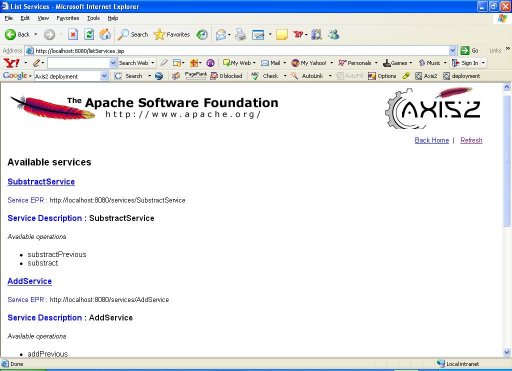
axis2: the sequel reeks

(outpourings biased by a series of unfortunate events)

I recently returned to the natatorium of web services with the most variations of alphabet soup, the most fertile bed of specifications, some unfortunate acronyms (it's the time to DISCO ... get yourself some ROPE ... and who can forget SOAP?) and enough layers around an old idea to make it look like an adorned overfed pachyderm. The tools seemed to have improved; or perhaps they had just grown to have stronger armour to withstand the onslaught of specifications and protocols. Axis, the most popular open-source toolkit for web services had made way for Axis2. Axis2, it turned out, had decided to try and beat the WS soup nazis at their own game. It came up with its own complex design (ADB, AARs) and its own alphabet soup (an object model called AXIOM).

Getting started was not a problem, but once you started using the beast, you began to see the cracks. A simple client needed 18 JARs and notched a footprint of several megabytes. You saw all the typos (When users sends SOAP messages) and poor grammar (User care able to set his own mime-boundary string using this property) in supporting articles and in the documentation (Substract?). You also saw how careless the documentation was at times (the supporting text files for the 1.5.1 distribution contain URLs for the 1.4 distribution). You were taken aback at how incomplete (why have two articles on configuration parameters, when you could have just added some more javadoc? Then there was lack of support for enums, which is unfortunate because you just lost a clean strong way to enforce some constraints on parameter values. It's also a bit silly since J2SE 1.5 is the JDK of choice and the support for enums represented one of the most useful things that came with that version. If you wanted to try using minOccurs or maxOccurs, you were out of luck again. It all started looking like a giant step back for WS-kind.

Let's not even get started on interoperability or support for Spring. There's a very limited view of the world as far that last thing is concerned and it's a gross violation of the larger view that the developers of Spring have adopted. It's time to look at something simpler and more useful. After all, getting an elephant to guard your house soon becomes an economic problem (there's also the pachydump to consider).

(a few hours later). Oh great! Despite tall claims, Axis2 has severe problems with basic inheritance.

(a few days later). I am of the opinion that the quality of logging in any project says a lot about the quality of the project itself. This makes Axis2 suck even more. Let's start with org.apache.axis2.context.AbstractContext and scroll down to the method debugPropertySet(String key, Object value). The following block of code contains enough to send your lunch back up your throat:

log.debug("==================");
log.debug(" Property set on object " + identity);
log.debug("  Key =" + key);
if (valueText != null) {
    log.debug("  Value =" + valueText);
}
log.debug("  Value Class = " + className);
log.debug("  Value Classloader = " + classloader);
log.debug(  "Call Stack = " + JavaUtils.callStackToString());
log.debug("==================");

What a great place to practise your minimal competence in ASCII art. The fun doesn't end here. Let us turn our attention to org.apache.axis2.util.JavaUtils and specifically to the method callStackToString.

/**
 * Get a string containing the stack of the current location.
 * Note This utility is useful in debug scenarios to dump out 
 * the call stack.
 *
 * @return String
 */
public static String callStackToString() {
    return stackToString(new RuntimeException());
}

/**
 * Get a string containing the stack of the specified exception
 *
 * @param e
 * @return
 */
public static String stackToString(Throwable e) {
    java.io.StringWriter sw = new java.io.StringWriter();
    java.io.BufferedWriter bw = new java.io.BufferedWriter(sw);
    java.io.PrintWriter pw = new java.io.PrintWriter(bw);
    e.printStackTrace(pw);
    pw.close();
    String text = sw.getBuffer().toString();
    // Jump past the throwable
    text = text.substring(text.indexOf("at"));
    text = replace(text, "at ", "DEBUG_FRAME = ");
    return text;
}

Turn up the logging for org.apache.axis2 to see what I mean. Your log file will start looking like Armageddon and none of the traces will offer any useful information. The lack of respect for both performance and the usefulness of information is, however, appalling.

[march 23, 2010]: I should have just seen if Hani Suleiman had anything to say about Axis2. Guess what? He already said his piece in 2006. It's all there in the bile. If only I had read this first: I agree about the documentation, the language, the quality of code (System.out.println calls instead of logging calls; a complete lack of logging in core code, which means that I have exactly no idea what's going on behind the scenes even with the Axis2 code in front of me). Heck! I agree about everything. I wonder how the ASF let such a sub-par project into its fold. I leave you with a sample log message (some details have been removed in the interests of privacy) from the morass of one of the numerous builders floating in the source tree: Build the OMElelment obfuscatedFieldNameBy the StaxSOAPModelBuilder
Saturday, February 27, 2010

ellison calling bollywood

Serves me right for not finishing the collection Dreams with Sharp Teeth I had bought several months ago. The final story in that compilation was something called Shatterday (go read it to figure out where that name came from). It's all about this guy called Peter Jay Novins who accidentally dials his home phone number and ends up talking to himself at the other end. It's been adapted for television too. That nugget of a premise should suffice to encourage you, dear reader, to utter three words: Karthik calling Karthik. You can be sure of one thing -- Karthik's a South Indian (the h is the giveaway, cotton-brain!). IMDB tells me his last name is Narayan, which still leaves some room for doubt, but I'll put my bets on दक्षिण. Perhaps someone should let Mr. Cordwainer Bird know.

Monday, February 22, 2010

another groaner

If Vijay Mallya's daughter got married to a Chinese guy and decided to emulate Miss World 1994, what would she become? A Mallya-Lee.

Sunday, February 21, 2010

the soup is hot, the soup is cold

I am not a fan of epics. I just can't enjoy all that fancy fighting and valour in skirts, armour and something other than a bulletproof vest. Since history is often distorted, I can't even expect to get information wrapped in entertainment. This means that the only reason I set my butt down to watch Joseph L. Mankiewicz's epic peplum Cleopatra would have to be masochism. This was the restored 4-hour cut (the opening and closing overtures might contribute a few more minutes) and what scares me is that this came from an original 6-hour cut that Mankiewicz had hoped -- wisely, I must say -- to see as two 3-hour pieces, Caesar and Cleopatra and Antony and Cleopatra. The names make more sense than the title of this elephant. It's a problem much like that with Inder Kumar's Raja (where we were all relieved that the film was not as much about Sanjay Kapoor at all).

The lines caught my attention more than anything else: there's innuendo, sarcasm (perhaps unintended), chauvinism (were she not a woman one would consider her to be an intellectual) and even my breasts are full of love and life; my hips are rounded and well apart; such women, they say, have sons. There is promise of a different kind of humour in lines like officially divine, at last, but it would seem that one would have to turn to the Carry On team or Monty Python to milk that cow. Cleopatra's when i am ready to die, i will die presages the Oracle in The Matrix series (or perhaps, the Oracle was Cleopatra in some alternative world).

At some point, I started seeing political allegory in the film. I started thinking of the Romans as the US of A meddling in the affairs of other countries. I couldn't think of an entity in the present day to match Egypt as it struggles to protect its art from the Romans and tries to convert its advantage in supplies to one of power. Some of the dialogue would fit rather well in a modern-day adaptation: there is no such thing as an unnecessary war, the way to prevent war is to prepare for it. If someone takes this idea to fruition, I just hope it's with a film that's not as butt-unfriendly as this one.

Saturday, February 20, 2010

what the hell happened to rosemary?

I am still trying to figure out what significance Béla Bartók's Mikrokosmos had in Lamberto Bava's most famous film, Demons. The fake splatter gore and the host of heavy metal songs on the soundtrack are the attractions; the straightforward narrative sans political commentary of any kind is not. I wish they had chosen to retain the Italian instead of dubbing everything into English. The resultant psychobabel of a film is a murder by numbers effort; the victims are people invited to a special preview at a theatre called Metropol, whose walls are covered with posters of films like No Nukes, Four Flies on Grey Velvet (co-written and directed by Dario Argento who also co-wrote and produced this film), AC/DC: Let There Be Rock. I wonder if the Coca Cola vending machines and that can in the car represent product placement. The opening titles are underscored by a riff that sounds familiar; the theme sounds like Rockit served with a dash of Vangelis. But it's the heavy metal songs that dominate the proceedings once the screaming and killing begin. The finale is introduced by one of the greatest surprises I have seen in a long long time, but the twist over the end credits unfortunately reinforces a cliché. This is Romero stripped of allegory; if you don't mind the aphasic dialogue and like your gore served up funny, you will enjoy this.

get ready for the pulp

In the wake of the release of Daylight Robbery, there are signs of an increasing interest in this "revival" of Indian pulp fiction. Siddhartha points me an article over at Tehelka about Surendra Mohan Pathak (you've heard of Sudarshan, of course).Sudarshan raises the stakes with another article at Tehelka written by the Pastor of Pulp himself -- it's a review of a recent translation of two Ibn-e-Safi works along with notes about the author, who got an endorsement from the Dame of crime writing herself. He also tells me about an article in the Hindustan Times that includes a conversation with the man. Splatter me!

[march 28, 2010]: It takes me about a fortnight to shout out "He's famous!" after Sudarshan gets his mugshot and an interview in The Hindu. Awesome!

Wednesday, February 17, 2010

groaner

If they decide to make a sequel to Mili, they should call it Mil(l)isecond.

Monday, February 15, 2010

my name is thackeray and i am a hypocrite

Following SRK's remark of regret that no Pakistani cricket player had been bought by the IPL clubs, the Shiv Sena, a party famous for its extremist bigotry, unleashed its fury and threats at the star. The Sena then decided to make his forthcoming film My Name is Khan (released on Friday last week) the target of a boycott of violence (something they've been rather successful at). CM Chavan went through the motions of warning the Sena, assuring all protection to Khan and his can of film and then expressing his hope that good sense would prevail. Then the Sena decided not to kill the commercial goose and then went stateless like everyone's favourite kind of EJB and went back to threaten ape poop on the film's future. The state did what it could: 1000 sainiks were detained. Several cinema theatres and multiplexes, knowing fully well that no form of law and order either on paper or in practice would help them against the might of the Shiv Sena, decided not to screen the film. People, however, wanted their star. There are some things that defy the laws of physics; the Sena didn't stand a chance. The Sena refused to consider this a failure. They continued to chastise the administration and pat themselves on their backs.

Meanwhile, disaster struck in Pune. A bomb went off at German Bakery. The tragedy was followed by the usual mix of vacuous news reports and angry tweets (mixed with several tweets loaded with information) that cursed the politicians, the police and the government. The crowning flourish came now from Uddhav Thackeray. He decided to blame the CM and his "immature politics" and alleged that the blast had happened because the CM had sent all the security over to protect the Khan and the film. Sigh. Will all the people who support the Shiv Sena and dare to possess a smidgen of sound common sense please tell me exactly why they continue to support this confederacy of dunces?

Saturday, February 13, 2010

i want more sand in the desert

That's what Vittorio De Sica screams at one point in After the Fox. One wonders if Nagesh Kukunoor was running this film in his head when he wrote Om Puri clamouring for more balls in Bollywood Calling. The line in the Italian/English film is loaded with more bite, however. You see, De Sica is playing a director named Vittorio De Sica directing what is evidently a peplum in the desert. De Sica also directed this farce that makes digs at directors like John Huston (the reference to him playing Moses being the most obvious one), Fellini (the brooding artist and his angst; the film's climax featuring an exhortation in the defence of art), Antonioni and De Sica himself. Victor Mature plays Tony Powell, an alter ego of himself -- at one point in the film we see an old film starring Tony Powell playing in a theatre: the film is really Easy Living, which starred Victor Mature himself. Tony Powell isn't even his real name -- it's Tony Ampulski (a dig, perhaps, at Italian actors who became famous with English names in the dubbed versions of their films -- Bud Spencer and Terence Hill, anyone?). The film, written by Neil Simon, mixes over-the-top characterisations with very funny lines (you're even more beautiful in real life than you are in person, great jokes (the Fox reading a book by Stanislavski, truck drivers reading Playboy, politically incorrect use of the veil) and also a film within a film. If you love movies and you know your movie trivia, you'll enjoy Peter Sellers hamming it away as Aldo Vanucci; you'll nod your head when Aldo Vanucci talks to Miss Okra through a girl in a bikini, because you saw the first sequel in the Austin Powers canon and that had a similar scene in it. [June 28, 2009]

Saturday, February 06, 2010

cacophony

Deepika Padukone (pronounced पाडुकोण) saying anything. That grating accent must go. Remake Reshma aur Shera with the Big B's character changed to a woman and give her that role. There will surely be an award or two. That should suffice to encourage the silence. Alternatively, one implores RGV to rope her in for a native part in one of his forthcoming films. He loves having घाटs in his flicks and they lend credible colour and texture to the goings-on set mostly in Bombay, Pune and their 'burbs.

Lucky Ali should sing a song for Farhan Akhtar. Why hasn't someone considered this yet? Perhaps because Farhan Akhtar chose to warble his own way in Rock On!!

Someone should make a movie starring The Nasal Warrior in which his character sports a feminine alter ego with the voice of Lata Mangeshkar. The title? How about काँच को क्या आँच?

Friday, February 05, 2010

to become the first superpower to developer super powers

It's a hotel room in Kuwait. George Clooney sits on the bed and explains a Jedi warrior to Ewan McGregor. This is probably the movie joke that's easiest to understand in The Men Who Stare At Goats. If you know why "Ask Angela Lansbury" is funny, pat yourself on the back. If you don't, it's hard to tell you why without ruining the experience of a classic film (and I don't mean this one) for you. Jeff Bridges taps into Jeffrey Lebowski as he plays Bill Django, who, after an epiphany during the Vietnam War, goes hippy and returns to found the New Earth Army -- an army of modern-day Obi Wans. George Clooney plays Lyn Cassady with his mix of star power and whimsy. His straight face gets all the laughs you can ask for while the content of McGregor's voiceover keeps you smiling. Kevin Spacey, as the villain of the piece, seems to be trying to explore nooks and crannies in the ham sandwich showroom. This drama of men is not a dark brooding allegorical meditation like Apocalypse Now or Platoon or even the starkly straight-faced Full Metal Jacket. There isn't anything terribly profound in the goings-on even though the dark comedy skewers popular culture and American silliness while reinforcing everything we might have thought was wrong with the army. With several quotable lines, the only problem is that this quirky and bizarre flick works without any bite. It seems to miss the optimum trajectory.

Wednesday, February 03, 2010

SMP returns

Sudarshan is back. After The 65 Lakh Heist, he and Blaft are back with Daylight Robbery. Blaft now lets you buy the awesome items in their catalogue from them without having to waste time in the aisles of bookstores searching in vain or talking to clueless store attendants. The word heist was, from personal experience, not a very helpful word, when one evaluated the reactions of the aforementioned attendants (no habla heist). If you're in desiiland and you want to let Sudarshan know that you think this is cool too, head over to Blaft's website and order a copy.

Saturday, January 30, 2010

revivah


Mawidge...Mawidge is what brings us together
-- the impressive clergyman (The Princess Bride)

[January 07, 2007] One could think of a few reasons why Sooraj Barjatya would want to unleash upon the modern masses a film like Vivah that lives in a sandbox of the yesteryears, of the innocence of the family dramas of the 70s and the early 80s, of the simple events that formed the foundation of Hrishikesh Mukherjee's canon. The most important one is to ensure that Alok Nath continued to receive a welfare cheque (this was before Rajshri took over the idiot box and sent Alok Nath back to where he came from, plumper, older, slower and donned in garbs so ornate as to put Sanjay Leela Bhansali's costume designer to shame). A minor reason is the warped sense of the world that Barjatya nurses. It's a world without shades; there is only good and evil (which can be counted upon to repent and come over to the good side in less than 3 hours). It's a world where emotions are thicker than the pancake syrup in Waffle House or IHOP, sweeter than the most generously glazed doughnut from Krispy Kreme. It's a world that should simply cease to exist. It's a regressive nightmare that purports to offer a form of optimism that is more dangerous than the darkness nihilistic cynical view of the world you might find.

The film has very little to hold your attention. The script is a poor blend of Satyam Shivam Sundaram, tired dross of love without event and Rajshri tropes. The songs are terrible (Ravindra Jain, who delivered many a memorable song for Rajshsri products in the past, does his reputation a great disservice), the sets are a tribute to unsubtle artifice, there is nothing you can call "acting" (although there's a lot of blah-blah, posing, glaring and gesticulation) and there are musical cues added to underscore moments of "comedy." The events, as they are, occur in fictional places named Madhupur (if only someone had renamed it Sweetwater in the subtitles) and Somasarovar (Lake Luna, people).

If you care about subtitles, watch out for (sister:sister) (sister-in-law:sister-in-law), soiree (for संगीत). If you care for lazy background scores, keep your ears perked up for the Doom fireball sound as the camera tracks the fire.

Just in case your dropping jaw made you forget who was responsible for this Clockwork Orange Cocktail, the protagonist is called Prem, there's a wedding at the heart of it all and there's a wedding band playing दीदी तेरा देवर दीवाना. If you missed the presence of his lucky mascot, watch out for a poster of Salman Khan in a phone booth as well as two posters of Saawan ... The Love Season (yes, that film with the crazy song).

Mercifully, neither Herr Nath nor Herr Barjatya have dared another big-screen venture. Unfortunately, they decided to take their terror to the glass teat. Luckily, I don't watch TV.

no objections to disclosure


there is no such thing as [sic] free lunch
-- Raj Malhotra (Akshay Kumar)

[May 29, 2006] Known for giving Priyanka Chopra the role that earned her a Filmfare Award for Best Villain (and becoming only the second woman to do so), Aitraaz also offered several songs from the Nasalite that became hits, characteristic Bollywood hamming, extremely poor scripting and dialogue. With producer Subhash Ghai's blessings, the Burmawalla brothers took Disclosure, stripped (no pun intended) it of anything that might prevent their copy from getting the U certificate (they settled for U/A). The background score from Salim-Sulaiman evokes memories of Enigma, while the subtitles department goes gaga turning "ladies room" into "living room," तलातुम into "quagmire" and 987 into 973. A variation on Carmina Burana plays every time Priyanka Chopra's character, Sonia, is seducing her next victim. The songs are silly enough: गेला गेला features Akshay Kumar and Kareena Kapoor on the beach doing a stupid dance while four babes of varying dimensions are wearing bikinis and sashaying on a boat in the background; I wanna be with you (ये दिल तुम पे आ गया) features Akshay Kumar and Priyanka Chopra taking a family-friendly shower together, having a jacuzzi moment and then ending up in bed (curtains please); I wanna make love to you is shot in one take (interesting) with Priyanka Chopra delivering an act of seduction and shooting playing cards from a deck into Akshay Kumar's face just as the song goes into जुआ जुआ प्यार का.

Every film I remember by the Brothers Ripoff has boasted a sign with an egregious spelling mistake; this one butchers इत्तेफ़ाक़ (it becomes इत्तफाक).

There's as much "sensitive" content in this film as can be expected from a Bollywood bowl hoping to reel in the moolah without offending the prudes, the housewives and the "innocent" youngsters. Consider the scene where a groups of guys at a restaurant go drooling over a picture of Sonia on the cover of a magazine before one of them takes the magazine (to a private place, no doubt).

Consider also the following lines from an exchange between Sonia and Raj (Akshay Kumar):

sonia: show me you're an animal raj; show me you're an animal

raj : तुम s*x के लिए मुझ पर मेहरबान हो ...

sonia: what do you think eh? i'm a bitch; i'm a slut; a bloody prostitute?
raj : do you think i'm a male prostitute जो तुम मुझे अपने दिए हुए post और पैसे के बदले में इस्तेमाल करो? no!

Things take a turn for the worst as the film hurtles slowly to the inevitable climactic courtroom drama. Bollywood's continued ineptitude with this rather common setpiece is obvious when Paresh Rawal calls Akshay Kumar to the stand during his opening statement. Annu Kapoor's character (named राम चौतरानी, the most interesting name in the film) gets a line of dialogue laced with different synonyms in Hindi for tush. He also gets to make sweeping pronouncements like समाज में दो किस्म के लोग रहते हैं: औरत ज़ात, मर्द ज़ात. He tops this all with the immortal line खरबूजा खुद चाकू को मजबूर कर रहा था कि आ ... काट! come and slice me!. There's a nice shot of Priyanka Chopra sitting in the witness box; it's a silhouette with a decent use of light. It's the only saving grace of a film that largely seems to have been made in the absence of a technical crew of any kind.

The moral of the film is two-fold: it is extremely convenient to have a lawyer as your neighbour; it is really convenient to have a wife who has an LLB.

This film also contained, for those of you who were not busy ogling at Kakista Kapoor and Ms. Ooh-La-La, a reference to next year's Bewafaa, which Akshay Kumar and Kareena Kapoor starred in; what else can one make of Akshay Kumar turning to Kareena Kapoor just after uttering और ये वो वफ़ा है जो आदमी को बेवफा होने नहीं देती? I leave you with Kareena Kapoor's immortal axiom.

mrs sonia, bitch वो होती है जिसको अपने बच्चे के बाप का पता नहीं होता

the dangers of surveys

Sudarshan has a new post up in which he gives it (Tehelka's survey of Indian readers of English writing) those ones (justifiable barbs and objections). The post only goes to show us the familiar danger of any kind of survey. Your two problems are the sample set (the people you survey) and the questions you ask (if you ask questions like all those moronic reporters on India's numerous channels, the respondent often just has a boolean reply for you). Tehelka's survey seems to have suffered from both problems.

There are a few interesting things in the result. The appearance of Chetan Bhagat is not surprising, but the absence of Shobha Dé (whose ouevre clogged several rows of shelves in places like Crossword) is strange. "Indians" supposedly spend 360 post-colonial rupees on books every month. This means that Penguin is probably not doing so well, because you'd only get a book and a sixth from their catalogue. Most readers, according to the survey, read for learning; the most popular books are those with action and adventure, the thrillers and mysteries. Combine these two and you have to wonder what people learn. I sign off by remaining stumped at how frequently the Bard figures in this survey. Do you really expect me to believe that the unabridged Shakespeare is so popular? This is the stuff that dreams are made on. Oh, and please get a new keyboard and someone who understands why turning on CAPS LOCK IS SUCH A BAD IDEA!

Wednesday, January 27, 2010

why

were people clapping so often and indulging in standing ovations for President Obama's State of the Union address? Perhaps I'm too jaded from all those pep talks from corporate executives laced with crapspeak, loaded with words of familial encouragement in the aftermath of layoffs (oh, sorry, "reductions in force"). He trounced DADT, delivered the familiar litany of "healthcare reform" and "immigration reform." The sense of déjà vu was strong. Some people probably need and welcome this motivational stream, but I'd like to see some exhibits. I'll wait. (Someone should have put a cushion on the podium ... the thump of his hands was ominous).

Tuesday, January 26, 2010

liberty gets a memo

On January 11, 2010 at EWR, many H-1B holders aboard Continental Airlines flight CO 49 found themselves at the mercy of the CBP. All this thanks to a new memo from Donald Neufeld, Associate Director, Service Center Operations, USCIS. The memo tried to explain what a valid "employer-employee relationship" meant when one considered H-1B petitions. I found just one post online that talked about the memo and had more details about the incident itself. I was unable to find more about the people who were deported. The actions of the CBP clearly qualified as a "means to the end" -- authorities have been trying to crack down on the consulting firms of questionable repute that have long given the H-1B a bad name. The measures taken at EWR probably achieved this to some extent. It is quite likely that some of these people were lax with the documents they had to carry on their person. It is also likely that some were taken by surprise and behaved in a manner that made them vulnerable to unfortunate coercion. The details of the actions invite a sense of discomfort -- can someone really get away with "hunting for Indian H-1B workers"? with "remarks about why these H-1B workers earned more than U.S. workers and that they should not be paid so much"? The CBP and TSA have always been particular about noting their professionalism and courtesy in such matters. Then how did such events come to pass? The lack of sufficient coverage is also disturbing. Without such coverage, it is hard to get facts. Without facts, it is difficult to raise a voice in protest, to ask that power not be abused thus? Surely that is not too much to ask, is it?

what if someone pretending to be confucius used Eclipse

depecrated (deserves to be execrated); chinese internationalisation (whatever); this abstract class houses default and common implementation for some interfaces (very observant); all tranctional processing classes are responsible for calling this method and for providing what action is provided (schizoid indecision); used to identify newly instantiated instances (काला टीका?); later is to be (absolutely). This is a heck (what the hack!).

Someone would get paid for writing code that invoked the toString() method on an instance of java.lang.String. Meanwhile, in the woods, someone talks about methods consuming a lot of memory consumption (Borges would be proud, no doubt).

Monday, January 25, 2010

those dusty cans of nitrate

White Zombie [January 29, 2007]: It's hard to be interested in horror films and their history and not have heard of White Zombie. Besides, once you've seen Bela Lugosi as Murder Legendre sporting Jack Pierce's makeup, you can't quite forget that close-up. The film's a cheapie that reuses sets on the Universal lot, but has, to its credit, some moments rich in atmosphere. There's unfortunately not much to applaud in the acting department. Lugosi is himself and makes this perhaps his most memorable role after having sealed the fate of his career playing the sanguinary Count. The background score makes up for the film's limited use of dialogue and there's a chant you hear over the opening credits that sounds like the parent of the chant of initiation in Finding Nemo.

Chak De! India [October 06, 2007]: After directing the wonderful Ab Tak Chhappan (aah, the iTrans-friendly title), Shimit Amin quit RGV's Factory (something that a lot of the talented people there have been doing for the last few years). When he landed at Yash Raj Films, it was hard to contain the surprise and shock. The fear was that he had sold out. Talent had turned pragmatic. When he roped in Shah Rukh Khan (not surprising since SRK's the leading contract player of sorts there and over the fence at Dharma Productions), one could only fear the worst. Then we found out it was a sports film (now, how many of those do you have?). We then noticed that Jaideep Sahni (the man who wrote Jungle, Company Bunty aur Babli and Khosla ka Ghosla), another RGV expat, was handling the writing and the lyrics. All this set the stage for something that might satisfy both camps -- those who cared for films that looked like they were made by people who had their wits about them and those that cared merely for star vehicles. As it turned out, this engaging ensemble effort did. Shah Rukh Khan did another Swades, but with far less grandeur. There seemed to be no moments for the camera. Kabir Khan instead seemed like a man who had borne the religious bigotry and the bad luck of failure well and who had let it drive his rage to snag one last shot at glory, even though it would be from the shadows. The structure of the film was familiar to those used to watching all those sports films about underdogs that played on cable television here in the US and on Star Movies back home (The Miracle, Hoosiers). The film unfolded with one familiar flourish after another, but each was delivered with competence. What you got at the end was something that you could watch without adjusting your derriere on the couch or letting your mind drift to times better spent. There were great scenes (Bindiya Naik coming on to Kabir, the locker room speech that could have become a crowd-pulling rabble rouser but ended up being more of something else) seasoned with clichés both welcome and unwelcome. You got interesting characters (Kabir Khan, Bindiya Naik) who shared the screen with stock characters played well. All this still didn't acquit Amin. One had to wait for his next film to find out what turn he wanted to take.

Sunday, January 24, 2010

what songs can teach you about grammar

the good things: Get Together (made famous by The Youngbloods) boasts an understanding of the difference between each other and one another in its most famous line: come on people now, smile on your brother, try to love one another right now.

the bad things: In their third studio album Phantom, The Fixx cut a track, whose title became another of the many woeful examples of the failure to understand the difference between few and less. The track was called Less Cities, More Moving People.

a perspective standpoint

The froth from the rant about the egregious abuse of perspective was just beginning to dry when the cult of the evil twin surfaced. The name's standpoint and its exploitation has nothing to do with social science. The template remains the same: from a/an X standpoint. The chief culprits are overpaid bearers of corporate RIMjobs and under-educated code monkeys who climbed up the rungs of the corporate ladder to expound balderdash using Tufte's bête noire. There can be no more effective way to divest oneself of the faculty of simple English than to sit listening to one such wrongdoer confidently hurl inane vacuous phrases like from a management standpoint, from a maintenance standpoint, from a customer satisfaction standpoint (notice the return of the noun-as-adjective kludge of lazy speakers) and from an overall quality standpoint. The irony in it all is lost on such windbags. All you can do is gnash your teeth from a sitting standpoint.

Saturday, January 16, 2010

a (small) purseful of previews

The man who made the interesting Main Madhuri Dixit Banna Chahti Hoon and the Hrishikesh Mukherjee film of 2005 (Main Meri Patni Aur Woh) returns with Striker. When was the last time you saw a trailer that opened with a carrom board? It might be a sports movie of a different kind but it looks like a familiar masala mix. One can only hope it's done reasonably well.

Ben Kingsley and Amitabh Bachchan appear on the same cast roster with Teen Patti. Kingsley supposedly plays a mathematician called Trachtenberg and it's a relief that his character's first name is not Jakow. The only rub is that the film's directed by a lady called Leena Yadav, who was responsible for that creatively misguided blotch of guano called Shabd.

The nicest thing about the trailer for Prakash Jha's next film Rajneeti is not the cast (The promise of Manoj Bajpai -- almost unrecognisable with the extra lard --, Nana Patekar and Naseeruddin Shah is offset by the presence of the likes of Katrina Kaif and Arjun Rampal). It's that voiceover that runs throughout in careful measured effective Hindi. This is not Hinglish. This is pure Hindi. It's disappointing to see the title surface at the end in English and a boring font (had it been in Hindi, we'd have remembered Govind Nihalani, who unflinchingly presented all the credits on his films in Hindi). Jha's recent efforts (Gangaajal and Apaharan) have been only moderately satisfying. One hopes that this supposed take on the Mahabharat (assignment: watch Benegal's Kalyug again) makes up for those.

Saturday, January 09, 2010

a handful of signs

During a recent visit to Chennai, the eyes spotted some interesting signs.

hoome appliances: blenders for रुदाली?

hotel ginger garlic: they named a hotel after a popular paste at Indian stores?

golden edelweiss: Am I alone in thinking that this is a euphemism for guano? There's also the surreal image the meaning conjures (golden noble white?)

baba pile foundation: A treatment clinic for haemorrhoids named after some godman or that famous star vehicle? Curious. Very curious.

balaji's hot spot: Possibly blasphemous. Great name for a fusion club or the first South Indian strip joint.

dutch betrayal

Some of the things movies teach you are funny. There I was watching Body of Lies (soon to be "remade" as जिस्म झूठ का), specifically the aftermath of a terrorist bomb in Amsterdam. That's when I found out what the abbreviation for the local police was. KLPD. I kid you not. Now, if you're Indian and you haven't been living a sheltered PG life or you haven't watched Monsoon Wedding, you know why I'm laughing.

Friday, January 08, 2010

my daddy cyborg

The Tamil Nadu state government, in a familiar political, pig-headed, jingoistic flourish, offers an exemption from Entertainment Tax to Tamil films bearing Tamil names. This is why Godfather hit the marquee as Varalaru. This is also why the next Rajinikanth/Shankar vehicle lost the name Robot and became Endhiran. (I must digress to note that I missed seeing the young old star when he showed up on Pune for a shooting stint for this flick). OscAR Rahman does the musical honours and Vairamuthu shares lyrical duties with Pa. Vijay. The former lyricist whips up a lyrical howl (go to slide 3) with Robovuku thaai mozhi kidaiyadhu, thandhai mozhidhan undu, which supposedly means A robot does not have a mother tongue; it only has a father tongue. Eh? Cyborg ain't got no lingua माता, but he sure got his daddy's licker. Eesh! Excuse me, while I get some Listerine.

word wrap

Seen on the menu in Chow Baby: Your first and only bowl we will wrap up for any additional bowl wrapped up will be 8.99

Were these messages outsourced to the land of IT rowdies or was the person writing it desperately trying to make it in time for a conference with Mother Nature? You were probably so in thrall of the wonderful stir fry on the table that you didn't notice.

Friday, January 01, 2010

kaalaa Tiikaa: DVD style

dear moser baer,
I would like to thank you for doing for DVDs what T-Series did for CDs. It feels much better to buy DVDs for prices like 99, 149 and the like (INR, of course) than 299, 399 and the like (INR, again). After all, Eagle Entertainment, Eagle, Eros, Adlabs, Sony/BMG, YashRaj Films and Shemaroo are also only giving me a DVD. There's nothing to speak of as far as cover and sleeve art are concerned. In fact, there's nothing at all to speak of in the manner of packaging. I will not mention special features, because that is something India does not understand (I must note that there are some exceptions, of course, but they are, after all, exceptions).

But I digress. I am sure I am not alone in finding watermarks tossed onto the film frame by DVD companies annoying. All of you companies insist on adding short unskippable films parading your logo on the DVDs; I have wondered why pressing the menu button on my DVD's remote control takes me to this loud movie instead of the menu; but I digress again.

Could you tell me why you insist on retaining your watermark on the entire film? Other DVD companies add their watermarks like screensavers -- they appear for a few several seconds at important moments in the film (songs for regular Bollywood far; random moments in "art" cinema). Knowing that these companies didn't care, I had almost made my peace with this annoying feature that destroyed the movie for me. I would like to just let you know that your decision to make this watermark (how can I call it a watermark when it's so plainly visible?) as permanent as a birthmark, a port-wine stain.

Thank you for not caring.

 
Creative Commons License
This work is licensed under a Creative Commons Attribution-NonCommercial-NoDerivs 3.0 Unported License.