Wednesday, August 04, 2010

my own hocus pocus

(with due apologies to Kurt Vonnegut, Jr.)

Finding a free copy of Crime and Punishment at the public library does not serve as an example of any form of irony.

Aamir Khan's performance as Rehan before the interval in Fanaa (yes, that movie) can be best understood as a dark parody of his character Dil Nawaaz in 1947: Earth

नाम मेरा Mango Dolly from Quick Gun Murugun is a delightful take on the club crooner's ditty that mixes Hindi and Tamil, but it's crowning moment is when Geeta John says eDitiTTa po, which, in Malayalam, means take it away. The smile of understanding makes you feel good about knowing more than one language.

What would happen if Aruna Irani married Brooke Shields? She would become Aruna Shields

3 Idiots is not a film about Kaalia and his ill-fated colleagues who met their untimely end at the hands of the Project Leader from Hell, Gabbar Hari Singh.

Incidentally, has anyone ever written a book about the fabulous advertising campaign by Sylvester da Cunha at ASP for Amul?

Has anyone written a term paper about Chetan Bhagat being the Dan Brown of Indian-English writing in India? Or, if you wanted to be jingoistically dense, about Dan Brown being the Chetan Bhagat of bestseller dross? Both write competently and churn out vacuous tombs of papyrii laced with hieroglyphics that would even make a desii IT code churner feel like Bertrand Russell. If someone now decides to write it, please don't forget that you read it here first. Coming Soon: a Robert Ludlum novel written by the Bhagat-Brown combine titled The Brown Ultimatum.

bappidas

I didn't know Kalpana Iyer had been a winner of the Miss India title. Having discovered this, I decided to check her filmography out. All my memories of Madame Iyer were of her as a vamp in hits churned out by Bappi Lahiri (hari Om hari in Pyaara Dushman and rambhaa ho in Armaan). Her filmography did not yield any surprises, however; there was no phase of roles indicating a desire to try some serious acting and snag an award or two. But I stumbled upon Manokaamnaa. I knew Bappi's songs for the film, but I had no idea that Madame Iyer had starred in this Raj Kiran flick. Predictably, the video for my favourite song on the soundtrack was up on Youtube. As with most of the songs for Bollywood films, what goings-on on screen added naught to my favourable impressions of the song. I, however, realised that in addition to sounding like himself, Bappi also seemed to be doing an impersonation of Yesudas. What the song would have sounded like if Yesudas had sung it is unfortunately a matter of speculation.

Friday, July 30, 2010

kashyap and koechlin return

Despite numerous notes about Bombay Velvet and an adaptation of Doga, the newest finished film of Anurag Kashyap turns out to be The Girl in Yellow Boots announced in October last year. Thanks to a new note over at PFC, we now have a trailer for the film (warning: NSFW) from TIFF 2010 in September. It's also going to be screened at the Venice Film Festival (also in September) along with Mani Ratnam's unwitting tribute to Tropic Thunder, Raavan. Ratnam's being honoured at the festival because he is, among other things, One of the great innovators in contemporary Indian cinema, he helped introduce the auteur concept to contemporary Bollywood. Jeez. Bollywood? They got their woods mixed up again. Auteur? You have got to be kidding me. Oh! Wait! They said contemporary. Never mind.

On a more optimistic note, Dennis Hopper's The Last Movie (still unavailable on DVD) is also on the list at Venice.

Thursday, July 29, 2010

derek does it again

I'm several months late in catching Nine Lives, Steve Winwood's 2008 album, his first in several years. The album opens with a faint echo of Blind Faith, but that could just be a feeling I got because, frankly, that's the only album featuring Steve Winwood that I remember (this, needless to say, is quite unfair to the immensely talented musician). This collection of nine tracks is an overflowing pot of influences (funk, jazz, soul, R&B, Latin), but the track that prompted me to ignore (unfairly, again) the rest of the music was Dirty City. It's a long track and features a catchy groove and a nice riff on the electric guitar. The fun starts near the last minute when a guitar solo takes the fore, while Winwood continues to sing. The solo thus takes the place of a second voice and flourishes of emotionally engaging licks are traded with vocal lines. It took me back to a song several years ago that featured a similar solo, except that solo was a "solo" in the true sense, taking centre stage from an introspective lyric and melody and transporting a good song into a great one. Not surprisingly, it was the same guitarist on both these songs. Good old Slowhand, who had made While My Guitar Gently Weeps all those years ago, returns to produce in a precious few seconds what he hasn't done on his longer recent albums. The guitarist -- nay artist -- seemed to have ceded to the creative aspirations of the singer, collaborator, musical explorer and producer of harmless pop on Back Home or Road to Escondido. But this short burst on Winwood's song puts paid to any fear that Derek had lost it or given it up. That it makes you yearn for more is a testament to its effectiveness. The sting ain't gone.

Friday, July 23, 2010

bobby: not directed by raj kapoor

Here's how you can avoid being confused when you read the title Bobby: Love and Lust. Raj Kapoor would never give things away in his titles. His films broke new ground in family-rated salaciousness but they never had suggestive titles (except perhaps Ram Teri Ganga Maili). But there is no denying producer Hyder Kazmi's desire to exploit the titular confusion. After all, a lot of VHS tapes will probably stick to the simpler version of the title and a lot of families will walk home expecting to see Dimple Kapadia only to see some lass named Mona Lisa (born Antara Biswas) playing a girl named Bobby. She's from Porbandar and ends up eloping to Bombay with a boy named Uday (hint: symbolic name). Unfortunately, it turns out that Uday is a pimp (working for a madam who has a fetish for breaking glasses and whose voice sounds like Perizad Zorabian with a cold) and a wimp (he can't bring himself to surrender her to madam).

Do you know why parents oppose children? So that they can take a decision themselves. It is because of such pronouncements that Uday eventually winds up dead (not too long after the credits and a messy flashback or two) and Bobby ends up in madam's clutches.

image courtesy: indiafm.com You know what kind of film this is as soon as you see Milind Gunaji (who plays a corrupt policeman on madam's payroll). It's one of those films that purports to deliver a social message under the garb of B-grade titillation. Madam supposedly runs a business for the elite but neither the girls in her care nor her clients will ever convince you that this is the case. We also have another herring in the form of Vishwajeet Pradhan, who has journeyed from films like Prahaar to films like Sangharsh, Aanch and Ek Aur Visphot. And you really can't go wrong with Mohan Joshi (although some of his lines sound like someone looped them in post-production).

You might remember producer Hyder Kazmi (who is also credited with the idea that the film's screenplay was based on) from Patth. He makes sure you don't forget him by playing KK, an intellectual who works for Madam, protecting her girls and ferrying them to and from clients. To underscore his importance in the film, the scene introducing him has him delivering a bucket of dialogue as a bird lies dying on the floor. He also gets to delivering lines of wisdom in a grave voice that sounds like Irrfan had something to do with it to various people in the film: जो कुत्ता भौंकता है (pause) काटता नहीं to Gunaji's corrupt cop, जो बोलते ज़्यादा हैं, वो सोचते कम हैं to Bobby.

The film has, of course, all the requisite song and dance interludes. There's the romantic song for Uday and Bobby on the beach (along with a bathtub full of roses) with sweeping camera moves and a female voice going आँ while Sonu Nigam belts out आँखों की ज़ुबां. There's not one but three item songs set in the same dance bar with McDowell's logos featured prominently: to ensure variety, one of the songs has an Arabian vibe while the other gets African on your senses. There's also a sad song (Sonu Nigam again, of course) with a dream sequence, an over-enthusiastic smoke machine and plenty of romantic sniffing of the armpits. Most of the film has Bobby dealing expressionistically with her loss and situation and with KK turning out to be her saviour as he manages to save her cherry from each client that Madam sends her out to. Eventually the time comes for Madam to meet her end and for KK to free the birds (both from a large cage and from the brothel in slow motion -- never has symbolism been so overtly unsubtle). He then sends Bobby off on a train (of course it's raining -- don't you know how these films work?). It is at this point that we are treated to a temporal leap forward and we see that this was a book called ... Bobby (bingo!). The writer, Krishna Kant (aka KK), ends up winning a Booker prize (it happens only in Bollywood; see also: Baghban, Shabd). We also see that his wife looks familiar (hint: it's Bobby). Of course, he smiles when the journalist asks him if the book is based on fact and who Bobby was. We cut to the brothel under new management (a nice touch) and end credits accompanied by a nice oomph-laden funky instrumental piece that deserved better than this flick.

It would be unfair to depart from this B-treat without acknowledging the background score that was probably designed to represent the equivalent of novocaine in muzak along with piano riffs that tip their hat to Walking in Memphis, the sweeping shots of the Bombay skyline that were probably inspired by a late-night viewing of Blade Runner, a really competent scene between two girls at a hotel when one, a hooker, thinks the other is a hooker as well (it turns out she works in TV serials), a scene featuring the girls of the elite brothel watching a commercial for a breast enhancer and, finally, the subtitles.

The subtitles are quite sublime and represent a fine effort in all departments: Worli becomes volly, Divya becomes बिंदिया, झगड़ने की आवाज़ becomes someone lighting and bloody b*tch becomes rascal. The pièce de résistance, however, is a case when the subtitles enhance the silliness of the dialogue. Here is the sample of dialogue between two girls at the brothel without the subtitles:

A: you are a jealous b*tch
B: you mean ईर्षालू कुतिया?

And here is the sample with subtitles:

A: you are a jealous b*tch
(you are a jealous girl)
B: you mean ईर्षालू कुतिया?
(you mean a dog?)

And that, ladies and gentlemen, is what Rakesh Parmaar's directorial effort has to offer. Don't forget, that's Rakesh Parmaar and not Raj Kapoor. [april 17, 2010]
remakes remakes

After James Cameron appropriated the thunder of a Rajesh Khanna starrer with his 3D blockbuster, Philip Noyce has helmed a film that, thanks to its English title, will not be mistaken for that Kawal Sharma dud starring Sanjay Dutt

Meanwhile, back home, Robbing Hood Priyadarshan has returned to his own stash once again after regurgitating Vettam as De Dana Dan and the brief sojourn into foreign territory with Bumm Bumm Bhole. This time he drives his Chinkara Roadster back into 1988 to excavate his own Vellanakalude Nadu and try and pass it off under the moniker of a Basu Chatterjee film from the 70s (which in turn was an "adaptation" of Yours, Mine and Ours). Remember थोड़ा है थोड़े की ज़रूरत है? Interestingly, the 70s also saw another "adaptation" of Yours, Mine and Ours in the Sanjeev Kumar starrer Hamaare Tumhare (with music by the late R. D. Burman and an early appearance by Anil Kapoor). But we must return to Priyadarshan's flick that hit the marquee today. This is the flick that got its share of notoriety thanks to Akshay Kumar's character being linked to R. K. Laxman's most famous creation. It's also Trisha Krishnan's first Hindi flick. One wonders if Trisha's fate will be alike Daisy Bopanna's with Garam Masala. Time to catch the original flick and see why Mohanlal was not compared to the Common Man.

Thursday, July 22, 2010

the paralysing effect of rebranding

Since having acquired Sun Microsystems, Oracle has gone about with a bottomless pail of red paint on all the solar panels rendering pages ugly but consistent with its crimson facade. As a next step forward, Oracle took a leaf out of the book of Indian politicians called "Several ways to assert authority while occasionally causing havoc": rename everything you see. Asserting geekish credentials, this extended to changing strings within the JVM DLL. This "fix" released in update 21 of Java 6.0 brought Eclipse to its knees. Oracle was admirably swift in taking care of bug 6969236. It is admittedly a bad idea to depend on such internal values, but such rebranding is also a rather wasteful exercise. It's what results in wiki pages like this to be modified with directions like The best way to really eliminate PermGen problems is to run Eclipse against non-Sun JVM, e.g. IBM J9 and BEA WebRockit. It's a sad day when an IDE for a language that came from SunOracle won't run on a JVM that came from the same place. Welcome to Larry Ellison's wonderland.

Wednesday, July 21, 2010

armaan-e-mithun

Mithun Chakraborty might well be following the lead of Raj Kumar Kohli as his son Mimoh tries his luck at the marquee in Vikram Bhatt's film Haunted (nothing to do with the character he plays or the prospective audience of the film) with a new name. It's Mahakshay. Neither Armaan nor Munish helped the Kohli scion. Only time will tell if the Chakraborty चिरंजीव will surive the aliasing.

Saturday, July 17, 2010

buzzword blizzard

The world of management has always, for me, been a rich source of crapspeak. Some of it makes it to those screens in elevators powered by the Captivate Network. The most recent example comprised pieces from a series called 25 Stretch Goals for Management; in compliance with the need for inarticulate brevity the caption became 25 Management Stretch Goals. As I read these I found myself wondering what they really meant:

15. Create a democracy of information. Companies need holographic information systems that equip every employee to act in the interests of the entire enterprise.

All information will now presumably have the right to vote.

18. Create internal markets for ideas, talent, and resources. Markets are better than hierarchies at allocating resources, and companies' resource allocation processes need to reflect this fact.

Baba Sehgal had joked that rap stood for रहें आप परेशान. The world of business came up with its own version, which was completely shorn of all humour and sense: resource allocation processes.

22. Enable communities of passion. To maximize employee engagement, management systems must facilitate the formation of self-defining communities of passion

Employees are encouraged to adopt the spirit of free love from the sixties. All expenditure for substances of pleasure will be eligible for reimbursement.

24. Humanize the language and practice of business. Tomorrow's management systems must give as much credence to such timeless human ideals as beauty, justice and community as they do to the traditional goals of efficiency, advantage, and profit.

Hire beautiful shapely lasses to serve as secretaries and sales associates and enjoy several quarters of profit.

Friday, July 16, 2010

the indian government latest remedy for poverty: a new symbol

Unable to shake off the baggage of colonial servitude, the Indian government selected a blend of devanaagarii (the obvious choice, since the national language is Hindi and devanaagarii's the script thereof) and roman (we served under the yoke of the British several years ago, thank you very much) as the new symbol for the Indian rupee from five suspiciously similar finalists. This is expected to be as recognisable all around the world as the symbol for the Euro. I hope someone has started taking the necessary steps to get some representation in the Unicode character set. Expect some upgrades to various software toolkits supporting i18n and l10n. All this will keep some people busy and employed and keep the fire burning in their houses. The Indian government surely anticipates this new symbol to have a curative effect on the problems of poverty, illiteracy, drastic economic disparity and corruption. I proud to be Indian. RRRR!

Friday, July 09, 2010

get some bollyDVDs over to dvdtalk

A review over at DVDTalk of a Roger Corman compilation includes the following in the section skewering the video transfer:

Even worse, each transfer is WATERMARKED!!! That's right, a nice little transparent bug sits in the corner of the frame, never going away and announcing the current ownership of the product you are watching. How very proprietary circa 1995. If these were pristine remasters, that would be one thing. But with the shoddy presentation here, such copyright histrionics are ridiculous.

It's time the makers of DVDs in India got their share of such barbs.

Thursday, July 08, 2010

the most expensive film ever?

James Cameron's Avatar did not quite make the record books as the most expensive film ever made thanks to the mystical ways of Hollywood's creative accounting and also the need to adjust the figures of previous record holders for inflation. Herr Cameron and 20th Century Fox have decided to try again by resorting to a trick familiar from the world of DVDs: a special edition. This one will reportedly be released only in 3D. It has 8 extra minutes of Pandoran footage (and possibly a few extra seconds of end credits, if these sequences happen to feature some more extras). This means that hapless consumers, who will venture forth again to the theatres after having already seen the original version, will get to purchase yet another pair of Real3D glasses. Even if they had chosen wisely not to toss the glasses into that collecting bin outside the hall at the end of the screening, they will probably see some opposition at the ticket counter, since, I am told, theatre chains often do not allow you to use your own pair of glasses. Unless you prudently choose a cheaper show (like AMC's AM Cinema), you can expect to spend at least $13 for 8 minutes. That's clearly a record. The only people who are better off in this mess are those precious few who, perhaps wisely in hindsight, did not watch the original release.

Monday, July 05, 2010

retardiffusion

Rediff gets away with inventing garbage just for the sake of silly features once again. This time it's a waste of Internet space called The hottest Bollywood exports. The first slide is dedicated to Freida Pinto. Anyone reasonably familiar with this lass knows that her first feature was Danny Boyle's smash hit Slumdog Millionaire and some song-and-dance gobble of guano produced by Dharma/Chopra/Taurani/Tito/Kohli/Rao/Ghai.

Next up is Ayesha Dharker. There's nothing in her filmography that qualifies as Bollywood, except, perhaps, Saaz and that was not her first film.

Despite making a Bollysplash with Kasoor, Lisa Ray had already tested the waters with a Tamil film. The same holds true for Aishwarya Rai.

The rest of the entrants in the feature appear to qualify for the was first seen in a Bollyflick before she tried her luck elsewhere.

the continuing tale of strange names

The South Indian film industry has been known to import belles (buxom and otherwise) to cavort around leading men. The leading men usually look uncouth and unshaven and seem to suffer from a lack of sleep, short tempers and fewer vocal variations than a cow (or bull, if you like to be precise about that sort of thing). Occasionally, a shave is effected and the grungy persona is replaced with a certain walk that mixes rejected moves by Michael Jackson with a tribute to shuffling skeletons. The lassies, meanwhile, dress in leather, casuals or seductive minimals and try to get their lips around the inflections of the native language (all actual utterances come thanks to another famous star of the area or a dubbing artist).

That said, the industry seems to have moved from merely importing Bollywood familiars (Sonali Bendre) or has-beens (Nagma, Manisha Koirala) to tapping the tree that Bollywood already has an account with: the modelling world. In the past, the likes of the Misses India, Misses World and Misses Universe first made their way into Bollyreels before trying the Southern waters (sometimes after their Bollystock went down the Mariana trench). Nowadays, the other Woods are equally attractive. Consider Ileana D'Cruz, who went straight from modelling to Tollywood and has only recently started exploring Kollywood and Kanada films. There were rumours of a move to Bollywood opposite Shah Rukh Khan in a remake of Athadu (much like Asin's move with Aamir Khan in the remake of Ghajini), but since Ek: The Power of One (duh! no chance of a sequel called 4: A Power of 2) made it to the marquee without either name, one wonders what Ms. D'Cruz's Bollysplash will be.

Then there's the case of Parvati Melton, the daughter of a German father and a Punjabi mother, whose modelling stint in the USA caught the eyes of a producer back home and that set the stage of a career in Tollywood (and a occasional film in Malayalam). Frälein Melton is reputed to combine "the beauty of Aishwarya Rai, the looks and charm of Sushmita Sen, the physique of Shilpa Shetty, and the smile of Shriya"; if that is indeed the case, this was a great deal for investors and represnted a much lower cost than hiring those four.

And this brings us to Taapsee Pannu (anagram: Peanut Paens). The wikipedia page tells us that she is an ethnic Punjabi (if anyone knows what that means, please drop a comment here) and the obligatory rediff profile notes that she is a qualified engineer in computer science (again, enlightening comment please). The ambiguity of these attributes notwithstanding she seems to have credentials for the job: epidermal accolades (Miss India winner for Best Skin), an adequate score in the departments of height (tall), pulchritude (beautiful) and performance (a number of modelling assignments, both print and television, under her belt). She also has very clear reasons for choosing to take the cinematic dive:

Initially, I wanted to be a full-time model and never thought I could act. As time went by, modelling became not that exciting or enjoyable, as posing in front of the camera became monotonous.

Also, I felt my name was not being highlighted. The name gets highlighted only in films. One gets to do something new, meet new people every day and travel while doing films. Every day is a challenge and something new happens too. So I wanted to act.

She also has great things to say about her experience shooting for Jhumandi Naadam and other things that were asked of her:

the language: The South Indian and North Indian languages are different; the sound is different, the meaning is different.
her co-star Manoj Mancha: Manoj is full of energy. Even on a bad day, he is on top. His energy level is tremendous.
diet: I make sure I eat a balanced diet -- fruits and vegetables. I eat only when I'm hungry. One shouldn't restrict oneself by overeating or eating less.
fitness: I have a dancing background, so my fitness is taken care of. Even now as and when I get time, I dance.

Wednesday, June 30, 2010

v for verisimilitude

One of the many videos over at NDTV's portal confirms the following:
  1. despite the fervent attempts of those who wish to preserve the dignity of subjective and objective pronouns, who is soon set to acquire whom with all its assets and promptly effect a reduction in force to stand alone to represent subjects and objects
  2. date joins the list of unfortunate verbs in danger of losing their status as transitive verbs (unless those who made this headline were trying to imply that Sonam Kapoor was working on an archaeological project)
  3. NDTV, like Rediff, is guilty of manufacturing quotes that make catchy headlines and attribute them to the helpless speaker in the article or video

Saturday, June 26, 2010

the first casualty is language

Predators, the "reboot" of the Predator franchise is all set to hit theatres on July 09. It's produced by Robert Rodriguez and directed by Nimród Antal (who made familiar genre material engrossing and suspenseful in Vacancy). It's got Danny Trejo, whose face alone tells several stories. It's got Laurence Fishburne looking more like Mohanlal than the skinny Tyron Miller from Apocalypse Now. There's a lot of material up to whet your appetite until the big deal shows up at the marquee. There's a lot of repeated footage and there's one line uttered by Danny Trejo that is likely to be more horrifying than anything the film has in store for you, especially if you cringe each time you hear someone uttering one of those incorrect verbs derived from nouns: Does this look like a team-orientated group of individuals to you?

this plan is stupid

Alien vs. Predator: Requiem is the second child of the marriage of the Alien and Predator franchises and continues to mine the field of prequels trying to set things up for the Weyland-Yutani corporation while exploring Darwinian evolution for the predatory species on display. This child works slightly better than the first one, which was a boring mindless disaster. But its success is not because of the people behind it managed something interesting like Freddy vs Jason. It's because of dialogue that's mostly uninspiring and sometimes funny (Eddie, people are dying; we need guns; I'm not getting killed for no $6.25 an hour); it's because of the tendency to introduce characters, generate some interest in them and get them bumped off (we sometimes find out the person's name after he/she has been reduced to carnage). The film also seems to offer lessons in morality and comeuppance in a rather bizarre way: A woman on TDY (an interesting gender twist offering a sop of empowerment) returns to her husband and daughter (who loves her father) and the mother/daughter relationship is too cold to mean anything; the mother is disappointed at the state of affairs; enter an attacking alien at night, who consumes the father, while the mother and daughter escape; Now mother and daughter will get a chance to bond and revive their relationship. If you are a fan of either franchise, you can spend your time nodding at the references. You can also sit and wonder if Dunnison, CO was chosen because of the beer cans labelled for Aspen, CO in Alien.

You may also notice that the Predator's entry once the aliens are loose on Earth owes a debt to the classic entry of the Terminator: Arnold Schwarzenegger played the Terminator and also played Alan "Dutch" Schaeffer, who survived the encounter with the Predator in Guatemala. Since this encounter technically occurs in the future, the makers of this film are probably suggesting that the Terminator also had something in common with the Predator. Perhaps the Predator transferred its katra to Schaeffer and he went on to sell his secrets to Cyberdyne, except he did it after he went through the witness protection programme and became Sergeant Candy. You see, it explains everything.

If you are not a fan (why the hell are you watching this then?), you can learn what a 10-66 is (radio code for a suspicious person), spot Nokia cellphones and posters for ICOM 756 PRO II. Aside from showcasing the Predalien as it evolves in life, this film really offers naught in the departments of engaging story, satisfying thrills and sartorial gore. It's all splatter and no guts. [January 31, 2009]

Sunday, June 20, 2010

rediff reviews: all words, no matter

Rediff.com should consider hiring a competent editor for its movie reviews. It should also consider hiring some professional writers instead of bloggers. One of the many new additions over the weekend has been Pavithra Srinivasan's review of Raavanan. This review, as with several on the portal, doesn't offer much in content. It also does this with a strange choice of punctuation and the use of incomplete sentences -- a style more appropriate for amateur blogs -- and clichés. Here are a few examples of lazy writing that could have been fixed had there been a useful editorial presence involved. The original text is presented in italics.

But whether the movie satisfies the enormous hype it's generated story-wise, is something else, altogether
Had I edited this piece, I would have replaced it's with it has, simply because although the contraction it's is used for both it is and it has, I am more likely to read this as it is first, before figuring out that the writer meant it has. Note the adventurous use of the comma in a most inappropriate place.

The scene: The forested areas in the vicinity of Ambasamudram, or Megamalai, as it's so eloquently expressed in the local papers. Areas that are inaccessible to outsiders; only the local residents know the place; even then, its treacherous.
Note the use of incomplete sentences and the strange use of semi-colons. The incorrect use of its appears along with the correct it's (which now stands for it is). The last two fragments also seem to be predicated on the unproveable assertion that if the residents of a town or village know an area well, it no longer remains treacherous.

Intensely loyal to his people, his background is supposed to be a gory one.
As constructed, the sentence implies that his background was loyal to his people. The writer surely meant to convey two separate ideas and was driven by deadlines or laziness (or both) to combine them into a single senseless sentence.

There's a hurried song, "Kalvare", that shows her love for her husband and she does exhibit her loyalty to him throughout the film but it's does secondhand, in the way she resists Veera's attempts to subdue her.
One of the two uses of "does" in this extract is incorrect. I leave it to the erudite reader to determine which one that is.

Her dialogues are corny, artificially arrogant; one of her first lines is to taunt Veera with a recital that's so jarring you can barely believe it.
This fragment employs the word recital in a curious way. There is nothing in the review that helps you understand what recital the reviewer is referring to: a recital of music? a recital of verse? a narration of some other kind?

He's in character, sympathetic as the situation demands it, and comes across as realistic, despite the caricature-like portrayal.
This is another confusing line. If the actor is in character, how can the portrayal be caricature-like? Perhaps the reviewer means to suggest that this part is poorly written and the actor playing it improves things with his interpretation.

There are no twists and turns, nothing in the narration that shows intelligence leaving the viewer detached, with nothing to relate to.
This is a fragment that works better when spoken aloud with the appropriate pauses. The commas are misplaced and more than one sentence would have helped matters greatly.

Friday, June 18, 2010

the stars shine down: and down was where sheldon was headed

The 90s marked a decline in the quality of Sidney Sheldon's writing (something I noted not so long ago). He started with a sequel to one of his earlier successes. He followed that up with The Doomsday Conspiracy (post coming soon) and then The Stars Shine Down, another by-the-numbers tale of a strong woman who had tasted success, fame and power after a tough childhood and youth, after surviving a cruel world full of lascivious evil men. The book taught me what to do a Dun and Bradstreet on a firm meant, but made up for it with the Italian flashback, which was marked with the most violence I remember in any Sidney Sheldon book (take your pick from dismemberment of private parts, murder and rape -- not necessarily in that order, mind you). It's a pulpy page-turner with a twist you don't really care about. I leave you with yet another description of intimate achievement, as could only be written by Mr. Sheldon:

They were making love, and it was without a beginning or an ending, a river that swept him along faster and faster, and the tide began to pull at him, sucking him down and down, deeper and deeper, into a velvet darkness that exploded into a thousand stars. And the miracle was that it happened again, and once again, until he lay there panting and exhausted.

"I can't believe this," he said.

Same here.

movie morons

dear A P International,
I recently attempted to watch a DVD that you had supposedly produced -- it's hard to miss your name since you made sure that you stuffed several seconds of unskippable content as soon as the DVD player began playing the DVD. You made sure I looked at a bland (and occasionally gaudy) montage of your catalogue. I also like how you made sure that the DVD menu was not a simple one but a little movie in itself. I was so relieved to get to one of the items under it, but when I hit the Menu button on my remote control, I was quite shocked to be taken not to the main menu but back to your unskippable auto-fellating slideshow. Live long and prosper.

PS: Calling chapter one of the movie "starting of movie" was a stroke of pure genius.

PPS: needless to say, you were quite compliant with the rules of the Conglomerate of Indian DVD Makers in presenting your logo on the screen (bottom right, to be precise) during the songs (or "interludes" that appear to be songs). Unsubtle to the core. Evermore.

woe anglais

The sign on the truck that drove past the intersection included the words "fresh-baked cookies." Fresh-baked? Since when did adverbs (freshly) get replaced by adjectives and a hyphen (fresh-)?

Yahoo! Mail now shows me a column to the right called "Trending now"; I don't remember seeing trend used as a verb but Merriam-Webster confidently provides an entry for it. Coincidentally, there's an article dated today over at The Economist about this trend (no pun intended). It's titled verbing nouns; that's a nice title, but when did verb become a verb?

Monday, June 14, 2010

W: stone me twice

any kind of government will do, as long as it's a democracy

Oliver Stone's W. assembles a great cast led by a marvelleous performance by Josh Brolin as the worst American president in several years in a film that is remarkably restrained; in fact, if you considered Born on the Fourth of July, Platoon and Natural Born Killers as representative films of the director, you'd possibly be stupefied to find out that Stone had helmed this. This doesn't imply that W. was a terrible film. With a judicious mix of the present and flashbacks, interesting musical cues and research, Stone delivers the tale of a less-than-worthy son, who struggled hard to get out of his father's shadow and unfortunately strode into national politics despite knowing little to nothing about governing a nation. It's a muted horror story, especially for those who have lived through both his presidential terms. There's also humour and a sampling of the famous howlers that GWB delivered to the press. The film curiously works as an intimate look at famous figures from the outside. The distance is telling, because at the end I felt short-changed: I would have loved to see some balance for Thandie Newton's role as Condoleezza Rice, some more frames for Ellen Burstyn as Barbara Bush and perhaps a more intimate exploration of the man who seemed to succeed by pure determination and by being able to seem to endear to the hearts of many.

Saturday, June 12, 2010

are you afraid of the dark?: the whimper of whipped sheldon

Sidney Sheldon was one of those writers you had to read at some point growing up back home. He, along with Irving Wallace, Harold Robbins, Clive Cussler, Robin Cook and Robert Ludlum (to name just a few) marked a new phase of reading as you grew up. You had graduated from reading The Hardy Boys and Nancy Drew (it's the same blessed syndicate, so don't start getting wise about boys reading adventure books meant for girls; besides, there were guys who devoured everything that came from Mills and Boon). His books were easy to read, peppered with mercifully brief passages demonstrating that the author had done some background research, seasoned with twists and topped with the occasional scene of intimacy (referred to in most publicity blurbs as "steamy s*x scenes"). Given the prudish state of education back home, you often got a lesson in anatomy thanks to Messrs. Sheldon, Wallace and Robbins.

Then you graduated to the next milestone of reading and left Sheldon's books behind. Years later, you experienced a moment of nostalgia and were tempted to take a look at the books, which entertained you as you were growing up. But you had grown up, you had read more, you had read about these authors, you had read about the structure of popular writing and you had also developed a certain withdrawn suspicion of the stuff that had entertained you -- you had "realised" how manipulative some of it had been. But you still yielded to temptation and picked up a few of those old page-turners.

Are You Afraid of the Dark? is one of only two novels by Sheldon published in the 2000s. It also ended up being his last book. Unfortunately, it did not offer any hope for the quality of writing, which has begun a steep descent in the 90s (coincidentally, this was the time I had stopped reading his stuff, otherwise the disappointment would have been severe enough to dispel any nostalgia several years later). The novel packs the familiar tropes (conspiracy, women protagonists -- a Sheldon trademark, twists, intimacy) along with sloppy writing and some outrageous howlers that would be more at home in sophomoric writing than in something written by the man who wrote The Naked Face. One wonders the "invaluable contribution" of his assistant Mary Langford, to whom special thanks go in the opening, involved writing most of this book (Sheldon was about 87 years old at the time and I wonder just how much writing he actually got done). Here's an extract from chapter 32 (page 235):

When they walked in, Diane went to the card vending machine
to purchase an hour of Internet access.
When she came back, Kelly said, "Where do we start?"
"Let's ask the computer."
They found an empty cubicle and sat down.
Kelly watched as Diane logged on to the Internet. "What happens now?"
"First we do a Google search to find the names of the other victims who were employees of KIG."
Diane typed "www.google.com" and then typed in her search criteria: "obituary" and "KIG."

Why do I think this stinks? Perhaps because it just seems so amateur (I wasn't expecting William Gibson or Neal Stephenson, mind you).

Having our leading ladies use the names of famous writers (Emily Brönte, Harriet Beecher Stowe, Mary Cassatt) makes sense only in a world where such names would not raise suspicion. The book isn't without its moments. I liked how the sequence where Diane and Kelly argue and hate each other's guts worked like a sequence between the leads in a buddy film (since Sheldon loves to put women in the lead, he could have done a Thelma and Louise but he decides to try Lethal Weapon with Melanie Gibson and Danielle Glover). I also liked the little surprise at the end of chapter 41 but the xylocaine in Chapter 43 destroys it. The two ladies unravel the mystery of KIG (Kingsley International Group) and we get an ending that should satisfy at least a few people, who took the trouble to read till the last chapter. It's time to return to the stuff from the 70s and 80s and wash off this unpleasant experience. I will leave you with my favourite sample of sloppiness. This is what an editor should prevent the writer from doing.

Chapter 38: he [Sam Meadows] dropped his shorts, and his organ was engorged.

Chapter 43: he [Harry Flint] dropped his shorts, and his member was stiff and turgid.

Thankfully, the book did not have more male characters inclined to doing this sort of thing. I dropped the book and its pages were thin and lifeless.

Thursday, June 10, 2010

recommended additions to every software developer's lexicon

There's a thread over on Stack Overflow dedicated to jargon from the world of programming. Some of these are old nuggets familiar to fans of Dilbert and The Jargon File; others are eye-opening revelatory catalysts for belly-aching laughter. My favourites so far are the taxonomy of bug reports, the amazing moniker (why didn't I ever think of this before?) for the Sun standard for braces and a delicious alternative to spaghetti code. If you've been a student of computer networks, hot potato and hot potatoes seem so appropriate as slang for HTTP and HTTPS. Excuse me while I fetch my guts.

joyce

behind locked doors a woman under the influence in the bedroom where the wild things are up in the air when it rains before the devil knows you're dead saw shadows squirm away from her on the waterfront one day in september across the universe under siege from dusk till dawn following heavenly creatures in the mood for love in bruges

Wednesday, June 09, 2010

axioms of bollywood

In traditional logic, an axiom or postulate is a proposition that is not proved or demonstrated but considered to be either self-evident, or subject to necessary decision. Therefore, its truth is taken for granted, and serves as a starting point for deducing and inferring other (theory dependent) truths. [source: wikipedia]

Everyone knows that the simplest way to disguise yourself in Bollywood is to wear a pair of sun glasses. In order to accommodate a slightly more intelligent mainstream audience, the said pair of sun glasses has ceded the throne to a beard stuck on with insufficient spirit gum.

Last names are irrelevant in the Bollyverse. Honorifics are applied directly to first names (Mr. Suresh, Miss Mala) and the surname is only heard, if at all, in court scenes when summons are read. The 90s have tried to reinstate the importance of the last name, but the likes of Tyson, Jibran, Jorrat and Jindal never really entered the standard court room at Filmistan.

No fingerprints will ever be left behind on any item of evidence by any police officer or any investigating entity; the only films that are allowed to violate this directive are those in which the guilty party happens to be a police officer or investigator either pretending to go through the motions or arriving to clear his/her tracks.

metafun

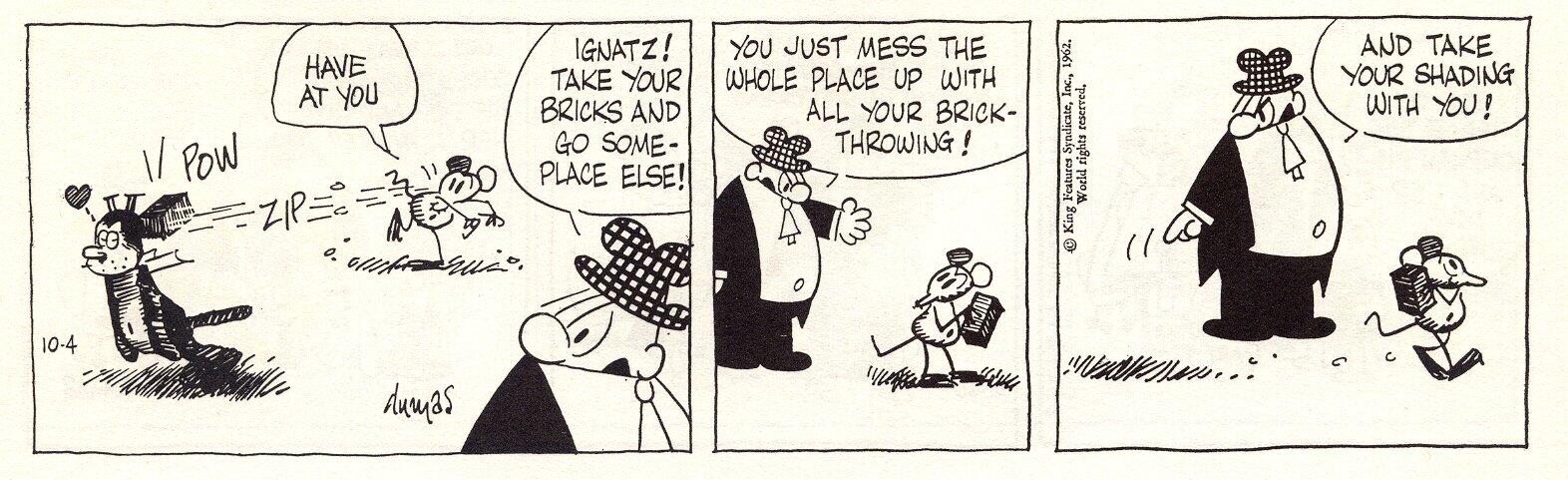
I had heard of Mort Walker thanks to the Beetle Bailey strips adorning the Sunday Times. Years later, I found out about the The Lexicon of Comicana and relished the pleasure of screaming grawlixes! as an alternative to cussing (mostly in private, however, for fear of being strapped and led away in a white van). The lexicon helped me bridge the gap between his most famous comic strip and what was to offer me the most interesting comic book experience since Watchmen, The Dark Knight Returns and Sandman, his collaboration with Jerry Dumas.

image courtesy: isntlifeterrible.com

Sam, the title character of Sam's Strip, runs the comic strip Sam's Strip and is fully aware of being in the comic strip that he runs. Each strip offers a gag (and the occasional political nod) featuring Sam, his unnamed sidekick (later to be christened Silo in a follow-up series) and cameos from other characters from the world of comics (Blondie, Popeye, Charlie Brown) and fiction (Humpty Dumpty) and real life (Charlie Chaplin). The gags and jokes often challenge the world of comics -- characters know about the conventions of the strip they exist in; all the tropes (gloom clouds, black eyes, sleep logs) of comic strips are available in a cartoon prop closet; there are howlers and groaners, nice and terrible puns, interesting takes on famous jokes and scores of famous names dropped about.

The collection subtitled "The Comic About Comics" offers all the strips along with an introduction and an appendix of notes. Highly recommended.

Sunday, June 06, 2010

universal hawas

The Indian subtitling industry should file a patent for the process of converting any G-rated or PG-rated film into something that only adults can appreciate. The industry has enough prior art to support the claim too (YT has written about this before). A video I recently caught (courtesy: Baradwaj Rangan). The song's from a film called Kaakkii Chattai (that means Khaki Shirt, I believe) and recognisably an Ilayaraaja creation. Being a true professional, Kamal Saar complies with the disco fetish of the time and dons an outlandish costume. His co-star Madhavi and the supporting dancers do the same, while Sathyaraj (who was also the subject of a couple of posts hereabouts). The subtitling department has not only introduced mature content but has also done so with the brevity that marked some of Ghalib's verse. For a song that runs for 3 minutes and 40 seconds, you only have a pitiful handful of subtitles and quite a few are repeated. Here are all of them for your reading pleasure once you have enjoyed the video augmented by S. Janaki's sighing.

a young matured girl is dancing by kick
dear! come here/dear come here
he asks my sari at night and it disturbe[sic] my king
shall i play music instrument on your body?
i am straving[sic] for you very much.
shall i see your secret parts without taking risk?
i didn't see any wounds by love
we are getting fired in lust

If you're wondering what the costumes have to do with a half-saree, you're not alone. But I don't think anyone really cared.

Saturday, June 05, 2010

ash and sin: the sequels

(extracts from an internal memo at a famous production studio discussing possible sequels to Paap ko Jalaa Kar Raakh Kar Doonga)

The first sequel should be called राख को बुझाकर खाख कर दूँगा and it should accommodate enough pulpy violence and high drama to ensure that fans of the first film are not disappointed. While doing this, the film must also attempt to include a metaphysical meditation on the themes of morality, guilt and rage: one of the ways that this could be achieved is using a conversation scene featuring the top two starrers jogging and working out on a foggy morning in some hill station; the conversation could include an explanation of the title (which suggests that dousing of ash is not only possible but also effective in eliminating the presence thereof); this literary liberty could be reinforced by the diegetic use of the Gulzar/R. D. Burman classic मेरा कुछ सामान (translation: some of my goods) as our heroes trade nested flashbacks, suggestive looks and gulps of Vat 69. The inclusion of a rape scene is crucial in order to secure an advertising partnership with a leading dealer in saris and a swimsuit chain -- the substitution of inner wear with a suitably tasteful swimming outfit would, I believe, be an acceptable compromise. In order to reach a larger audience, we must ensure that this scene is filmed in pitch darkness and we must rely on effective sound design as well as some suitable lines of dialogue to let the audience know what is happening ([name of sari dealer] की साड़ी को फाड़ते हुए बुरा लग रहा है मेरी जान मगर क्या करूं ... and [name of swimsuit chain] का swimsuit?? तुम्हारी पसंद तो लाजवाब है जान-ए-मन)...

The second sequel must offer less violence and fewer salacious acts and be made for the younger college audience. It must have a tragic ending but otherwise maintain a lighter tone from the start. It will be challenging to balance essential narrative elements such as the destruction of the nuclear family, the corruption of the joint family, the morally compromising temptations rife in middle-class life, the obligatory presence of a pure villainous entity and the defoliation of damsels as well as two item numbers that must feature the matriarch of the household (the producer has been kind enough to relax this need in the first sequel; we will need to express our gratitude for this creative freedom). We could learn a thing or two from masters such as Alfred Hitchcock, who managed to explore personal themes and ideas and fulfill creative aspirations while making films that appealed to a large audience and were commercially viable. In keeping with the goals of the film and in order to remind audiences of the heritage of the film, I believe पाप से राख तक would be an appropriate title.

Friday, June 04, 2010

r d belafonte

On a whim I had checked out the first three volumes in the series Troubadours of the Folk Era from the public library. It was nice to hear San Francisco Bay Blues, Pete Seeger singing Turn! Turn! Turn!, Buffy Saint-Marie singing The Universal Soldier and the Brothers Four singing Greenfields. Two tracks after Greenfields had faded away, The Tarriers began belting out their hit version of The Banana Boat Song, which has been most famous as Harry Belafonte's signature song (arguably this is the song most popularly cited when people think of calypso). The melody was familiar, but the addition of Hill and Gully Rider was a nice touch. As I hummed along with them on Well, I sleep by sun and I work by moon, I suddenly realised that I had heard this melody before. It was in a Hindi film song that had interestingly blended lyrics addressing a boatman with the ambience of a dance number. Numerous articles about the song had called it a "cabaret boat" song although the video was evidence that the only thing on the minds of the filmmakers was a dance of the fisher folk (and hence the boatman was no longer an interesting device but a natural choice). The film was Bandhe Haath and the song was ओ माँझी (a transcription by yours truly appears here). The man behind the song was the late great Rahul Dev Burman. The a-ha! moment comes at the start of each a.ntaraa and continues till the turnaround. Wait for प्यार ओ माँझी तेरा झूठा है / मीत बनके तूने लूटा है / भरी दुनिया में अकेली हूँ / जान घायल दिल टूटा है at the 02:27 mark in the video and then for तू मेरा है मैंने सोचा था / यही सपना था निगाहों में / तू खिवैया होगा रे जीवन का / पार उतरूँगी तेरी बाहों में at the 04:21 mark.

elsewhere hereabouts: thoughts on the title song of the same film.

Wednesday, June 02, 2010

both sides of the wall

challenge: is there anybody there?
response: nobody home

challenge: stop
response: run like hell

Friday, May 28, 2010

where have i heard it before?

Does anyone remember Anu Malik's non-film album Ho Raha Hai Sama? That's right; it's the one with the song धुआँ धुआँ हो रहा है समा (yeah yeah, लगी लगी ये दिल की लगी न समझो इसे दिल्लगी). That album had a song called पागल पागल, whose tune was quite familiar and simple to remember: the Cambridge Chimes made famous by the Big Ben. To put it politely, Malik quotes the melody and riffs on it; to put it plainly, he stole it. The case for theft isn't a strong one, because the authorship of the melody is disputed and the tune's probably in the public domain. Fans of R. D. Burman will probably see another source of inspiration -- the mood of रात Christmas की थी.

दे दे दे दे दिल दे दे मुझको might have been the most famous song on Alisha's album Bombay Girl released by the now-deceased Magnasound in the early 90s, but the title track was guilty of quoting (filching?) the famous riff from Na Na Hey Hey Kiss Him Goodbye. Wonder if producer Leslie Lewis had something to do with that.

The brothers Pandit have never been subtle about the influence of R. D. Burman on their music. शहर की परियों from Jo Jeeta Wohi Sikandar (whose a.ntaraas owed a debt to जीना क्या from Dhan Daulat) finds a cousin in जान-ए-मन जाने दो from Dhoondte Reh Jaaoge; the source? क्या हुआ यारों from Bundal Baaz.

Last year, Suhel Rais Khan, the song of legendary sitar player Ustad Rais Khan, delivered a new album called Jazbah to the masses. The album featured him sharing the microphone with the likes of Shreya Ghoshal, Bhupinder Singh, Mitali and Sadhna Sargam on a melange of semi-classical pop. The opening song मेरी आँखों में owes a debt to the late R. D. Burman: All you have to do is cue up किसी से दोस्ती from Dil Diwana.

Wednesday, May 26, 2010

travis von trapp: are you singing to me?

A review of Harry Brown in the Daily Mail includes this:

Harry Brown makes any Quentin Tarantino film seem like The Magic Roundabout. Makes Taxi Driver look like The Sound Of Music. Makes The Long Good Friday feel like a Pixar movie

This makes me wonder about the ultimate saccharine fuzzy family-friendly feel-good film: what kind of movie would make The Sound Of Music look like Taxi Driver?

Monday, May 24, 2010

linty barroom

It appears that you can count on the French (and especially Jean-Pierre Melville) to take a mystery thriller and lace it with tragedy and world weariness. The most recent example for me was Tell No One. In the hands of a genre hack, this film might well have been a flashy tank of cliché laced with anxious motifs and herrings. But director Guillame Canet makes judicious use of good performances, an understated use of action sequences and serves up an engaging drama embellished with a background score employing bass, dissonance and chords and bends on an electric guitar.

It turned out the film was based on a novel by an American writer named Harlan Coben. All this was not without precedent (Truffaut had adapted David Goodis; René Clément had adapted Patricia Highsmith). There was just one problem: I had not heard of Harlan Coben. This was unfortunate, because he's quite famous and well-lauded. So I did the only thing I could: I ventured forth to the public library to mend my ways. I picked up Tell No One (still unread), Fade Away, Drop Shot and Promise Me.

The last three happened to be be part of the canon dedicated to his creation Myron Bolitar, a star college basketball player with a degree from Harvard Law School, who is now a sports agent, who ends up becoming a gumshoe while trying to protect or defend the interests of his clients. His closest friend and associate is, perhaps, the most curious character I have seen in detective fiction. Windsor "Win" Lock-Horne III is rich, smart, extremely loyal and coldly dispassionate; he could be trading trivia about the West/Ward Batman TV show or crisply sending a couple of no-good goons to their maker. Then there's Esperanza Diaz, Myron's associate at his company MBSportsReps; Esperanza used to be a professional wrestler bearing the moniker "Little Pocahontas." Then there's Coben penchant for loading the books with witticisms and word play. It's the kind of wisecracking that brought the 007 films to their knees in the days of Roger Moore, but it seems to work rather well here. Consider the following extract from Fade Away:

"[...] It took a while to get the ducks all in a row. It's a balance, you know. Got to keep the ducks on an even keel. Losing Greg really knocked the wind from our sails, but we finally got those ducks back up. Now you come along, see. Clip doesn't tell us why , but he insists we add you to the roster. Fine, Clip is the big chief, no question. But we worry about getting our ducks back sailing straight, you see?"
The mixing of metaphors was making Myron dizzy. "Sure, I don't want to cause any problems."
"I know that." He stood, put the chair back with a sweeping motion. "You're a good guy, Myron. Always were a straight arrow. We need that now. A team-comes-first kinda guy, am I right?"
Myron nodded. "A straight-sailing duck."

All the Bolitar novels pack in multiple twists at the end and, if you've been a good reader of thrillers with obligatory twists, you can probably figure out what's going to unfold. To Coben's credit, he doesn't write to set you up for a big payoff. He just writes matter that's straight and engaging with characters that are fun to follow. It's also a relief that Coben doesn't indulge in the bestseller fetish for dumping paragraphs of informative discourse as evidence of the writer having spent hours in the library and on the Internet. All three Bolitar novels have been "unputdownable" and I hope the rest are just as entertaining.

Saturday, May 22, 2010

disregard all bells

I picked up Up the Down Staircase from the shelf in the library for two reasons. The first was simply because it had been on that shelf for weeks with the title plastered on the jacket in an interesting font and layout. The second was because I was interested in what else Robert Mulligan had done besides To Kill A Mockingbird, which might be the film he is most famous for. The film stars Sandy Dennis as a teacher with ideals and dreams in her first teaching assignment at an inner-city school. If you've seen Who's Afraid of Virginia Woolf?, it is hard to forget Sandy Dennis; the neurotic interpretation of characters is evident in her portrayal of Sylvia Barrett. The film also covers aspects of a teacher's life often not seen in movies of this genre -- the emphasis on forms and procedures is reminiscent of its use for satire in The Ipcress File. I can't think of another film that contained references to Delaney cards. You also hear of nerts and darklings in addition to references to Emily Dickinson and Idylls of the King. That's not bad for a visit to the school. [February 05, 2010]

Thursday, May 20, 2010

tropical muse

Siddhartha points me to one of the many articles dedicated to the cyclone assailing South-East India: Cyclone Laila Kills 12 screams the headline. The reasons for choosing the name are clear, but I can't help wondering that the guy who chose this name was watching Madhur Bhandarkar's revelatory opus Aan: Men at Work featuring that Sunidhi Chauhan club song that began thus:

एक लैला ने दिल उछाला है
सारे आलम को मार डाला है

The subtitles, for those who were not as privileged as I to witness them, were one juliet has offered her heart/she has killed the whole atmosphere.

Sunday, May 16, 2010

word clouds for reels

Two Mules for Sister Sara: Boetticher's original screenplay was transformed to suit the players. Don Siegel directs Clint Eastwood singing The Ballad of Sam Hall and Shirley MacLaine, who despite reportedly having enjoyed working on the film bravely serves up a performance of gusto and the occasional loudness. There are moments that remind you of Sergio Leone and Ennio Morricone's score reinforces the feeling (there's a motif that seems to quote from one of his cues for The Good the Bad and the Ugly. [September 26, 2009]

It is difficult to forget Paul Scofield after his performance as Thomas More in A Man for all Seasons. Fred Zinnemann's film opens with a shot of the hands of Orson Welles, who plays Cardinal Wolsey. It's a small part that prevents Welles from even think of stealing the show from Scofield. [April 03, 2009]

Saturday, May 15, 2010

LA in atlanta

As he drove the golf cart slowly towards the second model unit, the couple considered the irony: The location was bland, eerie. The populace looked scary. A montage would look like it had come out of Training Day or Colors. But the apartment they had just seen had a great floor plan. The rooms felt spacious instead of merely being so by virtue of geometry. It was strange, however, to see a walk-in closet attached to the secondary bedroom while the master bedroom was relegated to a carpeted aisle sandwiched between a simple wall closet and a washbasin.

Their attention went back to him as he talked about noting the tag on a car, an Infiniti. The reason: a smashed windshield. Lest we think that he was doing a great job as a sardonic wit, he pulled up next to the said car. The guilty rock lying next to the front wheel added to the texture of the event. The lady who pulled up in her SUV nearby noted that she had seen this when she returned at 2 AM. Nobody seemed shocked or surprised or even alarmed. It was like people talking about the pollen in the Spring.

The perfect coda came when he asked the couple if they could guess who owned this place back in the 70s and the 80s. The answer, quite unguessably, was Larry Flynt.

Thursday, May 13, 2010

they said it

This Rediff article is one of the few going gaga about Ashutosh Gowariker signing on Karl Walter Lindenlaub (हा कोण?) for Buddha (hopefully the conclusion of what will, several years later, be known as his Period Trilogy). After formally noting what a joy (what a joy) it was to work with Lindenlaub, Gowariker goes on to justify the choice of English as the language of the film:

The first important decision that Dr Modi (producer) took was to make Buddha in English and that got me immediately interested because I have always felt that when it comes to religion, you must cater to an international audience, especially so in the case of Buddha.

The hunt for a "new face" to play सिद्धार्थ गौतम is on. Once they find him, expect an article titled Buddha मिल गया.

caffeinated predictability


He knows the benefits of coffee because it helps to free decision making. (Laughter.) Thank you very much. So let's have some coffee because it helps to free decision making. (Laughter.) Thank you very much. So let's have some coffee because it helps to free decision making. (Laughter.) Thank you very much. So let's have some coffee because it helps to free decision making. (Laughter.) Thank you very much. So let's have some coffee because it helps to free decision making. (Laughter.) Thank you very much. So let's have some coffee because it helps to free decision making. (Laughter.) Thank you very much. So let's have some coffee because it helps to free decision making. (Laughter.) Thank you very much. So let's have some coffee because it helps to free decision making. (Laughter.) Thank you very much. So let's have some coffee because it helps to free decision making. (Laughter.) Thank you very much. So let's have some coffee in the morning to get us all extremely excited.

{generated by selecting coffee as all the inputs to tedPAD}

Wednesday, May 12, 2010

a stalker in a taurus

Jim Jarmusch's Broken Flowers is less layered than Dead Man, less adventurous than Ghost Dog: The Way of the Samurai and not as unpredictable as Coffee and Cigarettes. But it's still a nice, calm little story with a great cast (Bill Murray, Jeffrey Wright, Sharon Stone, Francis Conroy, Jessica Lange, Tilda Swinton, Julie Delpy), a wonderfully eclectic soundtrack and product placement (MSN, MapQuest, Ford, Budget): Don Johnston, a ladies man in his youth has done well in computers and lives life listening to music and watching old films. An innocuous pink envelope arrives on the day his current girlfriend is moving out -- the envelope contains a letter from one of his former girlfriends telling him that he has a 19-year old son who may be out looking for his father. The only problem is that the girlfriend does not write her name. Don's neighbour Winston (Wright) convinces him to track the writer of the letter down. What follows is a journey from one interesting encounter to another.

Bill Murray turns in another performance dominated by his ability to convey a lot by appearing to do nothing. Call it expressive nothingness, if you will. Jarmusch raises the stakes with the ladies and only underscores the humour of Murray's performance. He is ably supported by Jeffrey Wright in a performance that is as different from his turn in Syriana as it is from his interpretation of Felix Leiter in Casino Royale. The film offers several mysteries, most of which remain unresolved even as the end credits roll. But it is undeniably a familiar trope -- the road movie -- attacked in a most charmingly unfamiliar way. And I'm sure the fact that Pell James and Chloe Sevigny were also in Zodiac has no bearing on the proceedings. [June 28, 2008]

Sunday, May 09, 2010

It's All About Love: apocalyptic ailings

Thomas Vinterberg's It's All About Love has Joaquin Phoenix and Claire Daines playing a couple on the verge of a divorce in a world that's falling apart. There are flying Ugandans, there is snow in July, people are falling dead all over the place because they have no love, and there is a brother (played by Sean Penn), who used to be afraid of flying, but now can't do anything but fly about in a plane. There's also some intrigue tossed in perhaps to add some vim to this often sober exploration of love in a time out of joint (I stole that from Philip K Dick who appropriated it from the Bard). The DVD transfer looks and sounds gorgeous and, if you have the patience to sit through a not-so-moving love story set in a world resigned to its doom, offers a fairly rewarding viewing experience. [june 23, 2008]

Saturday, May 08, 2010

the things people do and still get paid

The programmers who are paid well and get promoted while being completely ignorant of the implications of a package name for a Java source file. While it seems stentorian to expect everyone to read the Java Language Specification (Chapter 7, in this case, and section 7.2.1 to be precise), it surely isn't too much to ask that people heed the complaints of javac when it fails to successfully compile files whose package names have nothing to do with where the file is located on the disk.

The programmers who flaunt experience with the newer versions of the JDK (5.0 and 6.0) on their résumé but ignore javac's warnings about all the raw types abundant in their freshly written code, simply because they do not understand why the compiler has a problem with code that works.

The programmers who just don't understand why XSLT (from the wikipedia page: XSLT (XSL Transformations) is a declarative, XML-based language used for the transformation of XML documents...) does not work on a document that is not XML.

Friday, May 07, 2010

acronymous apathy

SEVIS. PIMS (more here). SAVE. And now REPAIR. The incongruity is getting a bit more unsubtle. The high concept version is "a healthcare reform proposal for immigration." 'Tis nothing but a case of total flatulence in the absence of excrement.

Thursday, May 06, 2010

the song remains the same

I've been listening to CDs I had heard years ago and as The Best of Simon and Garfunkel spun away, I thought of songs like The Boxer that I had kept listening in a loop. I realised that, years later, things hadn't changed. As soon as the guitar opened the track, I knew that I hadn't forgotten all the things I had relished so long ago: Paul Simon's way with words, the arrangements (the brass, the piccolo trumpet, the pedal steel) and the catchy refrain.

All lies and jest
Still, a man hears what he wants to hear
And disregards the rest

The undergraduate days back home were when I got an education in rock. I had managed to cover some ground with Pink Floyd and The Beatles thanks to spending time in the reference section of The British Council Library. Unfortunately, I had only heard of Led Zeppelin. I had not managed to hear even a single song by the band. This was before the omnipresence of Wikipedia and the numerous portals of streaming radio. The music shops around town lacked an interesting back catalogue. I had struck gold with some Beatles tapes (Sergeant Pepper's Lonely Hearts Club Band) and Pink Floyd albums still adorned the shelves, but as far as Plant, Page, Bonham and Jones were concerned, there was just nada. Zilch. Until the day I struck gold on a music store in Pune camp. Innocently sitting on a rack amidst other random unsold tapes was Physical Graffiti. In retrospect, this double album serving as my introduction to the band was rather risky; it's almost like introducing someone to the The Beatles with The White Album. The Zeppelin double, however, was arguably less sprawling in its excess than The White Album. I was hooked as soon as the snarling energetic unapologetic riff of Custard Pie opened the album. As the mix of wah-wah, clavinet, harmonica and (once I paid close attention) the risqué lyrics faded away, I was a fan.

Monday, May 03, 2010

united i stand

From one of the many news items about the proposed merger of Continental Arilines and United Airlines:

"The only people happier than Jeff and I today is our corporate sales team," Tilton said.

An example of the abuse of I (explored hereabout earlier) in the corporate uppersphere. There's the minor matter of trying to match people and is (one could argue about the true subject in that sentence), but it's not worth it. It's truly sad that such gaffes appear instead of the familiar bag of bland yet safe crapspeak (you know, stuff about the union being a strategic initiative in order to serve their customers and patrons better and marking a positive step forward down the runway of air travel).

Sunday, May 02, 2010

all those reels ago

War of the Worlds [april 29, 2007]: This take on the H. G. Wells classic gets the Steven Spielberg treatment complete with great special effects mixed well into a narrative founded in a focus on the immediate believable trope called the family. Cruise was, as he was in Minority Report, bearable enough and Dakota Fanning stays under aural control for the most part. All things considered, the only significant thing in the film for me was that bravura piece of SFX responsible for the opening attack; at the end of a long sequence of death rays and mayhem is this shot of Cruise and the others driving out of the city. That icing on the cake is worth the rest of this film, which, sadly, ends disappointingly. Morgan Freeman's narration, a device that didn't work for me, only underscores the whimper.

Willie Dynamite [july 15, 2007]: Willie is an ambitious pimp in New York City driving a Cadillac (what else) whose plates read WILLIE in the front and DYNAMITE at the back. The funky theme song introduces us to him as he walks with "seven women in the palm of his hand" and this is how we see him. The directness of the visuals is just one of the problems of the film. The other is the rather bland direction of what could have been a fine tragedy bolstered by strong earnest performances. The outrageous costumes, the overtly emphasised acting and dialogue delivery (especially in the meeting of the pimps) stick out like elephant's legs with mumps; they would have fit so well had Gilbert Moses III been more adventurous. Great title, cool music, little else.

This Man Can't Die [january 11, 2007]: If only Bollywood had relied more on Spaghetti Westerns for plot, narrative elements and cinematic style than just music, we'd have had a far better crop of revenge dramas. Consider Gianfranco Baldanello's tale of revenge laced with a persistent catchy guitar theme (as well as an appropriation of Morricone's theme from A Fistful of Dollars) and some nudity to keep the lascivious lads happy. There are murdered parents and a raped mute sister to offer motivation and there are a few twists for good effect. Toss in an interesting saloon brawl and you've got yourself a half-decent flick. I leave you with the lyrics of the song written to the guitar theme, sung almost like a tribute to the theme song for Thunderball:

life is the only precious thing god's given to you
life is too marvellous, too bright to make a man die
if no one can give his own life without someone who cares
it's a shame that you cannot forgive another man

life is too marvellous for you as well as for me
love is the common precious thing to take and to give
if no one can give his own life without someone who cares
it's a shame that you cannot forget your hate

Friday, April 30, 2010

a denial of self and other croutons

Amogh points me to a TOI blog post dedicated to an incident featuring a passport office in India refusing the accept a passport it issued as valid proof of identification.

In the year 2011, Bollywood will likely see a new face making her début. The name's Manasvi Mamgai and she's just been crowned Pantaloons Femina Miss India World 2010 (which means she gets to represent India in October's Miss World contest). That last name, despite being interesting, will probably not make it to the marquee.

If you believeust the headlines of articles you would think Udita Goswami was truly confused. On one hand, she insists I am not here to please anyone and on the other she says I won't disappoint my fans (the stock photograph accompanying the article seems to reinforce this claim). When she finally tells you what kind of films she really wants to do, you know there's trouble:

I wouldn't want to play a glamourous, sexy role now. It's just by chance that I got these kind of roles after my first movie. But now, I am looking forward to doing a happy role, where I can just be myself and enjoy myself. I want to play a girl my own age, who loves to have fun. I am looking forward to doing a movie where I get to see happy people on the sets. I really want to do a romantic comedy

Thursday, April 29, 2010

kibble and quibble

The words that David Foster Wallace circled in his copy of the American Heritage Dictionary and the interest in them remind me of the interest in Vladimir Nabokov's use of exotic, esoteric and often precise (frass, for example, which I filched in an old post).

The abuse of the word blog to refer to a post gets some attention in a Visual Thesaurus post. I've been furious about this abuse by the misinformed masses for a while and also disappointed at its growing frequency (as with a lot of abuse that succeeds in establishing itself as accepted usage). The protest seems a little too late, however, and perhaps even a futile exercise. But, as with pedantry, it shouldn't dissuade those in the right from standing by their guns.

strong lines

The time has come to recognise another strong body of contribution to the well that is Bollywood dialogue. The label says Taaqatwar, David Dhawan's ode to Manmohan Desai, Bollywood clichés, stock music and kitchen sink cinema. A gentleman named Anwar Khan is responsible for seasoning this goulash with zingy lines that have made kino clunkers worth everyone's while over chicken and booze on Friday nights. The film itself deserves a separate post acknowledging the numerous references to Bollypop and convention. This entry, however, focuses only on the contributions officially credited to Anwar Khan.


माल चाहे दो हज़ार का हो, दो लाख का हो या दो करोड़ का हो, footpath पे आकार दो कौड़ी का हो जाता है

ये दो टके का officer officer नहीं हमारे लिये cancer है cancer

हम वो शैतान हैं जो बिना दाम के जान ख़रीद लेते हैं तो दुकान क्या चीज़ है?

दुनिया चाँद तक पहुँची है और मुझे (beat) इंतेक़ाम के आसमाँ तक पहुँचना है पिताजी

तेरी जबान है क्या whole-sale की दुकान है?

क़सम Jesus की मुंजाल ख़ुराना को जब तक खल्लास नहीं कर डालेगा, अपुन Jesus की शकल भी नहीं देखेगा

ये ज़माना रावण का है; नज़र उठा के देख; चारों तरफ़ रावण ही रावण हैं; छोटी कुर्सी पर छोटा रावण बड़ी कुर्सी पर बड़ा रावण; लोहे की कुर्सी पर मज़बूत रावण; लकड़ी की कुर्सी पर कमज़ोर रावण

watch the hands

That's what they tell you if you're keen on figuring out how a magician's magic worked. That's how you spot the legerdemain. The presdigitation. The sleight of hand. Someone gave most TV anchors in India the idea that a magician's actions were the best guide for on-screen behaviour. This explains why all those anchors on countdown shows, all those "reporters" on various "news" channels, all those "interviewers" in celebrity snuff pieces look like they were trying to do one of the following:
  • trying to do card tricks with neither cards nor tricks
  • trying to practise sign language
  • trying to wash invisible windows
  • trying to get exercise for the axilla

Unfortunately, some of these on-screen shenanigans end up seeming rather unfortunately ... inappropriate. Consider this "interview." The "interviewer" looks like he's either trying to audition for a commercial for Steak N' Shake burgers or trying to describe innovations in personal flotation devices. The latter gives you another way of looking at all such videos online. Consider it the equivalent in the world of online videos of the clinomaniacal suffix appended to those random lines found in fortune cookies.

Wednesday, April 28, 2010

reverse name mangling

Don't you get worried when you can't put your full name on forms in the US? Or in the corporate address book that most probably has the woefully inadequate fields First Name and Last Name (why didn't the designers think of such obviously essential fields like Family Name, Village Name, Genus and Phylum?). Yes, I'm talking to you Dasarath Venkata Subramania Varaprasad Balaji and Colonel Julius Nagendranath Wilfred Singh. Doesn't your temperature rise when you hear 'em knock the sails out of all the love and adoration infused in your big long tongue-twisting name by those who named you? Aren't you enraged when the mutilators of your moniker are shameless enough to butcher your name even when you've been accommodating enough to just provide a first name and last name? Here's your chance to take revenge. All you to do is be prepared with an arsenal of names of the Indian disposition and proceed to convert the American names to suitable alternatives that are kinder to the tongue. Then proceed to use them instead of the originals (make sure you protect yourself with COBRA if you do this at work and have a good lawyer in any case). Here are a few examples to get your started: Chris becomes Krishna (although several Krishnas have probably changed to Chris to accommodate their capitalist masters); Scott becomes Saket; Mike becomes Mukul (it's easy to see how when you consider "Michael"); Smith becomes Samanth; Jones could become Joshi or Jonnalagadda; David Koppel becomes Dawood Koppula, but it might smell of the case of Sikhs named Abdullah Khan and Dost Akbar; Norris Pendegrass becomes Naresh Pendharkar. The rest is up to you hippomonstro-sesquippedaliomaniacs. Play it again Sameer.

Saturday, April 24, 2010

flashback

Julie Taymor's Across the Universe offers a heady mix of references to all things about and by the Beatles as well as an assortment of interesting videos (J. M. Flagg's famous poster and the Statue of Liberty for I Want You (She's So Heavy) to help you pass the time while the film makes its way to the end. Neither the performances (barring, perhaps, Dana Fuchs as Sadie and Martin Luther McCoy as Jojo) nor the cameos (Salma Hayek as the nurses in Happiness is a Warm Gun or Bono as Dr. Robert belting out I Am The Walrus or Eddie Izzard as Mr. Kite or Joe Cocker -- nudge nudge wink wink -- singing Come Together) can make up for a screenplay that remains but a strand connecting trivia. [January 08, 2009]

TMNT must represent the first time a live-action franchise was rebooted using CGI. The first animated TMNT film begins with the clichéd sound of the Doom fireball and then decides to use voice-over for back story. It makes up for these missteps with some great production design for the cityscape; the dark alleys and the lighting make this film worth one's while.

Sunday, April 18, 2010

they said it

Bipasha Basu in an interview for rediff.com after topping the Maxim annual hot 100 list several months ago:

We have to ask: In your opinion, who is the hottest of them all? Minus you, of course!

The industry today has so many beautiful women, each one of them with their own brand of sex appeal. It's hard for me to peg one down, especially as they are all hot in their own way. Besides, I never really look at women, I'm an all-man woman.

Celina Jaitley introducing something she wrote for the TOI:

Being a public personality I feel it's my duty to let my fans know what I think about 'love'. Love, I feel, is what makes everything in this world go round and mind you, it could be 'love' or merely the 'absence of love' which can change a person's life forever.

Saturday, April 17, 2010

pour some detergent on me

Siddhartha sends me a pointer to yet another interview where keeping the brain running rewards you with some laughs. Jagmohan Mundhra, the IIT alumnus who moved from making exploitation soft-core yawners to mixing titillation and issues with films like Kamala is all set to unleash a psychological thriller called Apartment (not to be confused with that old classic). The film stars two lasses who have stacked their beamers in Bollywood with their acting chops, Tanushree Dutta and Neetu Chandra. The narrative, of course, demands that epidermal vistas be provided. So it's no surprise that both the kittens have lapped up a chance to tantalise the ignorant souls who hoped to get a breakfast tray. This will be strictly family-rated droolery, Freunde und Freundinen, but one cannot talk sense to those whose minds are churning out tunes to 'em Clair-de-Lunes. Those of us who know better can chuckle by reading Neetu Chandra's interview, in which some attempt is made to make all this seem artistic by comparing her bathing in a bathroom to a sequence with much more relevance in the bleak classic Chakra. Having noted that the lass and the interviewer have missed the point of the Smita Patil starrer, we can move on to the other funny bits.

We first have evidence of competition:

Were you awkward or uncomfortable?
I went about it very professionally. Initially, I was nervous but later, after seeing the scene and the way it was shot, I am confident it will go down well. They also showed me Tanushree's shower scene with Rohit in her lavish apartment and then there is my bathing scene in a run-down broken bathroom. I am sure there will be comparisons.

We then move on to a behind-the-scenes (no pun intended) take on the sequence:

Were you really bare, as it seems in the photograph?
Well it shows that I am nude but I don't want to comment beyond that. It can be a trick of the camera too. Do you think any actress would pose for a scene like this without wearing anything?

Technical trickery can hide or reveal a lot of things, but one must not forget the Bollytropes that are immune to it (Rani Mukerji's voice, Celina Jaitley's inability to act, Emraan Hashmi's cult of personality).

Wednesday, April 14, 2010

a hexadecimal dollar's worth of laughs

I am embarrassed at not having stumbled upon George Vaccaro's blog dominated by posts about his encounter with surreal customer service at Verizon that refused to acknowledge the influence of units of measure on financial calculations. You can listen to the recording of the phone call here and read a transcript here. Here's a sample to make sure you actually follow those links.

G: Do you recognize that there's a difference between "point zero zero two dollars" and "point zero zero two cents"?
[pause]
M: Point zero zero two dollars?
G: Do you recognize that there is actually...
M: ...and point zero zero two cents.
G: Yes, do you you recognize there's a difference between those 2 numbers?
[pause]
M: No.
G: Okay, is there a difference between 2 dollars and 2 cents?
M: Well, yeah, sir..
G: Well okay, is it.. is there a difference between .002 dollars and .002 cents?
M: .002 dollars and .002 cents.
G: Yes, is there a difference between..
M: Sir, sir, they're.. they're both the same if you, if you look at 'em on paper-wise

G: [big sigh] Okay, I think I have to do this again. Do you recognize that there's a difference between one dollar and one cent?
A: Definitely.
G: Do you recognize there's a difference between half a dollar and half a cent?
A: Definitely
G: Then, do you therefore recognize there's a difference between .002 dollars and .002 cents
A: No.
G: No?
A: I mean there's... there's no .002 dollars.

Saturday, April 10, 2010

what happens to the taste of coffee now?

James Gosling has decided to "move on" from Oracle. This must surely be significant in the list of changes and happenings since Oracle's acquisition of Sun. Oracle now owns both the HotSpot JVM and JRockit; it owns BEA WebLogic and controls the fate of Glassfish (which, interestingly, owes something to code from Oracle TopLink -- itself an acquired product -- donated by Oracle years ago). Gosling's been supportive of JavaFX and didn't quite like the state of the JCP, another thing that Oracle will control. My thoughts about the future of Java since Oracle's acquisition of Sun have not been positive. They were surely biased by what I saw happening to Orion and TopLink after Oracle had acquired them. Gosling's departure, unfortunately does not help matters. It suggests that a lot may be wrong with the direction Oracle intends to go with Java. Still, Java is bigger than anything else that Oracle has acquired and one will have to wait to see how things shape up.

Friday, April 09, 2010

the first husband leaves

Saat Khoon Maaf is what the Vishal/Priyanka flick written by Ruskin Bond is called and the roster of the seven bridegrooms has looked interesting ever since it started out with Mohanlal. Alas, the list which also features Naseeruddin Shah, Neil Nitin Mukesh, Irrfan Khan and Anu Kapoor will be missing the thunder from down under, because, reportedly, Mohanlal is no longer of the film. Little else is known yet. Perhaps it's just a joke. Perhaps it's not. Only time will tell.

[Cross-posted on the Vishal Bhardwaj blog]

Wednesday, April 07, 2010

comatose and brain-dead

With Intervention, Robin Cook dares to venture into Dan Brown territory. I could have said Umberto Eco territory (purely for Foucault's Pendulum, but it would do Eco's reputation injustice while implying (incorrectly) that Robin Cook was capable of being more than a writer of serviceable medical thrillers.

begin flashback

I was an avid reader of genre fiction years ago and Robin Cook was one of the many whose books I picked off the shelves of the Popular Book House library and turned the pages of. Memories can tend to become more favourable over the years and this might account for my impression that I was entertained. There was a lot of information in the pages -- Cook was, like Crichton (who, interestingly, helmed the first of two cinematic adaptations of Cook's ouevre, Coma) and Grisham, to name a couple, the kind of writer who wove proof that he had done his research into the narrative. I do not recall having trouble finishing any of his books. Not being able to glide from cover to cover should have, in retrospect, told me that I had found a book that demanded more and would be more important than these potboilers. I remember quitting Cook when a book I picked up had a protagonist with the same name as a book I had read a week or so before. That, for me all those years ago, was the last straw. I could tolerate the guy hopping around in the medical milieu and finding places to stuff a thriller's narrative elements. But running out of names (or was it the same protagonist?) was just a sign of laziness.

end flashback

Intervention, now that I have turned over the back cover to look at the author posing with a smile in his house (presumably), seems like harsh punishment for daring to challenge my decision to abandon this guy's ouevre years ago. If Cook was good in his older novels, this novel makes them look like literary masterpieces. Cook stretches beyond his turf (the medical thriller) and tries to pluck clumps of grass from the Brown verdant fields of religious conspiracy and revelation. In doing so, he shows us why Irving Wallace's The Word is a far superior richer work. He also makes Dan Brown look like a nominee for the Pulitzer Prize. The characters are stock, the abuse of literally is appalling and the final portion of the book throws up a twist that comes early enough to make the rest of the limp conclusion even worse than it is -- Cook abandons a mix of narrative and dialogue and churns out hasty pages that look like a poor submission in an essay competition. If anyone's about to make an impulsive selection as I did and is looking for some advice, here it is: this dish stinks.

Sunday, April 04, 2010

the appropriation of abbreviations

CPU used to mean Central Processing Unit until Oracle decided to use the abbreviation to refer to Critical Patch Updates; apparently patches did not seem to exciting for some corporate lover of cornflower blue.
 
Creative Commons License
This work is licensed under a Creative Commons Attribution-NonCommercial-NoDerivs 3.0 Unported License.